Exercise is a foundation of a healthy body. Doing a combination of cardio and strength-training activities on most days of the week helps lower the risk of heart disease, prevent cancer, maintain a healthy weight, and strengthen the muscles and bones that keep you upright. Physical fitness is also a strong predictor of survival in adults.
Flexibility exercises don’t get quite as much attention—but they should. Unfortunately, the older you get, the less flexible you become. Research has shown that the range of movements like hip flexion (the ability to pull your thigh up toward your chest) and shoulder abduction (raising your arm in a sideways direction) decline steadily starting in your 60s and 70s.
There are good reasons to maintain flexibility as you age. If your joints are mobile, you’ll have an easier time doing everyday activities, like bending down to pick up items off the floor, putting on shoes, bathing, and getting in and out of bed and the car. Flexibility training is also an exercise intervention recommended for reducing falls in older people.
Be flexible, live longer?
Some research suggests that being flexible might even help you live longer. In one study, researchers at the Exercise Medicine Clinic in Rio de Janeiro, Brazil, followed more than 3,100 men and women, ages 46 to 65, for an average of 13 years.
During that time, participants underwent a series of flexibility evaluations known as the Flexitest, which measures the range of motion in seven sets of joints: ankle, knee, hip, trunk, wrist, elbow, and shoulder. Twenty movements—including ankle flexion, hip abduction, and wrist extension—were then scored from 0 to 4, with higher scores indicating more flexible joints.
The researchers found that the participants with the lowest flexibility scores had the highest risk of dying. Men with poor flexibility were almost twice as likely to die during the study period. The difference was even more pronounced in women with low flexibility, who were almost five times more likely to die.
It’s important to note that this was an observational study. The participants didn’t follow a specific stretching regimen. In addition, the researchers didn’t take into account other factors that might have shortened lifespan, such as smoking or diet.
How might flexibility extend lifespan?
The answer to this question isn’t well understood. It’s possible that people who are less flexible are more likely to fall, which is the number-one cause of injuries and injury-related deaths in people ages 65 and older.
Another possible reason for the earlier deaths is that flexibility is a marker for other health measures. A study from Japan found that poor flexibility in the arms and trunk of middle-aged men correlated with hardening of the arteries (atherosclerosis). The association persisted, even when the researchers factored in other atherosclerosis risks, such as blood pressure, cholesterol levels, smoking habits, and belly fat.
Even if the ability to touch your toes or raise your leg straight up might not help you live longer, there are many other benefits to having a flexible body. More blood flows to your joints and muscles, which delivers oxygen and other essential nutrients to these tissues. You’ll have better range of motion when you play tennis or reach for a glass on a high shelf, so you are more likely to perform better and less likely to injure yourself. Besides making you more flexible, stretching exercises, like all other kinds of exercise, are also good for relieving stress.
Improving your flexibility—safely
Stretching is the best way to get more flexible. There are two basic types of stretches: Static stretches help lengthen muscles, such as your hamstrings, quadriceps, and shoulder muscles. Dynamic stretches (like squats, arm circles, and knee raises) increase blood flow and warm up your muscles. (See box for examples.)
Proper technique is important because stretching incorrectly, or when you shouldn’t, can do more harm than good. Moving the wrong way can cause tiny tears in muscles and connective tissue, which may leave scar tissue after healing. The scar tissue may then tighten the muscle, decreasing flexibility and possibly increasing susceptibility to pain and injury.
The following are safety principles that, depending on the type of stretching you are doing, can help guide you:
- Stretch your entire body, from head to foot, in any order that feels right to you. The best strategy varies from person to person. Focus on the body’s major muscle groups, including calf, thigh, hip, lower- and upper-back, neck, and shoulders. Don’t neglect your knees, feet, and ankles. Keep your body properly aligned, as uncontrolled twisting or turning can lead to injury. Incorporate a full range of motion—both side to side and front to back—where appropriate.
- Move slowly and gently. Vigorous stretching or jerking into a stretch can put undue stress on the ligaments and tendons, tearing them or decreasing joint stability.
- Breathe. Holding your breath while you stretch can cause blood pressure to rise. Begin by exhaling and extending the muscle, breathe slowly and deeply while holding the stretch, and inhale when returning to a relaxed position.
- Don’t lock your joints when you straighten them. They should remain just slightly bent.
- When lying on your back, move one leg at a time. Sudden movements with both legs can strain the muscles and ligaments of the lower back.
- Don’t stretch until it hurts. Stretching should feel good. If not, your technique is incorrect or you may have a medical problem. Stop and check with your doctor before continuing.
BOTTOM LINE: Cardio and strength training are key parts of any fitness routine—but don’t overlook flexibility. Regular stretching helps keep your joints healthy and more mobile, makes everyday movements easier, and might even contribute to a longer life. Just five to 10 minutes of static or dynamic stretching a day—incorporated into each workout or done outside of your workouts, such as while you’re watching TV—can make a big difference. If you’re not sure where to begin, a certified personal trainer, athletic trainer, or physical therapist can help teach you some simple, easy, and effective stretches.
Experts generally recommend stretching at least two to three times a week, preferably daily.
Static stretches: Do these after you work out, when your muscles are still warm. Most people should hold a static stretch for 15 to 30 seconds, and repeat each one two to four times. But older people may want to hold each stretch for up to 60 seconds (as your joints, connective tissue, and muscles stiffen with age, a longer stretch may be needed to be effective). Some examples of static stretches are:
- Hamstring stretch. Sit on the floor with your left leg straight out in front of you and your right leg bent with the foot resting on or against your left thigh. Lean forward from your hips and reach for the toes of the extended leg, keeping your back straight. Hold. Repeat on the right side.
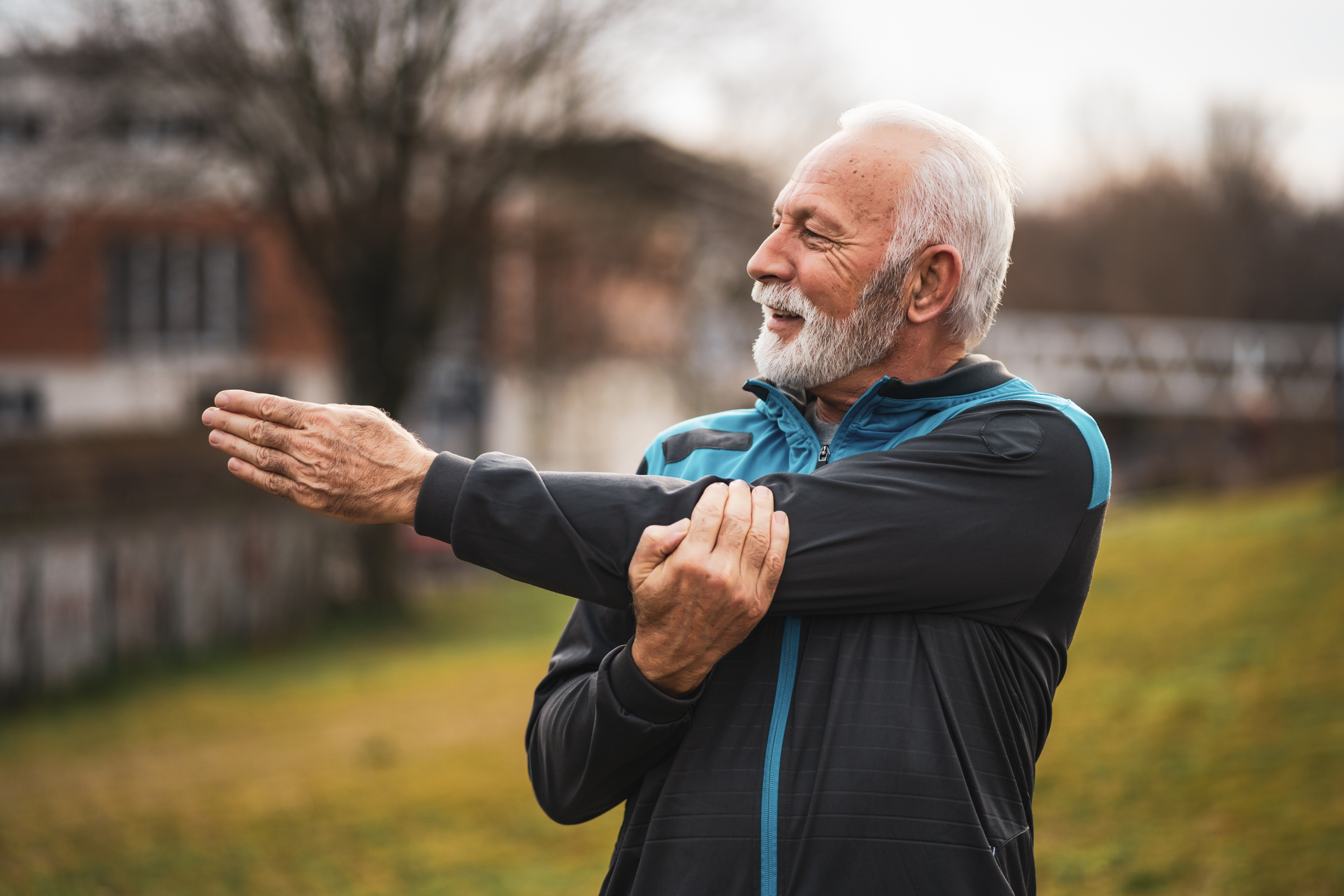
- Shoulder stretch. Bring your left arm straight across your body at shoulder height. With your right hand on the outside of the elbow or forearm of your left arm, pull gently toward your body. Hold. Repeat with your right arm.
- Quadriceps stretch. While holding onto a heavy chair or wall for support, grab your left foot with your left hand from behind and gently pull it toward your buttocks. Keep your spine straight. Hold. Repeat with the right leg. If you can’t reach your foot, use a soft belt or robe sash to loop around your ankle to help pull your foot up and bend your knee.
- Seated Figure 4 (hip/glute) stretch. Sitting in a chair, lift your right leg and place that ankle on the opposite thigh. Let your right knee fall to the side and gently exert downward pressure with your right hand. Bend your torso forward at the hips as much as is comfortable. Hold. Then go back to the starting position and switch legs.
Dynamic stretches: Done primarily before a workout, these stretches involve continuous, controlled motions that move different parts of the body through their full range. They are often performed quickly (but still with control), lasting only a second or two. Here are some examples:
- Leg swings. While holding onto a chair or pressing your left hand against a wall for support, shift your weight to your left leg. Keeping your left knee slightly bent, swing your right leg to the front and back 10 times. Turn around and repeat with the left leg, using the right hand for support.
- Arm circles. Stand with your feet shoulder-width apart and arms extended straight out to the sides at shoulder height, palms facing down. Circle your arms forward 20 times, then backward 20 times. Start with small circles, gradually increasing their size as you warm up and as much as your flexibility allows.
- Knee raises. While holding onto a chair or wall with your left hand for support, step forward with your left leg and raise your right knee up toward your chest and then lower it. Repeat 10 times. Turn around and step forward with your right leg and raise and then lower your left knee 10 times, using the right hand for support.
- Cat and Cow. Borrowed from yoga, this easy stretch increases mobility in the upper back. Starting on your hands and knees in a tabletop position on the floor or a firm mattress, exhale and round your back toward the ceiling, tucking your chin and pelvis (Cat). Then inhale and arch your back, lifting your chest and glutes and letting your belly sink toward the floor (Cow). Continue flowing between Cat and Cow with each exhale and inhale for 10 repetitions.