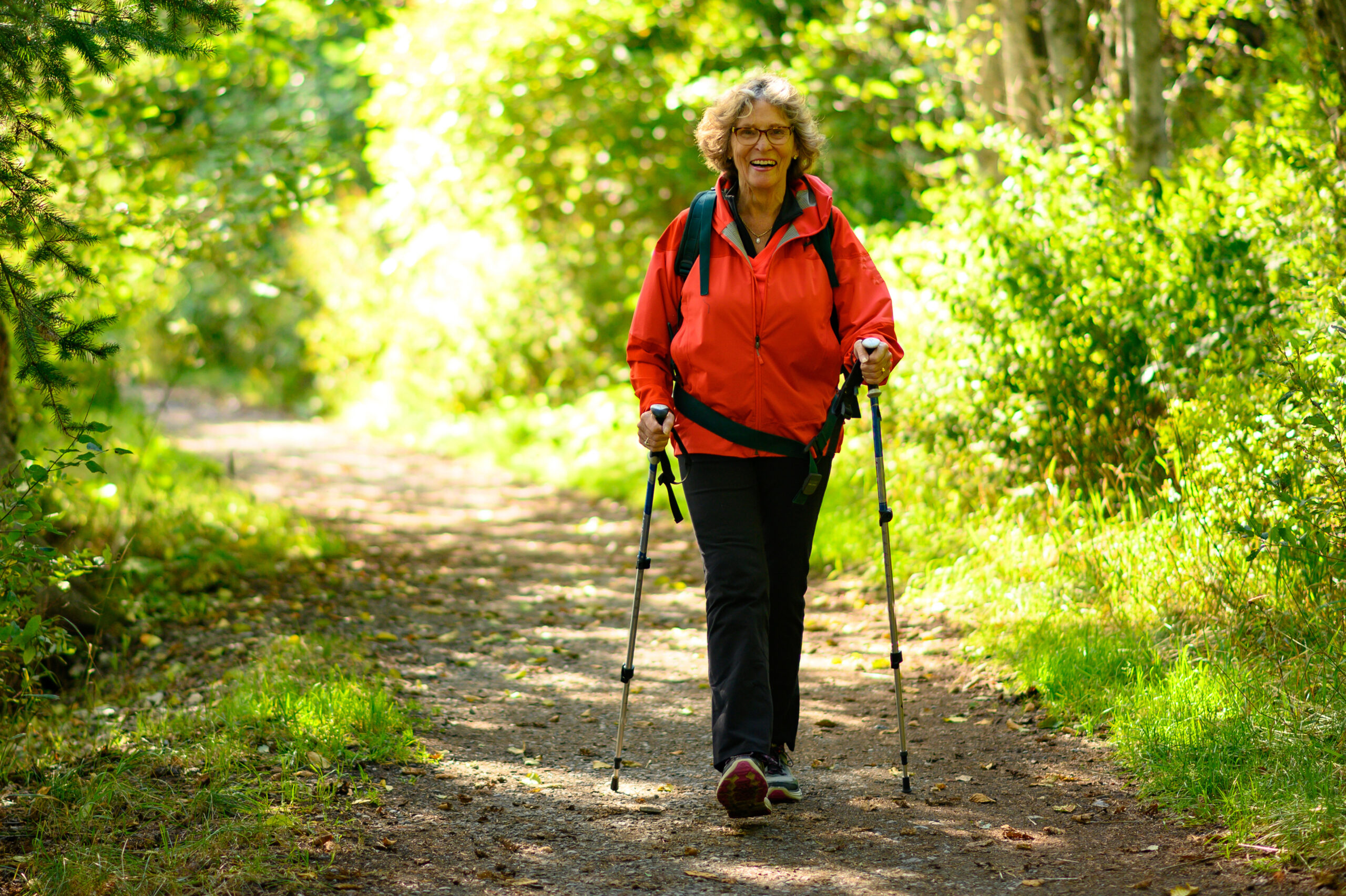
If you’re a regular walker or hiker—or aim to become one—grabbing a pair of trekking poles before you set out can make your excursion easier, safer, and maybe even more enjoyable. They are a good accessory to have whether you are ambling uphill, downhill, or on the flats, and whether you’ll be out for a short time or on a multi-day trip.
Also called hiking poles or walking sticks, these specially designed poles are a more common sight in other parts of the world, like Switzerland, Germany, Austria, and Italy, where, for example, you’ll see hikers of all ages using them on trails in the Alps and Pyrenees.
Pole paybacks
Studies have found that trekking poles provide many benefits, from increasing balance and speed to reducing knee strain.
A small study in the European Journal of Applied Physiology in 2023 analyzed 15 young male athletes (trail runners) over several days while they walked uphill (both on a treadmill and outdoors) to exhaustion with or without poles. Not only were the participants able to go at a faster clip while using the poles, but they also experienced less stress on their feet. The researchers concluded that this would translate to less stress on the rest of the leg as well (since stress on the feet from impacting the ground is transferred to the rest of the leg). In their words, the use of poles when going uphill “saves the legs.”
A 2023 review paper in Bioengineering, which looked at 31 studies, similarly found that pole users experienced less pressure on their feet—and, additionally, had an increase in oxygen consumption. This boost in energy expenditure (calorie burning) could be because more muscles are activated when using poles—of the trunk (abs) and arms (triceps and biceps)—compared to when not using poles.
There’s some evidence that the poles can also reduce delayed onset muscle soreness (DOMS), especially after a downhill trek. DOMS is that pain and stiffness that sometimes occurs a day or so after a new or strenuous workout. That makes sense since the poles help you break your forward downhill momentum, thereby reducing the eccentric muscle contractions in the thigh that are associated with DOMS.
Other advantages: Using poles (in one or both hands) can improve your balance by distributing your weight more evenly, and this may help prevent you from tripping over exposed roots, rocks, or other irregularities and obstacles you may encounter on a trail. Having better balance is especially important if you are wearing a backpack on your hike, since the added weight and instability of the bag can throw off your center of gravity and increase the load on your legs even more.
In addition, using trekking poles gives your upper body more of a workout than walking unaided and, as alluded to earlier, can increase the number of calories you burn.
Pole tips
There are many options for buying trekking poles. Depending on the material (carbon fiber or aluminum) and design (folding or telescopic), they can weigh anywhere from about 12 ounces to 1.5 pounds per pair and cost about $80 to well over $120, with higher-priced ones generally being of better overall quality (lighter, more comfortable grip, greater durability, for instance). Leki is one of the better-known brands—but bear in mind that adjusting the poles to suit your needs, along with using proper technique, matters more than the brand. Here are some points to keep in mind:
- Poles that are collapsible allow you to adjust their height (and make them easier to pack and transport). You’ll want to be able to adjust the poles easily when hiking downhill versus uphill—lengthening them on the downhill and shortening them on the uphill.
- All poles have adjustable wrist straps, so they won’t get away from you. To grip the poles, slide each hand up through the strap from below and then reach down for the pole’s grip. The strap should rest comfortably on the back of your wrist and not feel tight—that way, you can easily let go of the pole when needed (say, if you have to tie your shoe or want to snap a picture) and then just as easily grasp the pole again when you’re ready to move on.
- For proper form, when the pole is extended in front of you, your forearms should be parallel to the ground, and your elbows bent at 90 degrees. When you step, with the pole angled behind you, use your upper arm (triceps) muscle to press the pole downwards and then push off. This propels you forward—and is helpful when walking on flat terrain and uphill (but not so much on downhills, where, rather, the poles are helping to stabilize you).
- Keep your posture upright. It’s best to practice using poles on the flats before going on any rolling terrain. When hiking with poles, you’ll be alternating planting your right foot on the ground with the left pole and then planting your left foot with the right pole. The more you do it, the more natural it will feel.
- Trekking poles are sold as a pair, but you may decide to use just one if that feels more comfortable. A single pole may be better if there are obstacles to negotiate because you’ll have a free hand to help if you need to scramble up or, should you fall on a downhill, you can extend your free hand to brace yourself.
BOTTOM LINE. Trekking poles are not a necessity, but if you’re open to new experiences, you could give them a try and see if they make for a more comfortable and pleasant walk or hike. Many people find that the poles help reduce strain on their knees and other joints and improve stability on uneven ground. They can be especially helpful—along with balance exercises—if you find yourself having increasing balance problems when you walk. To learn more about using trekking poles, you can check out online videos.
When reviewing this article for publication, some members of our editorial board, as well as our executive editor, managing editor, and researcher, shared their own positive experiences with trekking poles. Here are a few of their comments:
John Swartzberg, MD, Chairperson: “I use them for both backpacking and day hiking trips. They make a big difference!”
Dale Ogar, Managing Editor: “I took a pair to British Columbia to visit the rainforest. They were very helpful because the ground was so uneven and I am very clumsy.”
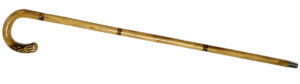
Marlon Maus, MD, Associate Chair: “I still have an old wooden walking stick I bought in Germany years ago—what everyone used before trekking poles were invented! It’s a simple reminder that even old ideas can still keep you steady.”
Steve Jacobsohn, MD, Editorial Board Member: “Trekking poles have kept me upright for many years. They are helpful to maintain balance and to preserve knees, particularly on uneven terrain and steep downhills.”
Andrea Klausner, MS, RDN, Editor: “Besides saving my knees, trekking poles keep me from tripping on the trail and help me move with a steady rhythm.”
Jeanine Barone, MS, Researcher: “I always hike with one trekking pole no matter how short the trail. And, in those off times when I was stuck without one, I felt like I had lost a supportive friend.”