If you’ve seen ads for acupressure mats—that they can relieve back and other body pains, reduce muscle tension, lessen stress, promote relaxation, increase energy levels, improve sleep, get rid of headaches, and enhance overall well-being—you may wonder whether they are “legit,” and if so, how they work and how to use them.
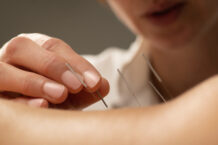
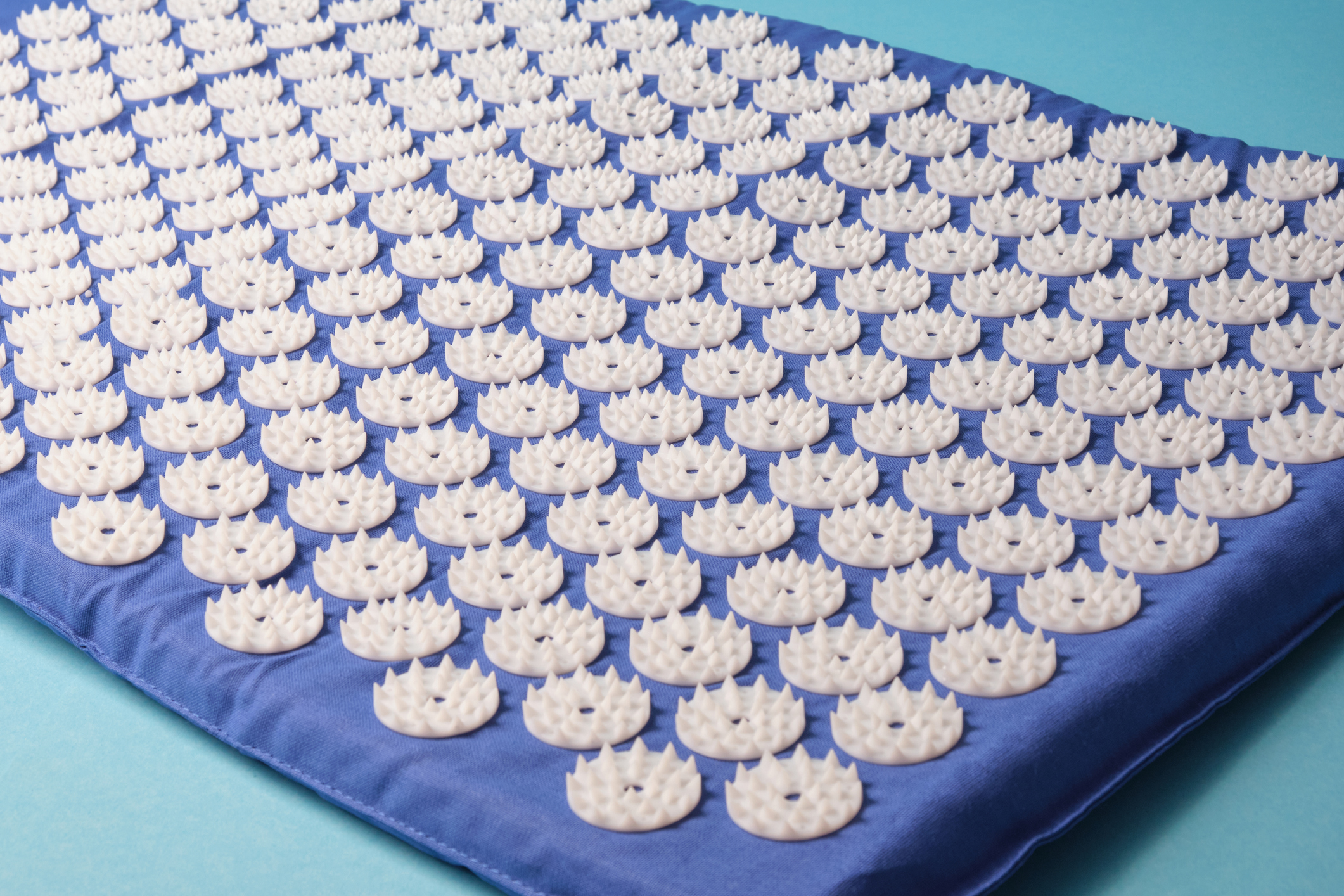
Acupressure mats resemble yoga mats but with a significant difference: They are embedded with plastic spikes all over their surface (hence their other names “needle stimulation pads” or “spike mats”). Unlike with acupuncture—which involves inserting thin needles into specific body points—there’s no puncturing of the skin with the mats. But, unlike traditional acupressure—which involves applying manual pressure to those points—lying on a mat may feel pointedly more painful, at least at first.
As with acupuncture and acupressure, the spikes on acupressure mats exert pressure on parts of the body referred to as meridians. According to traditional Chinese medicine, applying pressure on or stimulating these spots promotes the free flow and balance of energy (Qi) in the body in order to relieve pain and anxiety, among other benefits. In contrast to acupuncture and regular acupressure, however, the mats stimulate meridians as well as unspecific areas.
The pressure for proof
While both acupuncture and acupressure have been investigated over the years (though with varying degrees of positive outcomes and plenty of null findings), the problem with acupressure mats is that there are few studies on them. And the ones conducted tend to be small and have methodological issues, such as not having a control group (or a good control group), not being double-blinded, and having a short follow-up time. In addition, there are myriad causes of neck/back pain, and researchers don’t always distinguish between them. Still, here’s a sampling of published research on using the mats for pain relief.
- A paper in Evidence-Based Complementary and Alternative Medicine in 2012 reported on two randomized, controlled pilot studies with a total of 82 adults in Europe who had chronic neck pain (in one of the trials) or low back pain (in the other). Participants in the treatment groups were instructed to use a needle stimulation pad at home for about 30 minutes a day, starting first by pressing their hands (if they had neck pain) or feet (for back pain) into the mat for 10 minutes, and then lying on top of it. The control group was simply waitlisted for treatment, and didn’t receive any sham procedure. After two weeks, the majority of those in the treatment groups reported feeling less pain compared with those in the control groups.
- A study in the European Journal of Integrative Medicine in 2016 looked at the effects of an acupressure mat in more than 90 people with chronic or recurrent low back pain. Authored by some of the same researchers as the above-cited study, this study similarly instructed participants to use the mat for 30 minutes a day over two weeks, each time first placing their feet on the mat and then lying on top of it. Although there was no significant difference in the intensity of their pain, some participants had pain relief during the treatment, and some experienced pain relief for many days after. In addition, they reported improvement in disability after the two-week trial and then at four weeks, along with improvements in quality of life and decreased use of medicine. Some notable problems with the study were that there was no control group at all, and that several participants had to drop out because they found the mat too painful.
- An Italian study in Applied Sciences in 2021 included 44 people with chronic low back pain. Over four weeks, half of them spent one hour a day lying on an acupressure mat (the treatment group), while the other half (the control group) did not use the mats. Both groups participated in an exercise rehabilitation program (10 sessions over the study period) that focused on the back, including strengthening and stretching the spine and postural correction work. While both groups had decreased pain, the treatment group also reported improvement in quality of life.
According to researchers, the perceived benefits may be due to the spikes on the pads mechanically stimulating the skin and subcutaneous tissue, which affects receptors involved in transmitting sensory information to the brain. The pressure may also trigger the release of endorphins, improve circulation, and directly relieve tension in muscles. But as with traditional acupuncture and acupressure, the mechanisms by which the mats may work are not understood—and some of the benefits could still be attributed to a placebo effect, despite attempts to control for that.
Relaxing … on spikes?
At the very least, might acupressure mats be helpful for stress management? In a German study published in 2023, 62 healthy young people relaxed either on a mat three times a week for 20 to 30 minutes over three weeks, or on their mattress without any “tools” (the control group). Both groups were instructed to do their relaxation training in a quiet atmosphere, with phones, TV, and other devices shut off. At the end of the study period, participants reported reductions in perceived stress, along with improved sleep and overall well-being—but the treatment group fared no better than the control group, meaning that the mats didn’t afford any extra benefit beyond actively taking time to relax.
Still, the authors note that the mats may have led to benefits immediately after each session that they didn’t assess in the study, and that some individuals may respond more favorably than others.
Getting to the point
Although evidence of benefits is limited, acupressure mats are noninvasive, inexpensive (for the basic ones), and easy and convenient to use. Aside from some possible initial discomfort (which can be mitigated; see below), there’s no real downside to trying them for most people. Here are some tips to keep in mind:
- Acupressure mats come in different sizes, including small ones to stand on or to use for specific bothersome spots, and larger ones that you can lay your whole back over. There are also contoured acupressure pads for the neck that target the top of the spine.
- You may want to place a thin towel over the mat while you get used to the spikes, which can feel uncomfortable or even painful, at least at first. If you are going to lie down on the mat, you can alternatively wear a T-shirt; if you are placing your feet on the mat while sitting in a chair or standing, you can wear socks. Over time, however, you likely won’t need any buffer and will be able to tolerate the spikes directly.
- Start by spending just a few minutes on the mat, such as 5 to 10 minutes, and gradually increase the time, working your way up to 20 to 30 minutes or longer. You can do this daily, or even several times a day as desired, or use the mat just a few times a week—whatever suits you.
- It may sound pretty obvious, but don’t use acupressure mats on areas of skin that have lacerations, irritation, inflammation, or blisters. If you have skin that tends to bruise easily, use with caution (or not at all) and not on bare skin. Don’t use if you are taking anticoagulant medication or have problems with your peripheral nerves, including in your feet, from peripheral neuropathy. To be on the safe side, if you have any chronic health condition, including arthritis or diabetes, or are pregnant, it’s a good idea to discuss the use of acupressure mats with your healthcare provider.
BOTTOM LINE: Larger, longer, and better-controlled studies are needed to determine the potential benefits of acupressure mats. We found no studies at all for several of the conditions the mats are sometimes touted for, such as headaches, menstrual pain, weight management, and digestion. It’s not known, either, what is the best duration or frequency, or how long the effects may last. But if you are basically healthy and simply want to try one—for relaxation, muscle tension, or uncomplicated neck or back pain, say—go for it. Just heed the cautions noted above.
Acupressure mats are sold online and in some yoga studios, typically as a set that includes a flat mat and a contoured neck pad. They come in different sizes, colors, and materials (synthetic and cotton), and with different numbers of spikes. A mat with more spikes distributes your body weight better and may be more comfortable if you’re just starting out. You don’t need anything fancy: Simple mats cost under $25. Ones with extra (and unnecessary) features, such as magnets and red light therapy, can run $80 to $150 or more. Product reviews can be found at topconsumerpick, bestbuypick, and other websites.