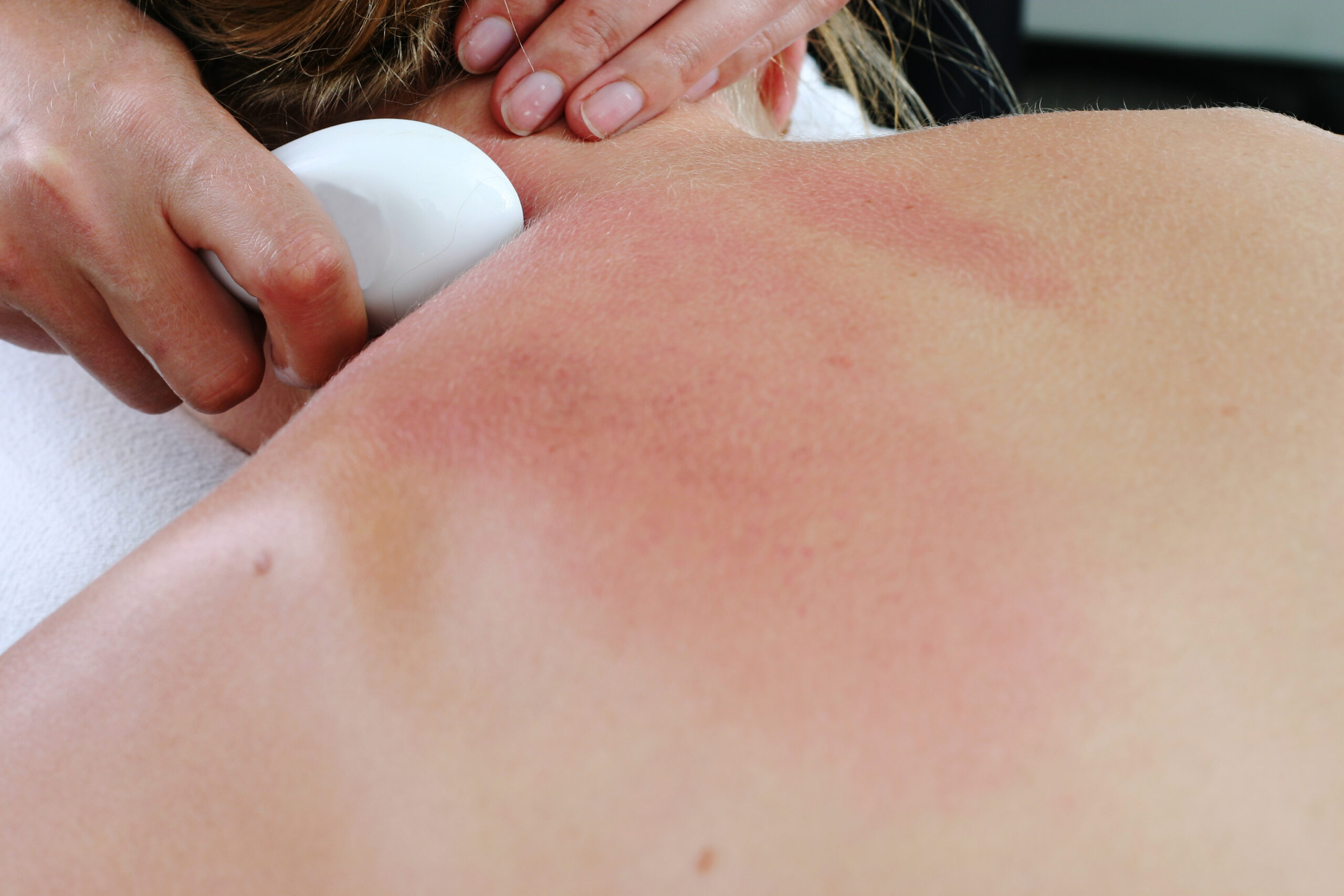
Gua sha—also known as skin scraping, scraping therapy, or press-stroking—is a traditional ancient healing therapy practiced in China and Southeast Asia that has made its way into integrative medicine practices in the West. It involves scraping and rubbing on the skin with a flat, smooth-edged tool (or sometimes a coin or even a ceramic spoon) and has been used for centuries to treat musculoskeletal problems as well as everything from headaches and asthma to insomnia and the common cold.
Depending on the body part, the practitioner, often an acupuncturist, may start off with gentler stroking and increase the pressure as tolerated. A similar practice sometimes done by physical therapists is the Graston technique.
In addition to acupuncturists, Gua sha is sometimes done by massage therapists, occupational therapists, and other healthcare professionals. Licensing is not required, but practitioners may have undergone a certification program—though there is no standardization for this, and some may have just completed an online training course.
Possible mechanisms
In traditional Asian medicine, blocked energy is considered a cause of illness. Gua sha is believed to unblock this energy—qi, the vital force—so it flows freely in the body.
Both Eastern and Western researchers have also proposed several physiological mechanisms to explain how Gua sha may work, although none have been proven. It has been shown, for example, that the scraping increases blood flow in the skin at the site treated, which may play a role in pain relief. Also, as the skin is scraped, it gets damaged in the process, and cells release pro-inflammatory compounds, which, in turn, leads to the release of anti-inflammatory compounds that, among other effects, may suppress pain by downregulating pain nerve cells or causing the body to increase production of endorphins.
It has been suggested that the scraping may additionally act as a counterirritant, causing a sensation of pain that travels along the same nerve pathway (to the spinal cord) as other pain in the body, thereby suppressing other sources of pain (similar to how counterirritants, such as menthol liniment and capsaicin, may work for muscle soreness).
What does the research say?
A German study in Pain Medicine in 2011 randomized 48 people with chronic neck pain to either receive a session of Gua sha or use a heating pad (the control group). After one week, those in the Gua sha group had a greater reduction in pain severity compared with the control group. They also experienced an improvement in pain when moving their neck. But it’s hard to say much about a study that used a single session of Gua sha and followed participants for such a short time.
In another German study, published in the journal Explore in 2007, one session of Gua sha reduced muscle pain in the treated area; some participants also experienced pain reduction elsewhere in the body. However, this study included only 11 people, had no control group, and also used just a single session.
A 2010 systematic review in Chinese Medicine found some evidence in favor of Gua sha over other types of treatment like acupuncture for various musculoskeletal problems—but the studies included were generally of low quality, and this may have overestimated the size of the effects. The authors concluded that the “current evidence is insufficient to show that Gua sha is effective in pain management. Further RCTs [randomized controlled trials] are warranted and methodological quality should be improved.”
Challenges in studying the benefits of Gua sha include the difficulty of selecting an appropriate control group and assessing for the placebo effect that is common in pain research.
What to know before you consider it
Practitioners should inform patients that Gua sha breaks capillaries in the skin as part of the supposed therapeutic effect, resulting in small red or purple raised spots (called petechiae), diffuse bruising and skin discoloration (ecchymoses), and sometimes soreness. The visuals can be alarming, but the marks are temporary and typically resolve within a few days to a week.
But because Gua sha breaks skin capillaries, you should not have it done if you are taking anti-clotting medication or if you have thin or frail skin, a skin condition such as psoriasis or eczema, or otherwise damaged skin in the area.
BOTTOM LINE: As is the case for so many ancient healing therapies, there aren’t a lot of high-quality studies to determine if Gua sha is effective by Western standards. The published studies to date are small and quite heterogeneous, with methodology varying greatly in terms of how the treatment is given, for how long, and how often. Long-term benefits are not known. Still, assuming Gua sha is not contraindicated, you could consider trying it. To be on the safe side, it’s strongly recommended that single-use disposable tools be used or that the tools at least be properly disinfected between uses. Or you might bring your own tool; they are widely available online, made of jade, stone, or stainless steel.