
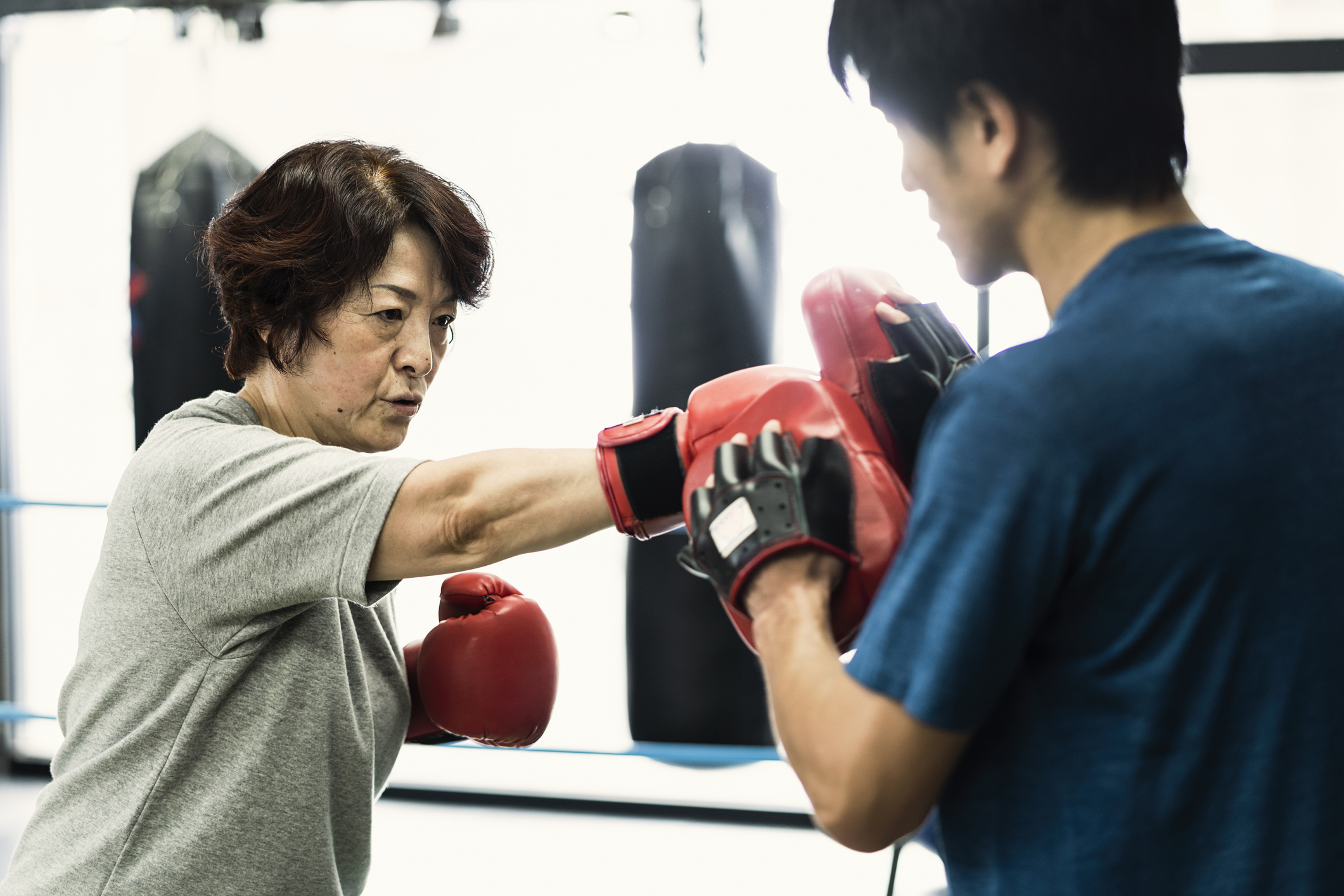
Most people probably don’t naturally gravitate to boxing as a workout activity. But it’s worth considering at any age, since this sport, which involves both upper and lower body movements, can be an excellent way to condition the cardiovascular system as well as improve muscle tone, coordination, reaction time, endurance, and balance. Like other forms of aerobic exercise, boxing may also provide some mental health benefits.
You can, of course, spar with a partner, but if you find that off-putting, a boxing workout doesn’t have to require physical contact with another person. Rather, it can be done by punching a heavy bag or speed bag while wearing mitts, or you can simply shadowbox (aka air box) with or without mitts.
There are even boxing video games (a form of “exergaming”) that you can do in the comfort of your living room, as well as “reflex balls” that are often used in boxing training (more on these below).
Boxing benefits
Though the vast majority of studies have been conducted in professional or elite young boxers, some research has involved “regular” adults engaging in what is often called fitness boxing, and some of these studies have included at least some older people. Unfortunately, to date there are no well-designed published studies that specifically evaluate fitness boxing alone as exercise for older adults—and the studies available have limitations, which makes their results of questionable value. Still, the sampling below gives an idea of what some research has found.
- A study in the International Journal of Clinical and Experimental Medicine in 2014 split 198 older people (65 and up) with mild cognitive impairment into one of two groups: The treatment group engaged in 30 minutes of supervised jogging and one hour of shadowboxing once a week for six months, while the control group did not participate in an exercise program. Those who exercised showed improvement in some aspects of memory as well as in ability to perform activities of daily living.
- In a very small pilot study in BMC Sports Science, Medicine and Rehabilitation in 2015, obese participants engaged in either a high-intensity boxing workout or brisk walking (the control group) four times a week for three months, where each session lasted 50 minutes. The boxing workout involved punching two different kinds of bags, hitting into focus mitts (that the trainer holds up), doing footwork drills such as shuffling side to side and back and forth, and skipping. Each of these activities was done at high intensity for two minutes followed by a one-minute rest (standing or pacing). Those in the boxing workout group—not the brisk walking group—had a significant reduction in body fat and blood pressure, as well as an improvement in aerobic fitness.
- A review of more than a dozen studies, published in the American Journal of Lifestyle Medicine in 2022, evaluated the effects of non-contact boxing on mental health in a wide age range of people (from pre-teens/teenagers to middle-age and older adults). Overall, the investigators found, this activity was linked with improvements in self-esteem, mood, and concentration, as well as reductions in anxiety and depression, though most of the studies were small, of varying protocols and duration, and not of high quality.
The virtues of virtual boxing
You don’t have to engage in “real” boxing to reap health rewards—several studies have investigated the benefits of virtual boxing done with a gaming system—exergaming boxing—in nonathlete adults. For instance, a small 2017 study involving 17 young and middle-aged adults who were wheelchair-bound because of spinal cord injury found that exergaming boxing (or punching a heavy bag) for 15 minutes could be enough to be considered a moderate-intensity activity. A 2021 review of 16 studies concluded that exergaming boxing could be done at high enough intensity to have cardiometabolic benefits, at least in younger adults, who were the focus of this research.
And in a small study sponsored by the American Council on Exercise (but not peer-reviewed or published in an academic journal), men and women ages 60 to 85 did three five-minute bouts of exergaming activities—boxing, dancing, and bowling. Boxing and dancing (but not bowling) were deemed equivalent to walking at a 2.5 mph pace and “could contribute toward meeting the daily recommendation of at least 30 minutes of moderate-intensity physical activity,” the researchers noted. Such exergaming “is an excellent alternative to the real thing.”
The boxing gaming system used in the ACE study was XaviX, whereby players wear boxing gloves with sensors as they throw punches at a virtual opponent. But there are others, including Wii Sports Boxing, Nintendo Switch Fitness Boxing, and Quell.
Boxing with BoxBollen
If you’re on social media, there’s a good chance you’ve come across alluring ads for BoxBollen. Maybe you’ve even bought a set yourself. Though BoxBollen may have TikTok cachet, there’s really nothing different about it compared with all other sorts of reflex balls. All involve a bouncy ball (of various sizes and weights) attached to a headband by an elastic string. The idea is to punch the ball—which bounces back at you—as many times as possible in order to increase your reaction time and hand-eye coordination. People who do martial arts as well as boxers, both professional and amateur, use reflex balls. But because there’s a learning curve (you get better over time, fairly quickly), you need to be careful that you don’t get hit in the eye with the ball. Even though the balls are on the softer side, you may want to consider using eye protection just to be safe, at least until you feel more confident in your abilities.
BoxBollen can be fun, and though you won’t necessarily get a real boxing workout, it gets you up and moving and could—in addition to boosting hand-eye coordination and reaction time—build some upper body and core strength if you do it long enough and with enough vigor.
The punchline
If going to a boxing gym feels intimidating, boxing classes are sometimes given in regular health clubs, YMCA/YMHAs, and community centers. These may involve one-on-one practice where you pair up with an instructor, hitting into their mitts, or you may spend your time hitting different types of bags or just shadowboxing.
Then again, you don’t even have to go to any of these venues to box. You can do a boxing workout at home by following a YouTube video, with some geared to older people either standing or seated. This video, for instance, shows a 14-minute seated boxing workout for seniors, while this video takes seniors through an 8-minute “boxing-inspired” workout that focuses on upper and lower body movements and engages your core muscles. Or you can buy (or borrow from your grandchild) a gaming system so you can box virtually.
As with all exercise, you should consult your doctor before starting a new program, especially if you have cardiovascular disease, musculoskeletal issues, or other chronic health conditions. And you should always stop working out if you feel dizzy, become short of breath, or feel pain.