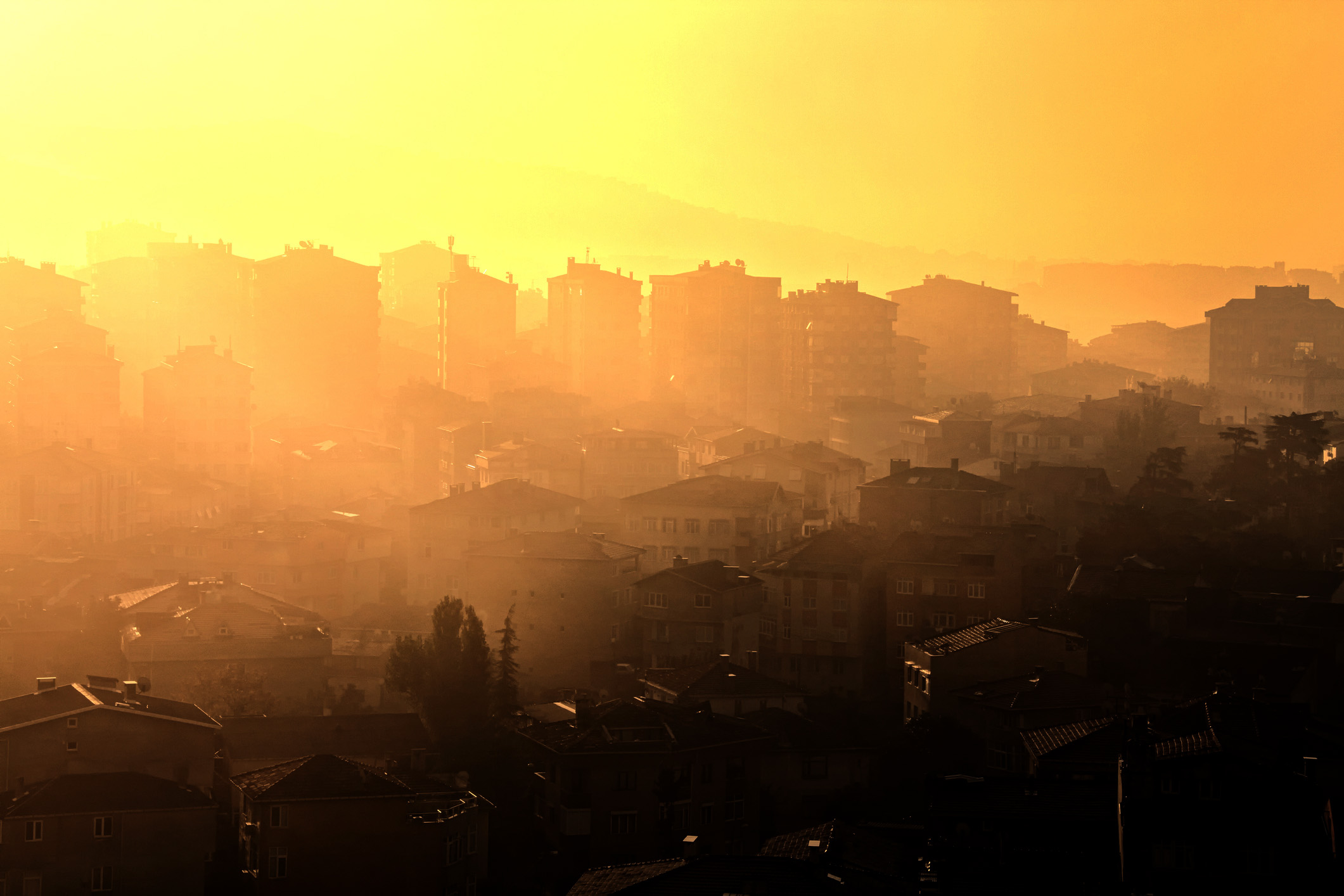
Each year, air pollution claims some nine million lives worldwide. One out of every six deaths can be attributed to the toxic stew of chemicals and particles released into the air by car and truck exhaust, factories, forest fires, and fuel-burning home appliances.
While much of the burden falls on low- and middle-income countries, high-income countries can’t escape the choking fumes. The Canadian wildfires that blanketed the U.S. East Coast and Midwest in haze this past summer illustrated that no one is immune to the dangers of air pollution.
In late June, more than one-third of Americans—120 million people—were living under an air quality alert because of the Canadian wildfires. Several states reached “Code Red” or “Code Purple” levels of air quality, meaning that breathing the air could cause myriad harmful effects, even in healthy people.
Air pollution and another existential threat facing humanity—climate change—are closely intertwined. The emissions that drive both issues largely stem from the same sources. Interventions to slow the rate of one problem could lessen the effects of the other, but those interventions have been slow to come, mired in a morass of political polarization and personal inaction.
Air pollution and your health
When health experts talk about the adverse health consequences of air pollution, they’re often referring to fine particulate matter (particles smaller than 2.5 microns, or PM2.5)—the tiny pieces of solids and liquids that float in the air. For comparison, a human hair is about 60 microns in diameter. Particle pollution is emitted from power plants, factories, gas-powered motor vehicles, wildfires, and wood-burning stoves.
The problems start when we breathe in these particles. The larger particles are filtered out by the nose and upper airway, but the smaller particles evade these defenses and are deposited in the air sacs (alveoli) of our lungs, where they can cause damage. The smallest particles (called “ultrafine”) can then pass into the bloodstream and further damage our organs and tissues.
Researchers have linked long-term exposure to particulate matter to a long list of harmful health effects, including increased risks of:
- Heart disease and stroke
- Lung diseases like asthma and chronic obstructive pulmonary disease (COPD)
- Lung cancer
- Diabetes
- Parkinson’s disease
- Alzheimer’s disease
It doesn’t take a lot of exposure to impact our health. A 2022 study of more than 68 million older adults enrolled in Medicare found that for every 10 micrograms (one-millionth of a gram) per cubic meter of air increase in fine particulate matter (PM2.5), the risk of death from all causes rose by 6 to 8 percent. Even short-term exposure to high levels of PM2.5—like from the Canadian wildfires—can be detrimental to health.
Ozone, also known as smog, is another major pollutant of concern. This gas is made up of three oxygen atoms (the oxygen we breathe is composed of two oxygen atoms). Ozone forms from a chemical reaction between two types of pollutants—nitrogen oxides (NOx) and volatile organic compounds (VOCs)—and sunlight.
The main danger from ozone is to our lungs. When the gas is breathed in, it irritates the delicate airways. Ozone exposure may both contribute to and aggravate lung diseases like asthma and COPD.
Children, older adults, pregnant people, and those with chronic health conditions are most vulnerable to the harmful effects of particle pollution and ozone.
Other air pollutants include carbon monoxide (mostly from vehicles) and sulfur dioxide (produced when sulfur-containing fuels such as coal and oil are burned).
How dirty is your air?
The American Lung Association released its 24th annual State of the Air report in April 2023, and the news is both good and bad.
On the upside, nearly 18 million fewer people are breathing unhealthy air compared to the previous year. Now the bad news: More than one in three Americans, over 119 million people, live in places that get failing grades for unhealthy ozone levels. And nearly 64 million people live in counties that get failing grades for daily spikes in particle pollution—the highest ever reported under current standards.
California ranks as the most polluted place in the U.S. to live. A warm climate, coupled with mountain ranges that trap pollutants, have muddied the air quality over the Golden State. In fact, the state of California falls in eight of the top 10 spots for ozone and particle pollution, with the cities of San Bernadino (about 60 miles east of Los Angeles), Riverside, and L.A. in the top three.
Pollution is not evenly distributed. According to this latest State of the Air report, 72 percent of residents in counties that get failing grades for all types of pollution are people of color. Nearly 15 million people who live in poverty are in counties that received an “F” grade from the American Lung Association for at least one pollutant.
The air inside many of our homes isn’t so clean, either. Gaseous pollutants released by paint chemicals, cleaning products, gas and wood stoves, furniture, and carpeting can compromise indoor air quality. So do allergens like dust, pollen, and mold. Americans spend an estimated 90 percent of time indoors, so the impact these pollutants have on our health can be considerable.
What can you do about pollution?
You can’t single-handedly clear the air—reducing pollution requires widespread changes in government and corporate policies, along with personal responsibility. Still, you do have some control over your impact on pollution and your exposure to it. Here are some things you can do right now to reduce the effects of air pollution on yourself and others in your community.
- Reduce your own emissions. If you drive, consider buying an electric car. Better yet, take public transportation, walk, or bike as much as possible. Swap your natural gas or wood stove, water heater, and furnace for electric versions of these appliances. Thanks to the 2022 Inflation Reduction Act, these clean-energy purchases may qualify you for tax credits. You can also do small things like turning off lights when not needed; setting air conditioners to 78°F or higher; buying appliances with high Energy Star ratings; not burning trash, leaves, or wood; and composting and mulching.
- Check the air where you live. Before you head out, get the air quality report for your city on AirNow.gov, from the U.S. Environmental Protection Agency (EPA). Green means the air is clear; yellow means the air is “acceptable.” Orange could be a problem if you’re sensitive—for example because you have asthma or another lung disease. When the air quality is in the red or higher, that’s the time to stay indoors, preferably in environments that have HEPA filtration (see next bullet).
- Consider installing a portable air cleaner (filtration device) to create a clean room in your home. A portable HEPA (high-efficiency particulate air) filtration device traps 99.97 percent of dust, pollen, mold, and other particles measuring 0.3 microns in diameter or larger. These devices are relatively inexpensive, but you need to have the right device for the size of the room (larger rooms need devices with greater air flow). Having such a device (or multiple ones for multiple rooms) in your home won’t shield you from all the health risks associated with air pollution but can definitely reduce your exposure. If you have central ventilation in your home, you can also install a MERV (minimum efficiency reporting value) 13 filter. This will further reduce your exposure to particle pollution in your home.
- Ventilate. To clear the air inside your home, open windows (on low-pollution, low-allergen days) to blow fresh air inside. Make sure your oven and clothes dryer are vented to the outside. Run the exhaust fan over your stove when you cook, and the one in your bathroom while showering. Keep windows closed on high-pollution days.
- If you live in an area susceptible to wildfires, be prepared ahead of time. Have an evacuation plan in place, along with an emergency kit that includes food, water, medications, and N95 respirators (masks). Create a clean room to use for times when you don’t need to evacuate, as explained in this video. You can track wildfires in your area at this site.
- Lastly, vote. If you care about air quality for yourself and family and for future generations, the only way for your voice to be heard and counted is to elect government officials who pledge to enact legislation that represents your position.
What is a “Code Red” air quality advisory, and what should you do if there’s one in your area? The U.S. Air Quality Index (AQI) is the EPA’s method of reporting air quality. It is color-coded by the degree of health concern.
Here’s what the six colors mean:
| Green | Good | The air quality is good and there’s little to no risk from air pollution. |
| Yellow | Moderate | Air quality is acceptable, but there may be a risk to people who are very sensitive—for example, those with lung disease. |
| Orange | Unhealthy for sensitive groups | Pollution may affect people in sensitive groups, such as the elderly, young children, people with preexisting heart and lung disease, and pregnant people. |
| Red | Unhealthy | People who are sensitive may experience more serious health effects, but even healthy people could have problems. |
| Purple | Very unhealthy | Everyone is at increased risk for health effects. |
| Maroon | Hazardous | Emergency conditions. Everyone is likely to be affected. |
Try to avoid spending time outdoors when the air quality is unhealthy. Stay indoors with windows closed and air conditioning on.