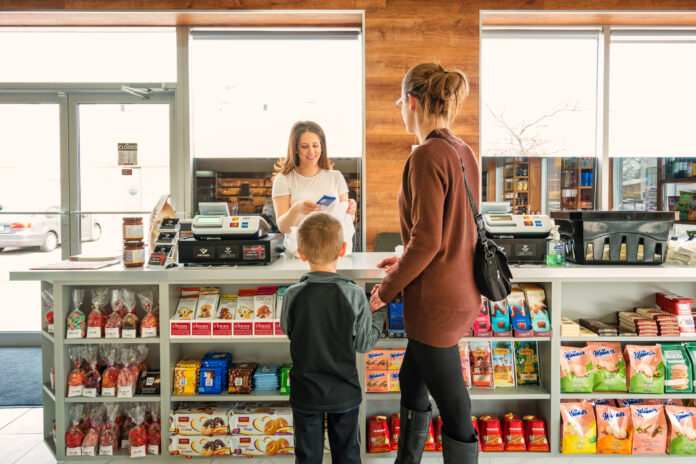
Keep your blinders on in the checkout lane at retail stores to avoid impulse purchases of candy bars, salty snacks, sugary sodas, and the like. It probably comes as no surprise, but as a study in Current Developments in Nutrition reported in April, most of the products sold on the way to and at the cash register are junk food.
A collaboration of researchers at the UC Berkeley School of Public Health, UC Davis, and University of Illinois Chicago assessed the nutritional composition (including sugar and sodium content) of close to 40,000 food and beverage “facings” (that is, what the customer sees, or faces, during the checkout process) at 102 stores in four cities in northern California (Berkeley, Davis, Oakland, Sacramento) in February 2021.
The retail stores were chain supermarkets, specialty food stores, drugstores, dollar stores, and mass merchandisers, as well as small independent grocery stores and supermarkets. The checkout areas included not just the standard checkout lane and register area but also snaking sections (those single long checkout lanes that wind around to multiple registers), endcaps (at the ends of the checkout lane, where there often is a fridge with beverages, for instance), and nearby standalone displays. The researchers rated the healthfulness of the products using “healthy checkout standards” that, overall, are consistent with the Dietary Guidelines for Americans.
Some key findings:
- 70 percent of the foods/beverages in checkout areas failed to meet the healthy standards—most frequently candy (44 percent) followed by sugar-sweetened beverages (15 percent), salty snacks (13 percent), and sweets (8 percent).
- When limiting to snack-sized products (which customers are more likely to grab on impulse when shopping), nearly 90 percent of the foods/beverages at checkout were deemed unhealthy.
- On the flip side, only 30 percent of checkout area foods/beverages met healthy standards—mostly sugar-free gums (54 percent), followed by sugar-free mints (15 percent), unsweetened beverages (15 percent), and nuts (7 percent). Good luck finding fruit, seeds, whole grains, vegetables, yogurt, or cheese at checkout. Of all beverages sold in the checkout area, only 16 percent was plain bottled water.
- Small independent grocery stores and chain dollar stores, which tend to serve lower-income communities, had the lowest percentage of items meeting healthy standards.
- No significant differences were found in the healthfulness of foods and beverages stocked at self-checkouts versus those at staffed checkouts, according to lead author Jennifer Falbe, Sc.D., M.P.H.
Previous studies have shown similar sales tactics. For instance, a study that looked at 32 supermarkets in several cities on the East Coast found that three-quarters of their checkout lanes had chocolate, half had sugary soft drinks and candies/sweets (separate from chocolate), and more than one-quarter had chips, while a study of 119 small food stores in Minnesota found that 98 percent featured at least one unhealthy item as an impulse buy at checkout. Even hardware, electronic, and apparel stores offer lots of junk food at checkout these days.
Why are these findings significant? According to a 2021 study in the journal Nutrients, more than one-third of customers overall reported having bought a food or beverage in the checkout area on their last trip to the grocery store, particularly parents, people with low income, and those in racial/ethnic minority groups. And it’s no accident, since food companies pay big bucks to put these high-profit food items there—“the only place all customers must pass through and is known to trigger impulse purchases,” the latest paper noted. Such arrangements give stores a strong motive to sell unhealthy items at checkout, often at children’s eye level.
A better trend: The city of Berkeley, California, has implemented a Healthy Checkout Ordinance that restricts the kinds of foods and beverages that can be promoted in the checkout lanes of large stores (more than 2,500 square feet). This first-of-its-kind policy in the U.S., which went into effect in January 2022, allows only unsweetened beverages (no added sugars or artificial sweeteners) at checkout and no foods that contain more than 5 grams of added sugar or more than 200 milligrams of sodium per serving.
Other cities and countries have or are in the process of adopting such policies, too, although they haven’t yet been evaluated to see what effects they have on buying behaviors. But it’s reasonable to think that if only healthy items like apples, bananas, and yogurt are offered at checkout, “impulse” purchases could actually be a good thing. Until such ordinances come to your local markets, however, make a list before you shop and do your best to stick with it.