My doctor recommended that I get an exercise stress test. Why are these done, and what should I expect?
An exercise stress test, also called a treadmill test, is often done when a person has experienced symptoms that could indicate cardiovascular disease, such as shortness of breath, chest pain, dizziness, lightheadedness, heart palpitations, or a rapid heartbeat, especially during exertion.
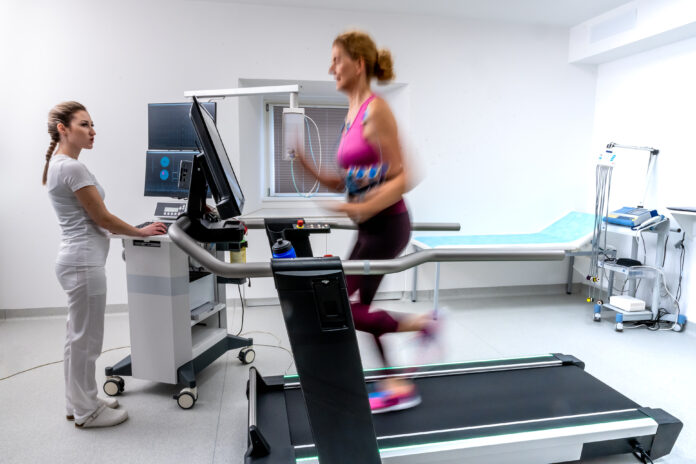
As the name suggests, the test puts your heart under stress while you work out, typically by walking on a treadmill or pedaling a stationary bike while the speed and incline or resistance are gradually increased. Because the heart is working harder than normal, signs of coronary artery narrowing are more likely to show up than when you’re at rest. Stress tests thus carry a slight risk of inducing cardiac problems, which is why they’re done only in a supervised medical setting.
The test typically takes place at a hospital or in a doctor’s office. You’ll wear electrodes to record your heart’s electrical activity (called an electrocardiogram, or EKG), and your heart rate and blood pressure will be monitored. You’ll also regularly report your level of perceived exertion and whether you’re experiencing any symptoms. You can expect to be on the treadmill or riding the bike for about 10 to 15 minutes, though your appointment will last longer than that since time is needed to set you up for the test, and you’ll continue to be observed while you cool down after exercising.
If the results show a problem—such as an abnormal heart rhythm or an inadequate supply of oxygen to the heart—or if you had excessive difficulty completing the test, your physician might order a subsequent exercise stress test with imaging. This enhanced version uses sound waves (echocardiograph) or injected radioactive dye to provide detailed images of the heart while you exercise. Your doctor might also order it if results on the standard stress test are normal but you continue to experience symptoms.
Depending on the results of an enhanced stress test, you may be referred for yet more testing, such as coronary angiography (a test that can detect narrowing in the blood vessels).
Certain people cannot safely undergo exercise stress testing, including those who recently had a heart attack and people with certain heart rhythm abnormalities (arrhythmias), endocarditis (a heart infection), very low blood pressure, unstable angina, or severe narrowing of the aortic valve. People taking certain medications for high blood pressure or heart failure may also not be candidates for exercise stress testing. And those who have lung disease, hip or knee arthritis, or poor circulation in the legs may not be able to exercise at a high enough intensity to detect heart disease. They may instead need to have a pharmacological stress test, in which the heart rate is increased using intravenous medication.