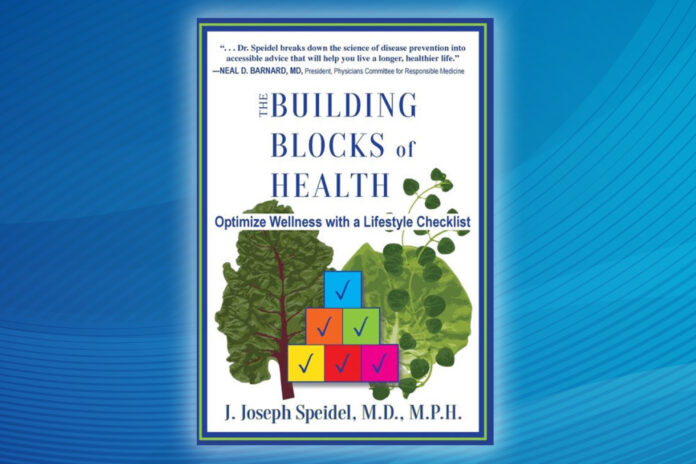
As readers of the Wellness Letter, you are undoubtedly committed to optimizing your health through improved lifestyle choices. And with the New Year soon upon us, you may be especially motivated to break some bad habits. J. Joseph Speidel, M.D., M.P.H., a professor emeritus at the University of California, San Francisco (UCSF), and a member of our editorial board, has authored a book that can help with that mission. The Building Blocks of Health: How to Optimize Your Wellness with a Lifestyle Checklist, published in 2020, is designed to help readers adopt new behaviors and reverse the negative health impacts of unhealthy behavioral factors that can lead to illness and premature death.
The book focuses on such key topics as healthy aging, nutrition, weight control, cardiovascular disease, diabetes, and cancer. Kirkus Reviews hailed the 600-page volume as “an authoritative, encyclopedic, and illuminating wellness manual,” noting that “each chapter is remarkably comprehensive in scope and detail, providing a wealth of information as well as extensive references to current scientific studies and relevant sources.”
Dr. Speidel, who is board certified in preventive medicine, is a graduate of Harvard College, Harvard Medical School, and the Harvard T.H. Chan School of Public Health. He has appeared frequently in print and broadcast media as an expert on medical and public health issues and has authored or co-authored more than 300 scientific publications. At various points in his career, Dr. Speidel served as director of the USAID Office of Population and Reproductive Health, president of Population Action International, director of the population grants program at the William and Flora Hewlett Foundation, and co-director of UCSF’s Bixby Center for Global Reproductive Health.
We spoke recently with Dr. Speidel about his motivations for writing the book, the payoff for making difficult lifestyle changes, and how to stay healthy while living in an unhealthy environment, among other issues.
The Wellness Letter: What prompted you to write the book?
Dr. Joe Speidel: When I was taking care of patients, I became aware that many of them had preventable conditions and diseases—like having heart attacks at a young age. It became clear to me that the public didn’t know how to best protect their own health. I went back and studied public health, which focuses on prevention strategies. So the idea of the book was to help people understand how they could adopt a healthier lifestyle to prevent and even reverse some of the damage leading to poor health outcomes. And a key intention of the book was to put what you need to know in one place. There are lots of books about diet, there are books about exercise. It seemed like we needed a book that would put it all together as a complete guide to healthy living.
To make sure this was a scientifically sound publication, I reviewed more than 2,000 articles from the medical literature. If you put it all together, you can prevent about 90 percent of cases of diabetes (which itself is a high-risk factor for many other problems) and about 80 percent of heart attacks. We know the number-one killer in the U.S. is still cardiovascular disease, so having a healthy blood lipid profile and blood pressure that’s as close to normal as possible and getting enough exercise are all extremely important.
We also know that preventing cancer is harder. Even so, most people probably don’t realize that being overweight makes you more likely to get cancer, and being in good physical condition can help prevent it. And as a new study affirmed, cigarette smoking accounts for some 30 percent of all cancers; hence, not smoking would go a long way in reducing risk. In addition, with an optimal lifestyle, you can feel more energetic, you can sleep better, and of course it’s better for your mental health—you’re less likely to have depression or develop dementia.
WL: One problem is that people with unhealthy lifestyles tend to have multiple problematic habits or risk factors for poor health, right?
JS: That’s right. People who have unhealthy habits in one domain are likely to have them in another as well. And it’s an unfortunate truth that each risk factor is often more than additive. So if you’re doing two things that might each double your risk, your risk may not go up four times but rather up by some exponential, like eight times. If, say, you’re overweight and you also smoke, you may have much more risk than if you just added up the two risks individually.
That means you can’t just get a lot of exercise or avoid one thing like smoking to get and stay healthy. And it can feel sort of overwhelming to people to think, “Oh, my God, I have to stop doing this, and I have to stop doing that.” There are multiple factors impacting health, and we know that the more of these factors you have in your favor, the healthier you will be on average. There have been a lot of studies that looked at, say, three or four or five different factors. Unfortunately, fewer than 5 percent of Americans would fall in the healthiest range of all of them.
WL: That message is kind of a bummer. What’s the flip side of the equation?
JS: Well, the flip side is that the payoff of taking care of yourself is great compared to people who don’t take care of themselves. There are no guarantees, of course, but on average, people who have healthier habits will live 10 to 15 years longer than people who don’t. In addition, you’re less likely to have many years of chronic disability. And that’s important, because a lot of Americans will have 10 years of ill health—they’re still alive but not doing very well or having a high quality of life. Some health experts are now talking about the importance of the “health span” rather than the “lifespan,” with the goal of having as many years of good health as possible.
WL: But isn’t all of this a challenge when we’re living in an unhealthy environment?
JS: Well, sure, we are stuck with a certain amount of air pollution if we live in a city, and if we live in New Delhi, for instance, we are subject to a lot more than in most places in the U.S. Or we have poor quality air because of wildfires in our neighborhood—that seems to be more and more frequent in California. And we have lots of products with chemicals that do who knows what. In other words, you’re right—we are surrounded with risks. We don’t know them all. All we can do is our best to limit as many as we can. And at least we can avoid making it worse by not smoking and creating our own air pollution, for example.
We also live in an environment that promotes unhealthy eating. If you go to any restaurant, including fast food establishments, the foods are designed to be tantalizing and tasty rather than healthy. A cookbook tells you how to make great-tasting food. It doesn’t necessarily tell you how to make healthy food. Not that there aren’t some cookbooks that focus on health, but most of them do not. And if you read the food section in the New York Times or the San Francisco Chronicle, they’re not typically focused on health. They’re focused on great-tasting food.
WL: So what is the answer for an individual confronting all these factors promoting poor health?
JS: I think there’s reasonably good evidence that any progress in the right direction is good. In other words, you may not adopt what I would call the optimal lifestyle, but we know that losing even just five or 10 pounds can often make a big difference. And although many medical problems, like cardiovascular disease, result from a lifetime of poor habits, the amazing thing is how quickly some of the damage can be reversed. So it’s not just a matter of staying as healthy as you currently are, but actually improving your health in some cases.
WL: In the book, you highlight some examples of people experiencing major health improvements.
JS: Yes, I point out some case studies of people who were really at death’s door. And they adopted a program where they pretty radically changed their life—including switching to a plant-based, very low-fat diet, along the lines of the Pritikin Diet or the Dean Ornish diet. And they tried to get as much physical activity as they were able to. Some amazing turnarounds can occur. Dean Ornish has documented improvements in large numbers of people in his program. A less radical change is to go on a Mediterranean-style diet, which allows for more plant-based unsaturated oils than the Pritikin and Ornish diets. Epidemiologic studies of the Mediterranean diet show that it leads to less heart disease, fewer heart attacks, and generally better health.
WL: If someone is seeking to pursue a healthy lifestyle, where does the use of medications to address some of these issues come in?
JS: We know that about half of people who have high blood pressure don’t have it under control. So there’s a lot to be done right there. Probably most of us in the U.S. are not going to go on a very low sodium diet that might bring blood pressure into a normal range. But if you don’t do that, you should still make sure you’re addressing the issue. First of all, everyone should know their blood pressure numbers. And if your blood pressure is high, fortunately we have some very good antihypertensives that have virtually no side effects. By all means, take those.
The same is true with cholesterol. Some people are going to have high cholesterol because of their genetics, and they are not going to be able to go on the Pritikin or Ornish diet or adopt another healthy eating pattern that can lower cholesterol. In that case, taking a statin is recommended, but I think doing both is probably best. The point is, not everybody is going to radically change. But any progress toward a healthier lifestyle is good. And if you need the help of pharmaceuticals, then take the drugs.
But as a cautionary note, that advice doesn’t apply to dietary supplements. Some people think, “Okay, I’m going to take a vitamin, then I’m going to be healthy.” So they take supplements, which are probably mostly pretty useless, and some might even be dangerous. People may think that supplements are tested and regulated like pharmaceuticals, but they’re not.
WL: Any last thoughts?
JS: Almost all of us have unhealthy lifestyle habits that contribute to illness and early death. Fortunately, the principles of healthy living are not complicated or difficult to learn. And our bodies have a remarkable power to heal when we stop the biological damage caused by our unhealthy lifestyle. The Building Blocks of Health provides the information doctors would tell their patients—if only they had enough time to provide good counseling about an optimally healthy lifestyle.
Dr. Speidel’s bottom-line advice for living a long, healthy life largely boils down to this:
- Avoid tobacco, vaping, and secondhand smoke. It is never too late to quit.
- Avoid overweight and obesity. Your body mass index, or BMI, should be 18.5–24.9. To identify excess fat stores, use your waist-to-height ratio; your waist should measure less than half your height.
- Be physically active.
- Eat a plant-based, whole-foods diet high in whole grains, legumes, and at least 2½ cups a day of vegetables and fruits.
- Avoid refined grains and added sugar.
- Eliminate or at least limit red meats to reduce saturated fat. Avoid processed meats.
- Avoid high-heat cooking of high-protein foods (poultry, meat, fish).
- Do not drink alcohol, or at least limit it to one alcoholic drink a day or less.
- Get enough sleep.
- Protect your skin from the sun.
- Avoid indoor and outdoor air pollution as much as possible.
- Have regular checkups, keep up to date with recommended cancer screening tests, and follow recommended vaccine schedules for your age group.