
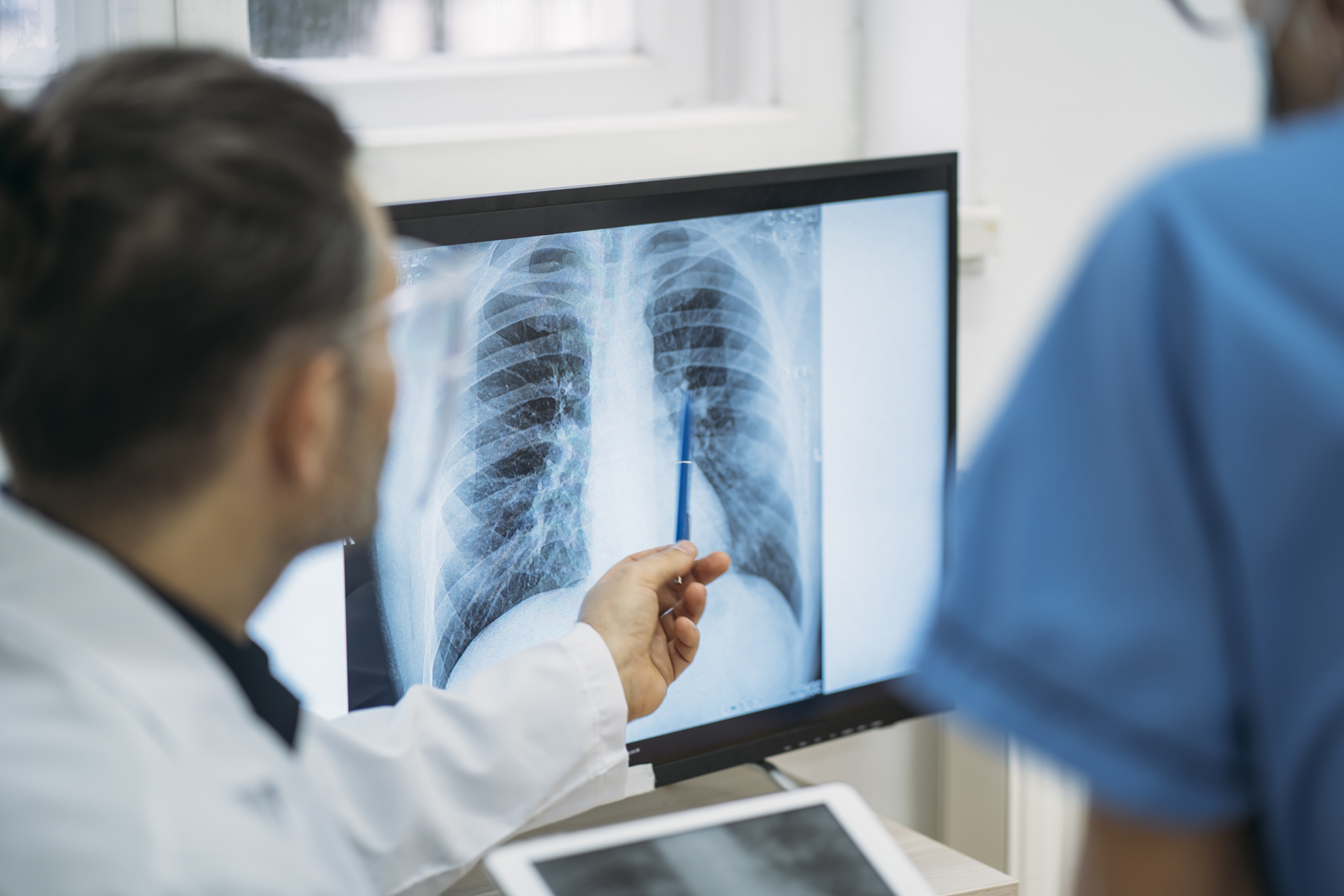
Screening people at high risk for lung cancer saves lives, a large clinical trial has confirmed. Yet another study found that few people in the U.S. for whom the screening is recommended are getting it.
The trial, published in The New England Journal of Medicine in February 2020, included 13,195 men and 2,594 women, ages 50 to 74, all current or former heavy smokers. Half were randomly assigned to undergo four rounds of low-dose chest computed tomography (LDCT) scans over 5.5 years. The other half got no screenings (the control group).
Over 10 years of follow-up, the rate of lung cancer deaths was 24 percent lower among men in the screening group than men in the non-screening group (156 deaths in the screening group and 206 in the control group). Among the women, the reduction was even greater—but the result did not reach statistical significance, possibly because the number of women with lung cancer included in the analysis was low.
LDCT scans can detect lung cancer early, when it’s at a more treatable stage, which is why they help reduce mortality. The clinical trial results have partly led to updated cancer screening guidelines. In March 2021, the U.S. Preventive Services Task Force (USPSTF) expanded its guidance to include a younger population of past and present smokers and a shorter smoking history than those included in its original 2013 recommendations. The USPSTF now recommends annual lung scans for people ages 50 to 80 who currently smoke or quit within the past 20 years and who have at least a 20 “pack-year” history of smoking (for example, smoking one pack a day for 20 years or two packs a day for 10 years).
The original recommendations were largely based on a landmark federal study in 2011, which found that annual LDCT scanning for three years cut lung cancer deaths by 20 percent in more than 53,000 high-risk adults. The updated guidelines incorporate findings from the 2020 clinical trial and subsequent risk-modeling studies.
Demand still down
Even as evidence supporting lung scans accumulates, a CDC report, released in February 2020, shows that most people in the U.S. who are candidates for annual scans aren’t getting them. The researchers analyzed data from more than 85,000 adults in 10 states who were surveyed by phone in 2017. Of the current or former smokers who met the 2013 USPSTF criteria for screening, only one in eight (12.5 percent) had undergone a lung scan in the previous 12 months. This rate is a much lower than for other nationally recommended screening tests, namely mammograms and colonoscopies—though it represents an improvement over 2015, when only about 4 percent of people eligible for lung scans got them.
What’s more, a surprising number of smokers who didn’t meet the criteria for screening said they got scanned anyway: from about 4 to 9 percent across the 10 states, or 8 percent overall.
Words to the wise: Lung cancer is the leading cause of cancer death among men and women in the U.S. If you are unsure whether you should be screened, the National Cancer Institute offers this online tool. Another tool, from the University of Michigan, is available at ShouldIScreen.com.
While the scans expose you to some radiation, it’s a very small amount (much less than in a standard CT scan). And the benefits for people who meet the screening criteria definitely outweigh this risk. The USPSTF says screening should be stopped once a person has not smoked for 15 years or if he or she develops a health problem that substantially limits life expectancy or the ability to have lung surgery to remove cancer.
Updated references
US Preventive Services Task Force. Screening for lung cancer: US Preventive Services Task Force recommendation statement. 2021 Mar 9; 325(10)962-968.
Screening for lung cancer. https://www.uptodate.com/contents/screening-for-lung-cancer. Accessed August 13, 2021.