
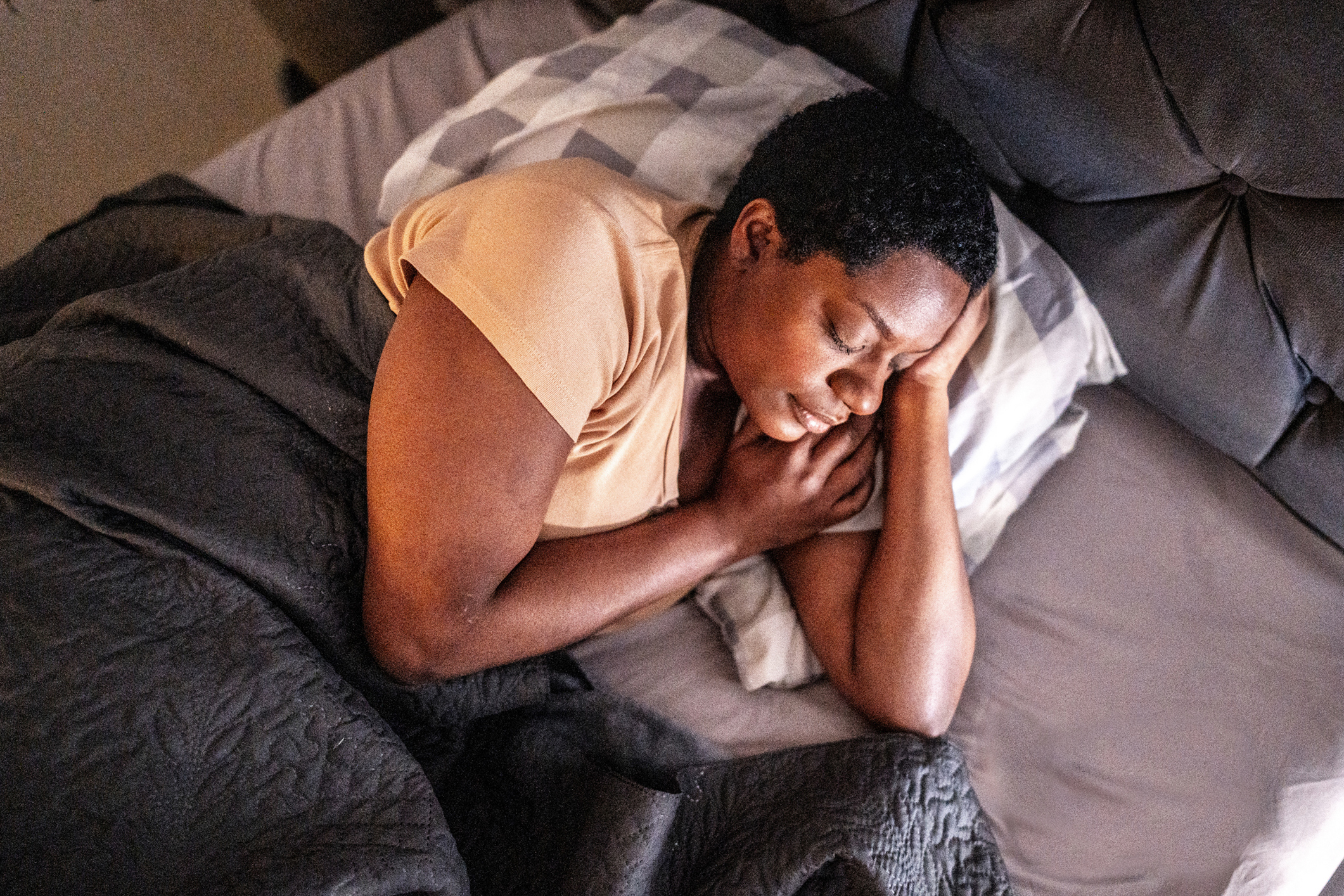
Are you a back, side, or stomach sleeper? Or a little of each, perhaps? The position you favor when sleeping can either support your spine in terms of maintaining its natural curves and alignment or it can stress your spine, from your neck down to your low back.
There’s no consensus on what the best sleep position is, or a clear-cut recommendation for everyone—what’s best depends on several factors, including whether you are a habitual snorer or have underlying health conditions like gastroesophageal reflux disease (GERD), sleep apnea, or neck, shoulder, or back pain.
The worst position?
If you have neck or back pain, one of the worst sleep positions may be on your stomach, referred to as the prone position, because it doesn’t support the natural alignment of your spine. Think about it: Your head is twisted to one side rather than being in line with the rest of your spine. And your low back isn’t being supported (the position accentuates the curve of the low back).
In a study in the journal Cureus in 2024, of 375 people with low back pain in Finland, a prone position was indeed most often associated with pain, with problems reported in sleeping and getting up in the morning, especially in women. But the authors also found that any sleep position could exacerbate low back pain.
According to a review of three articles that looked at different sleeping postures, in BMJ Open in 2019, stomach sleepers were more likely to wake up with pain and stiffness in the neck or back—while side sleeping was generally protective against spinal complaints. But the findings were nuanced, and the authors noted that due to the lack of high-quality studies in the review, there was still no definitive answer; more research is needed to come to any firm conclusion.
If you still really want to sleep on your stomach, place a small pillow under your pelvis to help keep your spine from sagging too much (see illustration in box below), which may alleviate any low back issues—but keep in mind that it won’t address potential neck stress.
But side isn’t always better, either …
While sleeping on your side may generally be better than sleeping on your stomach for neck and back pain, the outcome isn’t so straightforward. That’s because there are many variations involved in side sleeping, such as how your legs are positioned. If your top leg crosses over your bottom leg, that puts strain on your hips, pelvis, and low back. Sleeping in a fetal position, with your legs tucked up to your chest, may also put strain on your back because it doesn’t protect the natural curve of the low back.
To help maintain spinal (and hip/pelvis) alignment when side lying, have your knees slightly bent and then place the top leg atop the bottom leg. Putting a small pillow between your knees helps keep you in alignment and reduces pressure on hip and knee joints. Also, make sure your neck is aligned with and on the same level as the rest of your spine. That means having a pillow that is the right height—not too high, not too low.
Another potential problem with sleeping on your side is that it can aggravate shoulder pain. If you have shoulder pain, you may need to experiment to find what works best to reduce pressure on your shoulder. There are different positions or angles you can take with your torso so that you’re not completely on your side and not squashing your shoulder. You could also try positioning a pillow under your arm or under your arm and shoulder for support.
If you need help staying on your side, you can try various products that prevent you from rolling over—a wedge pillow, an inflatable bolster, or some kind of “positional aid” like a side-sleeping backpack, a sleep noodle, a sleep posture belt, or one of several “vibrotactile devices” (wearable devices you strap to your neck, chest, back, or forehead). Simply putting a tennis ball under a tight shirt or secured to the chest may also do the trick of keeping you on your side.
What about back sleepers?
Sleeping on your back (supine position) may not aggravate neck and back pain—but, again, it depends on such variables as the position of your legs and your pillow. (Your pillow shouldn’t be so soft that your head sinks down into it, or too thick, causing your neck to be flexed and not in line with your spine.) If you have low back pain and like to sleep on your back, placing a small pillow under your knees may reduce strain on your back (see box).
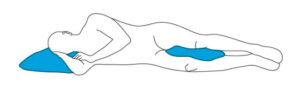 Sleeping on your side
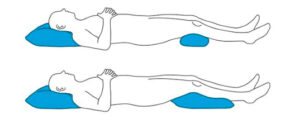 Sleeping on your back
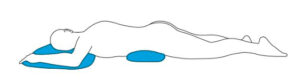 Sleeping on your stomach
Used with permission of the Mayo Foundation for Medical Education and Research, all rights reserved.
Positioning yourself against snoring
If you’re a habitual snorer, your sleep position could make it worse. That may be obvious to the bed partner of a snorer, who may find themselves repeatedly pushing their back-sleeping bedmate over to their side.
A 2023 study in Sleep Medicine looked at 83 adult snorers (60 percent male) who spent the night in a sleep lab, where their snoring was tracked with sound recordings. The researchers found that sleeping on the back was associated with more snoring episodes, and the snoring was louder and went on longer in that position.
What if your snoring is related to obstructive sleep apnea? In this disorder, the airway becomes partially or completely blocked during sleep, usually due to the relaxation of throat muscles, leading to repeated breathing interruptions, gasping, and the telltale sign of loud snoring.
As noted in a 2023 paper in Sleep Medicine Reviews, people with obstructive sleep apnea are more likely to experience airway obstruction when they sleep on their back, compared with side sleeping. But the research suggests that sleeping on the side doesn’t necessarily help reduce all apnea-related snoring—it may vary based on the individual.
For instance, a study in the journal Sleep, of 20 people with obstructive sleep apnea, found that only four of them benefited from sleeping on their side, versus when they slept on their back. The researchers noted that this may be due to anatomical differences, whereby the airway is able to stiffen and dilate more effectively in that position only in some people.
An earlier review paper in the journal Sleep and Breathing noted that only about 56 percent of people with sleep apnea are “position dependent,” meaning that they respond positively to changes in sleep position.
If you have sleep apnea, you can try sleeping on your side to see if that helps, but other treatments, including CPAP (continuous positive airway pressure), oral appliances, and hypoglossal nerve stimulation, are considered more effective.
Guarding yourself against GERD
Believe it or not, the side you sleep on can affect gastroesophageal reflux disease (GERD), a number of studies have reported. For instance, in a study in Clinical Gastroenterology and Hepatology in 2022, people with GERD who slept on their left side had more nights without reflux, compared to when they slept on their right side.
And a paper in the American Journal of Gastroenterology in 2022 found that people with GERD had a decrease in the amount of time the tissues of the esophagus were exposed to stomach acids when they slept on their left side, compared to when sleeping on the back or right side.
A review and meta-analysis in the World Journal of Clinical Cases in 2023 similarly found that sleeping on the left side was associated with a reduction in reflux symptoms, compared to sleeping on the back or right side.
BOTTOM LINE: If you often wake up with neck, back, or shoulder pain, you may want to try sleeping in a different position. And if you have chronic musculoskeletal pain issues, it’s a good idea to consult with a physical therapist who can discuss how your sleeping position impacts the alignment of your spine. If you have sleep apnea or GERD, speak with your healthcare provider to discuss what may be triggering your symptoms. If you don’t have a problem with any sleep-related body aches or any health issues, it’s okay to sleep any way you want that’s comfortable for you.
Jana Cooke, MD, a sleep expert and member of our editorial board, weighed in on sleep positioning, also called positional therapy when it pertains to sleep apnea. Here are some excerpts from her comments:
- In a perfect world, you would be able to sleep in a better aligned position the whole night through. But this is not realistic, and no matter how hard you try, you may still wake up in a position you are trying to avoid. That is, it’s really hard to control anything when we are asleep, despite our best intentions.
- Sleep can be hard for people much of the time, due to anxiety and insomnia, for example. And trying to follow the “recommendations” may only add to the anxiety about sleep: “Am I sleeping in the right position? Is the pillow in the right place?” Keep in mind also that sleeping with a pillow under or between your knees (as recommended for back and side sleepers, respectively) may have the unintended effect of disrupting your sleep because you have to adjust the pillow when you turn to another side or position, or if the pillow moves.
- As with everything in the health world, it’s complicated. Patients often ask me what the best pillow and mattress are, and I always tell them “the best” is what they are comfortable with. Ultimately, your best bet for alleviating chronic musculoskeletal issues is to strengthen your back and core muscles and overall body rather than focus exclusively on your sleep position.
Dr. Cooke’s bottom line? Try to follow the recommendations if you have back or neck or other musculoskeletal issues, but don’t be too hard on yourself if you’re not always successful. The most important thing is to get a good night’s sleep and not add more worry about your sleep position to the mix.