I went to a reputable hair loss clinic where, as a woman, I was diagnosed with androgenetic alopecia. The dermatologist there recommended I try a laser cap—but it’s expensive and time-consuming. Is it worth the cost and effort? Would a cheaper scalp massager, such as ones I see advertised on social media, be just as good?
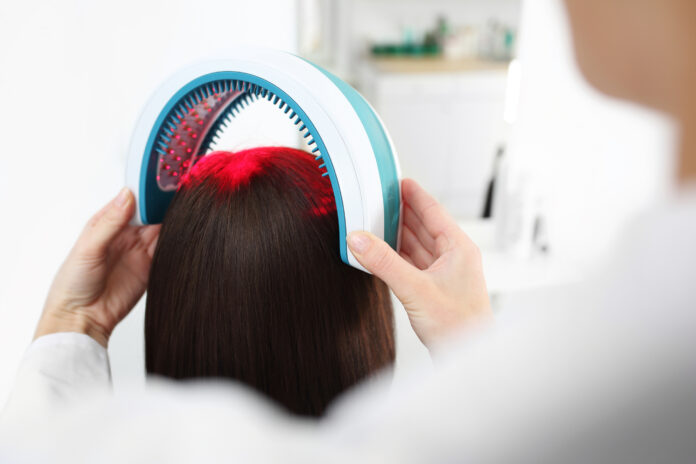
It’s hard to say which kind of device, if either, is better, as explained below. The laser cap your doctor recommended uses low-level light therapy (LLLT)—also called photomodulation or photobiomodulation—to treat mild to moderate male and female pattern baldness (androgenetic alopecia). Whether in the form of a cap, helmet, band, or comb, these devices are proposed to work by triggering the hair cells in the base of the follicles to transition into and prolong the growth phase. Some devices combine the lasers with LEDs (light-emitting diodes) to cover a greater area of the scalp and purportedly activate cells in the hair follicle.
According to a 2021 analysis of seven double-blind randomized controlled trials, published in the Journal of Clinical and Aesthetic Dermatology, laser devices (both cap and comb versions) improved hair density in both men and women, compared with sham devices. The paper deemed LLLT as “potentially effective” but also said that longer-term studies are needed.
One of the studies in this 2021 review tested the Capillus 272 Pro and found that women who used it half an hour a day, every other day for more than four months, had a significant improvement in hair count versus a sham device.
Several studies have looked at LLLT combined with the hair growth drug minoxidil—with some mixed results. A few have shown that the combination yields better results than either treatment alone. And one study, cited in a 2022 review, found that combining LLLT with 2% minoxidil was as effective as using 5% minoxidil alone. In contrast, in a 2023 randomized controlled trial, LLLT combined with minoxidil provided no statistically significant additional benefit over the drug alone over four months.
Evidence of benefit from LED therapy in human trials is especially scant (most studies have been done in the lab or in animals). In one of two studies we found, most of the participants had improvements in hair density and hair shaft width after using blue LEDs twice a week for 10 weeks—but there were only 20 participants and no control group. The second study included 140 people with post-Covid hair loss with or without androgenetic alopecia; those who underwent red LED therapy for 12 weeks had decreased hair shedding and a greater number of thick hairs no matter the type of hair loss, compared to those not treated with LED.
But not all devices have even been clinically tested in rigorous studies—or have had their results published in peer-reviewed journals. The manufacturer of Theradome PRO LH80, which has instructions to use it twice a week for 20 minutes, claims its laser device is clinically proven to be effective but doesn’t provide references to any research on its website (just testimonials).
Bear in mind also that many LLLT studies are funded by the manufacturers, which can result in overreporting positive outcomes and not reporting on negative results. Certainly, more well-controlled—and independent—studies are needed.
Another potential wrinkle is that hair growth and shedding go through natural cycles, and it’s possible that positive outcomes that users anecdotally report may simply be due to them entering a hair-growth phase during the course of treatment.
What researchers do seem to agree on is that if you’re experiencing hair loss and you want to try an LLLT device, the sooner you do so, the better. If your scalp is already shiny bald, it’s too late.
In terms of safety, LLLT devices can cause skin irritation, tenderness, itchiness, and headaches. Animal and lab studies have found that LLLT may promote the proliferation of existing melanoma, so it seems wise to avoid these devices if you have (or, to be extra cautious, if you have had) this skin cancer.
Also to consider is the price. As you observed, the devices don’t come cheap, ranging from about $1,000 to $2,500. That’s a lot to spend for results that are hardly guaranteed. Note, too, that hair growth gradually diminishes to what it was before if you stop using the devices, according to the manufacturers and the clinics that use and sell them.
So what about scalp massagers? Little research has been done on them in people with hair loss. In a study that relied on self-assessment, almost 70 percent of participants who were compliant with the protocol (using the scalp massager for 20 minutes twice a day for over six or so months) thought they either had hair regrowth or that their hair loss stabilized. And the more the participants used the device, the better the reported results, with self-perceived improvements occurring, on average, after about 36 total hours of use. Participants who had hair loss all over their scalp, however, didn’t report as much benefit as those with hair loss confined to certain areas, such as the front or sides of the head.
If scalp massagers even work, it’s not clear how. It’s speculated that they may stimulate hair growth by stretching the hair follicles and increasing subcutaneous blood flow.
Still, there’s little downside to trying a handheld scalp massager. In a review of products, the National Council on Aging chose the Vegamour GRO Revitalizing Scalp Massager as best overall, because it’s easy to use (on both wet and dry hair), portable, and inexpensive (under $20)—not necessarily that it’s more effective than others.
BOTTOM LINE: It’s hard enough to quantify the benefits of LLLT devices from the studies done to date, let alone compare them to scalp massagers, which have hardly been tested at all. Certainly, scalp massagers are cheaper and have no adverse effects. But if money is no object, you may want to invest in an LLT device. Just remember that, as already mentioned, there might be some side effects, and if you have balding over all (or most) of your head, neither type of device will help.