Nutrition experts recommend seafood as an excellent source of omega-3 fatty acids, which are critical to health, especially for the heart, eyes, and brain. Unfortunately, fishing grounds around the world are under enormous stress due to overfishing, poor management, and rampant environmental pollution. At the same time, the process of producing farmed fish is fraught with its own set of ecological and health challenges. The situation leaves consumers in a bind.
For years now, the ecologist Carl Safina, PhD, has been sounding the alarm about the deteriorating state of the world’s fisheries, an issue he addressed in a New York Times opinion piece this past August. The Wellness Letter recently spoke with Dr. Safina, winner of a 2000 MacArthur “Genius Award,” about his longtime interest in fisheries, the problems with farmed fish, and his recommendations for fish-loving consumers.
Wellness Letter: What led you to become so involved in the effort to protect fisheries?
Carl Safina: Being outside in natural settings has been a big part of my life. On Long Island, the most natural areas are the coasts and ocean, and as a kid I was always fishing out there. And I still fish regularly. Those experiences fueled what became a lot of my work, which has had to do with recovering the health and abundance of ocean fish through the development of fishery policy reform. I was probably the leading critic of U.S. fisheries management in the early to mid-1990s, and I was heavily involved in conceptualizing and writing what became the Sustainable Fisheries Act of 1996.
[The Fisheries Act changed the orientation of U.S. fisheries law from encouraging finding and catching more fish to mandating recovery plans for depleted populations and establishing new restrictions on catches, among other measures.]
WL: What was the impact of the Fisheries Act?
CS: Up until that time, almost all the trends among fish in U.S. waters were heading down toward further depletion. The act was implemented in 1998, and over the past 25 years it has been having positive effects. The country has made significant strides in management, in identifying depleted species and letting them recover. This has led to increased populations of many fish, although not all of them, in U.S. waters. So things here have gotten significantly better—and quite noticeably better from what I see, given all the fishing that I still do.
But up to 80 percent of the fish eaten in the U.S. is imported. And most of the rest of the world has very ineffective or practically nonexistent management and thus major depletion problems. New Zealand has good management, Australia has pretty good management, and Europe is in the process of improving its management. That’s about it. There are treaties of various kinds for fish in international waters, but most of them are very poorly implemented, and they’re largely voluntary. The monitoring lags a lot, and the treaties are just not terribly effective, though the salmon treaty has been more successful than most, and some of the tuna treaties are helping improve some tuna populations.
WL: Is this a general problem affecting all fish species?
CS: Overfishing and depletion is a global issue. The world cannot support eight billion people all wanting what they want when they want it—it is just not sustainable. Fish don’t breed faster to make up for being depleted. That’s why we need to have limits. We’re not going to really get control of the situation unless we limit catches of fish so that fisheries can start to recover. The limits that are in place in the U.S. have made a difference here.
And then there are problems with the deterioration of habitats from factors that are not containable or controllable by fishery management measures alone. Among these factors are the warming and acidification of global waters and the associated mortality to coral reefs, as well as the effects of pollution, toxic algae blooms, dams, the warming of rivers, and so on. That’s why we are seeing a general dying trend of species and destabilization of habitats.
WL: What about farmed fish? That creates a whole other set of problems, right?
CS: Yes. Most farmed shrimp and fish, like farmed salmon, are fed wild-caught fish that could otherwise feed people. There are scientists working on this issue and developing other formulations. For example, there’s an insect called a soldier fly, and they’re apparently very easy to breed in captivity. So soldier fly larvae might be a solution if they can be fed to farmed fish on a large scale.
Beyond that, shrimp farming is a major factor in destroying the mangrove and wetland nurseries of wild fish and other wildlife. And the usual process of farming salmon appears incompatible with the survival of wild salmon. Salmon farms can destroy wild salmon populations because they become reservoirs of parasites and diseases, which are then passed on to the wild fish as water flows through farm pens. Feed and feces also pollute the natural waterways. Farmed salmon escaped from pens have bred with wild salmon, adding genetic degradation to populations that have been finely tuned by evolution to particular conditions in specific rivers.
WL: What about smaller farmed fish—are they a better choice?
CS: Yes. Farming a pound of a large species such as tuna or salmon is a much more intensive process requiring a lot more energy and feed than producing a pound of carp or branzino. That’s because small fish are lower on the food chain and don’t go through as many rungs of the ladder. Small wild fish such as herring, sardines, or mackerel are even better, because it’s better to eat wild fish directly than to have them caught to be fed to farmed fish, farmed chickens, and pigs.
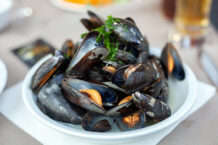
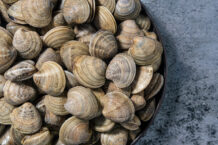
Farmed mollusks, including mussels, oysters, and clams, are also better choices. They eat by filtering out plankton from the water around them. Unlike the large fish, they don’t get fed anything, so that is not an issue. If anything, they’re helping to clean the water of excessive algae that is caused by excess nitrogen pollution from land-farm runoff and lawns.
WL: Given the situation, what should consumers do? Should we not be eating the large fish at all, no matter where they come from?
CS: I don’t really like commands that tell people what they can’t do at all. There’s a huge difference between eating meat twice a day and eating meat once a month, and the same goes for large fish. I would say it’s best to consume them in moderation, whether wild or farmed.
For individual consumers, if you’re going to eat seafood, my recommendations are to choose mostly U.S.-caught or U.S.-produced that are lower on the food chain, like shellfish rather than tuna and swordfish, for example. That’s partly for ecological reasons but also for health reasons. The bigger fish are the ones with the higher concentrations of contaminants, like mercury, that you don’t want to be eating a lot of, if any. And animals lower on the food chain rebuild their numbers in the face of fishing pressure more quickly.
For more specifics about which seafood is considered most (and least) sustainable, check out the seafood guides from Monterey Bay Aquarium. You can search by species and by region to find what they recommend as “best choices” and “good alternatives,” from anchovies to tilapia. Their “Super Green List” is an easy way to cut to the chase—it lists the top 10 seafood options that they’ve deemed to be best for both you and the planet.