If you have high blood pressure, strength training (also called resistance training or weight training) may help lower it, according to an analysis of clinical trials published in the journal Scientific Reports.
It’s well known that exercise can help manage high blood pressure, though much of the research focus has been on aerobic exercise—that brisk walk, bike ride, game of tennis, or other activity that keeps you moving, gets your heart rate up, and works up a sweat. The recent study, from São Paulo State University in Brazil, not only adds to the evidence that strength training can benefit blood pressure, too, but also offers more clarity on some important details: how often you should strength train and how “hard” you should work out.
For the analysis, researchers combed through the medical literature for randomized controlled trials that rigorously tested strength training for lowering blood pressure. They found 14 such trials that included a total of 253 people, mostly in their 60s, with hypertension. Each trial compared the effects of strengthening exercises against some “control” condition—aerobic exercise, for instance. Most of the trials prescribed three weekly strength-training sessions, while a few tested a twice-weekly routine.
When the researchers pooled all of the trial results, they found that after eight to 10 weeks of strength training, participants shaved an average of 10 points from their systolic blood pressure (the top number in a blood pressure reading). Their diastolic pressure (the bottom number) dipped by an average of almost 5 points.
Some of the trials went on for a longer period—up to a year. Overall, the reduction in systolic blood pressure was a bit greater the longer people kept up their strength conditioning routine—about 12 points.
How much is enough?
Based on these findings, you should aim to strength train two to three times a week—a frequency in line with the U.S. government’s Physical Activity Guidelines for Americans. If you’re strapped for time, the good news is that there was no evidence in the study that three sessions a week were better than two for lowering blood pressure.
Then there’s the question of intensity, or how “hard” you should work out. The analysis found that across the trials, the greatest blood pressure improvements came from working with a “load intensity” that was 60 to 70 percent of a person’s one-repetition maximum. The “one-rep max” (or 1RM) is the heaviest weight you can lift, push, or pull just once. So if, for example, the heaviest weight you can manage for one bicep curl is 10 pounds, you’d aim to perform that exercise with 6 to 7 pounds of weight.
However, it’s important to remember that some exercise is better than none. In the trials, participants who strength-trained with lower loads also saw reductions in blood pressure, albeit smaller (about 3 points, systolic).
As a general guideline, the CDC recommends doing eight to 12 repetitions of each strengthening exercise (that bicep curl, for instance); this counts as one set. To gain greater benefits, you should strive for two or three sets for each exercise. That means you need to work with a weight you can manage for that many repetitions, while minimizing the risk of injury and premature fatigue as you exercise.
Why does strength training help lower blood pressure?
All exercise puts demands on the cardiovascular system because your working muscles need more oxygen. During a workout, both your blood pressure and heart rate are likely to rise. But this is transient and not harmful for most people, even those with hypertension. Over time, regular strength training and other types of exercise lead to decreases in blood pressure and resting heart rate.
It’s not clear exactly how strength training lowers resting blood pressure. One hypothesis is that the benefit stems from increased production of nitric oxide. The body churns out this compound to help relax muscles in blood vessels, dilating them and allowing blood to flow with less resistance.
Where to start
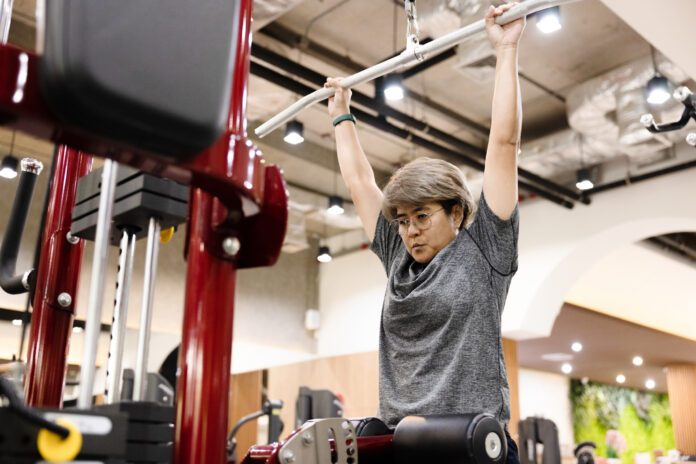
If the idea of strength training seems daunting, keep in mind that this type of exercise does not have to mean heaving barbells or even smaller dumbbells. Rather, it refers to any activity that challenges the muscles to work against a load or resistance. That can mean using weight machines, resistance bands, or hand or ankle weights. Alternatively, your own body weight can act as the resistance (doing squats, for example, or floor or wall push-ups). Even some yoga poses and heavy gardening can count as muscle-strengthening exercise.
Anyone new to strength training should start slowly, with lower weights and fewer repetitions, and work up to the frequency and, if using weights, to the load intensity level described above. If you have not been regularly active, or have poorly controlled high blood pressure or additional health conditions (like arthritis or heart disease), talk to your healthcare provider before starting a new exercise routine.
Once you’re ready to add strength conditioning to your life, the next question might be “what exercises should I do?” If you prefer in-person instruction, you might take some classes at a YMCA/YMHA, health club, or community center, or consider working with a personal trainer who can customize an exercise program for you so you can reach the moderate to vigorous load intensity found to be effective in the study. There are also plenty of free online resources with video demonstrations and verbal instructions on how to safely perform many of the movements. The National Institute on Aging, for instance, offers a series of strength-training videos geared toward older adults.
BOTTOM LINE: The best way to keep your blood pressure in check is to take a holistic view—which means eating healthfully (such as by following the DASH Diet), doing aerobic exercise, maintaining a healthy weight, not smoking, limiting alcohol, finding ways to de-stress, and taking medications as prescribed. Strength training is one more tool you can add to your toolbox.