
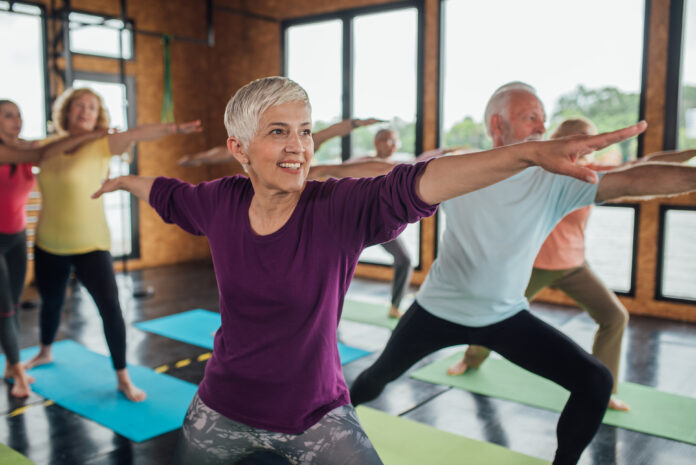
If you’re dealing with the pain of arthritic knees, you might get some relief by practicing yoga—about as much, in fact, as you could expect from conventional strength training, a recent clinical trial suggests.
The study, of 117 adults with knee osteoarthritis (OA), found that a few months of yoga worked as well as leg-strengthening exercises for reducing knee pain. And in some other respects—like improving knee stiffness and mobility—yoga proved a bit better.
That may be welcome news if you’re among the legions suffering from knee OA. Among adults ages 60 and older, around 13 percent of women and 10 percent of men have symptoms of the condition. (It’s also possible to have evidence of knee arthritis on an X-ray but no symptoms.) OA is a form of arthritis that results from a gradual breakdown in the cartilage that cushions a joint. That can eventually create a situation of bone rubbing on bone, leading to pain and stiffness that often worsens over time.
Exercise—best done with a physical therapist to start—has long been recommended as a first-line treatment for knee OA. But there’s less certainty about the types of exercise that bring benefits. Studies show that exercises that strengthen the muscles supporting the knee can help ease pain and get the joint functioning a little better. Accordingly, strength training (as well as aerobic exercise like walking and swimming) gets a “strong” recommendation in the combined treatment guidelines from the American College of Rheumatology (ACR) and Arthritis Foundation (AF).
Those same guidelines also say that yoga is worth a try, but give it a “conditional” recommendation because there is less evidence to support it.
So for the latest study, published in April in JAMA Network Open, researchers decided to directly test yoga against strength training. They recruited adults ages 40 and older with knee OA and randomly assigned them to attend group classes twice a week in either yoga or strength conditioning.
The yoga group practiced with a certified instructor, learning various poses to improve lower-body strength and mobility, with a focus on breathing and healthy joint alignment. The strength training classes were led by a physical therapist and involved squats, calf raises, and other exercises for the leg and hip muscles, sometimes with weights or resistance bands. After three months of classes, both groups switched to all home-based sessions for another three months.
While knee pain improved to a similar degree in both groups by month three, the yoga group also showed a small reduction in depression symptoms. (Such symptoms are fairly common among people with knee arthritis, especially when it interferes with walking and other daily activities.) By month six, the yoga practitioners were also faring modestly better when it came to knee stiffness and tests of walking speed.
The study suggested that there are a few areas where yoga may have a small advantage, although it’s not fully clear why. The classes did include more than physical exercise, incorporating breathing practices, meditation, and relaxation techniques—but the researchers did not speculate on whether those aspects had any bearing on the participants’ mental health gains. The yoga group was also more likely to keep up their home practice versus the strength conditioning group, which might help explain the better results at the six-month mark.
The bottom line, though, is that both types of exercise—strength training and yoga—were generally helpful for study participants. As the ACR/AF guidelines state, there’s not enough evidence to declare any one kind as the best prescription for knee OA. So ultimately, if you have knee arthritis, you could choose the type of physical activity that you enjoy more and, importantly, will stick with for the long haul.
Here are a few pointers for getting started:
- It’s always a good idea to talk with your doctor before jumping into a new physical activity, in part to find out whether there are any types of movement you should avoid because of knee OA. If you’re interested in learning strengthening exercises, your doctor might prescribe physical therapy.
- If you’re drawn to the idea of yoga, be aware that not all forms of yoga are the same: Classes described as “vinyasa” or “flow” typically move quickly and involve getting up and down from the floor repeatedly (and maybe bending yourself like a pretzel), which means they may not be appropriate for someone with knee OA. Yoga classes described as “gentle” or “beginner” are a better bet.
- To find yoga or strength-based exercise classes, you could ask your doctor for recommendations or check with your local community centers, YMCA, or hospitals (which may offer low-cost or free classes). The Arthritis Foundation has resources for finding various exercise programs that are arthritis-friendly. The Yoga Alliance has a directory where you can search for yoga centers in your area. And, if you belong to a gym or fitness center, it may offer classes in both. Just remember the point above; before you go all-in, call the center and ask whether they have classes that are slower-paced and appropriate for someone with knee OA. Another good resource is Silver Sneakers, which has online classes in fitness and yoga, plus a search feature to help you find local in-person classes (which are covered by some Medicare plans).
A final note. There are various ways of managing knee OA, including topical and oral anti-inflammatory pain relievers, heat or cold therapy, weight loss if you’re overweight, and wearing orthotics or a knee brace. Adding exercise to the mix can potentially benefit not only your knees but also your overall physical and mental health.