
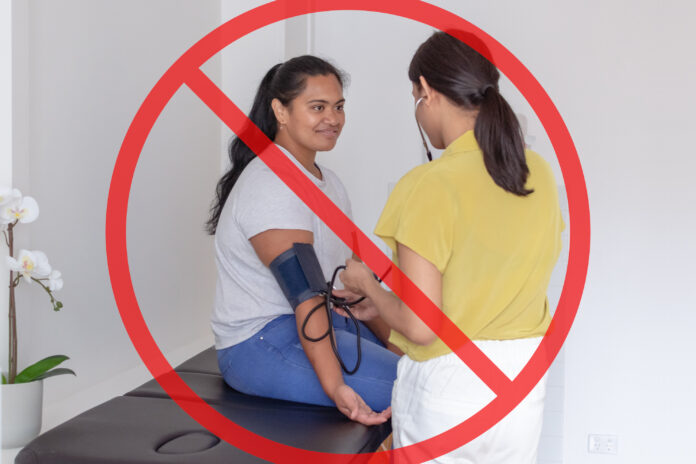
Blood pressure checks may seem simple, but some details need to be right to get an accurate reading. Now a new study shows that simply having your arm in the wrong position could substantially inflate your numbers.
Since high blood pressure generally causes no symptoms, experts recommend regular BP checks to catch the condition. Your doctor should measure your blood pressure at least once a year if your level is within the normal range (below 120/80); people with high blood pressure need more frequent measurements.
Given how routine blood pressure checks are when you go to the doctor, it’s easy to assume they’re being done correctly. But there are specific guidelines to getting an accurate measurement. Among them: Your arm should be resting on a flat surface, with the blood pressure cuff at the level of your heart. The problem is, during a medical appointment, patients are usually sitting on an exam table with no support within reach. So the healthcare provider might have you rest your arm in your lap or leave it hanging by your side.
How much does that matter? A lot, according to the study, published in JAMA Internal Medicine in October.
The study involved 133 adults ages 18 to 80—36 percent with high blood pressure and 41 percent with obesity. Each participant had their blood pressure measured under three different conditions: as recommended, with their arm supported on a desk; with their hand resting in their lap; and with their arm hanging by their side, unsupported.
On average, the lap position overestimated both systolic blood pressure (the top number) and diastolic (the bottom number) by 4 points. The hanging position was worse—overestimating systolic blood pressure by almost 7 points, on average, and diastolic by just over 4 points. Meanwhile, among those with high blood pressure (130 or higher in this study), the hanging arm position caused systolic blood pressure to go up 9 points, on average.
Why is arm position so important? One likely reason, the researchers say, is that when the blood pressure cuff is below the level of the heart, the force of gravity puts more pressure on the arm’s brachial artery, upping the blood pressure reading. Another possibility: When the arm is unsupported, its muscles may contract, which could trigger a temporary blood pressure spike.
In the real world—as opposed to a study setting—those pumped-up BP readings could have serious consequences, the researchers stress. Some people could be mistakenly diagnosed with high blood pressure. Others could end up being “overtreated” for the condition—with medication doses that are higher than necessary, or with an additional blood pressure drug.
In other words, just having your blood pressure checked isn’t enough—it has to be done properly. To that end, here are the how-to guidelines from the American Heart Association (AHA) in its latest Scientific Statement on the subject. Importantly, the same rules apply if you measure your blood pressure at home.
- Beforehand: Don’t exercise, consume caffeine, or smoke in the 30 minutes prior to a BP check (you should never be smoking anyway!). You should also empty your bladder and sit quietly for five minutes before the test is done.
- During: Sit upright with your back supported, with both feet flat on the floor (don’t cross your legs) and your arm in the proper (arm-resting-on-flat-surface) position. At the doctor’s office, this means sitting in a chair next to a table or desk (not on the exam table).
- The blood pressure cuff should be the right size for your arm. For people with larger arms, using a “regular” adult-size cuff can greatly overestimate blood pressure, while using a cuff that’s too big can result in lower readings. According to a 2023 randomized crossover study, “miscuffing resulted in strikingly inaccurate BP measurements.” The AHA offers more information on figuring out cuff size here.
- The cuff should be placed over bare skin, not clothes.
- Do not talk during the five-minute rest period before or during the test.
There’s some early evidence that, at least in healthy adults, measuring blood pressure while standing (with the arm still supported on a table) may be even better at diagnosing high blood pressure than a seated position. But that approach is still under study and not part of current guidelines.
BOTTOM LINE: Details matter during a blood pressure check. If you have any doubts the next time you’re having an in-office measurement—whether you’re in the right position or the cuff size is correct—don’t hesitate to ask questions (or you can take the initiative and assume the correct position yourself). High blood pressure is a major risk factor for heart disease, stroke, kidney disease, and more—and it’s critical to have it diagnosed and accurately tracked.