
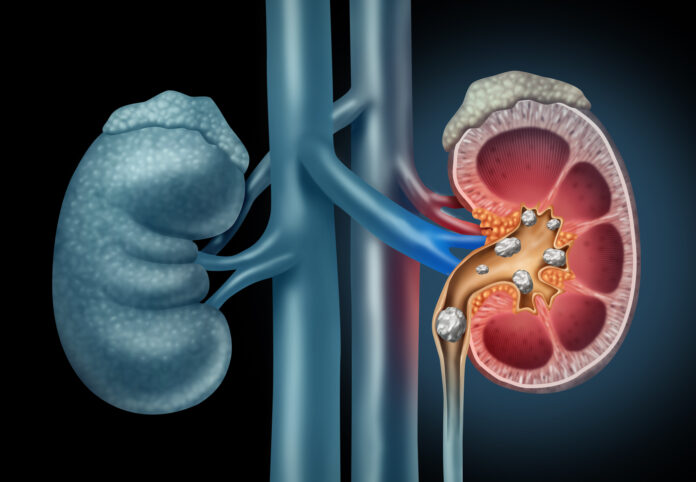
Another reason to limit added sugars, besides that they contribute to weight gain, diabetes, heart disease, and cavities: They may increase the risk of kidney stones, according to a study in Frontiers in Nutrition in August that used data from the National Health and Nutrition Examination Survey (NHANES) spanning 2007 to 2018.
Of the 28,303 adults (mean age, 48) included in the study, those in the top quartile of added sugar consumption (542 calories’ worth a day) were nearly 40 percent more likely to report a kidney stone than those in the lowest quartile (58 calories’ worth of added sugar)—after the researchers controlled for age, gender, race, body mass index, smoking, alcohol intake, total calorie intake, physical activity, medical conditions, and other potential confounding factors. Sugars did not include those found naturally in foods, such as in fruit and milk, but rather those added in processing.
Looking at the data in a different way, the researchers calculated that those who consumed 25 percent or more of their daily calories from added sugars had an 88 percent increased risk of stones compared to those who got less then 5 percent of their calories from added sugar. In a nutshell, the more sugar consumed, the greater the prevalence of kidney stones.
To note, though: The findings can show only an association between sugar and kidney stones, not a causal relationship, because it’s unknown from the study’s design which came first: the sugar intake or the kidney stone.
Kidney stones affect about one in 10 Americans and have a high recurrence rate. How they develop is not fully clear, but diet and lifestyle may play a role. The most common ones are calcium stones—though the study did not elucidate the composition of the stones participants had. Other types are uric acid, struvite, and cystine stones.
It’s not known from the study what a “safe” amount of added sugars is in regard to kidney stones, but participants in the top quartile of intake consumed about 135 grams of added sugar a day—about 34 teaspoons. One 12-ounce can of soda provides about 40 grams of added sugar, or 10 teaspoons. Americans get most of their added sugar from such sugar-sweetened beverages.
Recommended limits for added sugar differ across organizations. The Dietary Guidelines for Americans advise getting no more than 10 percent of daily calories from added sugars. For someone consuming 2,000 total calories a day, that’s no more than 200 calories’ worth of added sugar, or about 12 teaspoons a day.
The American Heart Association has an even lower recommended limit: no more than 9 teaspoons (36 grams, or 150 calories) for men, and no more than 6 teaspoons (25 grams, or 100 calories) for women.
Added sugars go by many names, including white sugar, cane sugar, cane syrup, cane juice, evaporated cane juice, raw sugar, brown sugar, fructose, high-fructose corn syrup, corn syrup solids, dextrose, fruit syrups, honey, maple syrup, molasses, and sorghum syrups. All provide empty calories, even if some sound more healthful than others.
To limit your intake of added sugars, check the Nutrition Facts labels on packaged foods. Better yet, avoid or at least limit packaged foods and beverages (many contain unexpected added sugars and other unhealthful ingredients) in favor of unprocessed ones, such as whole fruits and fresh juices, which provide sweetness from natural sugars that are accompanied by a range of healthful nutrients.