Can I get sick from food that a fly lands on?
Studies have shown that houseflies and blowflies, also known as common green bottle flies, may be carriers of more than 200 different infectious agents. That’s because flies eat and lay their eggs in feces, rotting flesh, and other decaying substances, where they come into contact with a variety of pathogens (disease-causing microorganisms). These pathogens stick to different body parts of flies as they feed and reproduce. Frequent back-and-forth travel between the waste in which flies thrive and environments where humans spend time enables them to potentially transmit disease.
Besides carrying pathogens on their bodies, flies are known to feed by regurgitating enzymes from their bodies onto food. The enzymes break down the food into a liquid that the fly slurps up. As a result, any pathogens inside the fly can end up on your food.
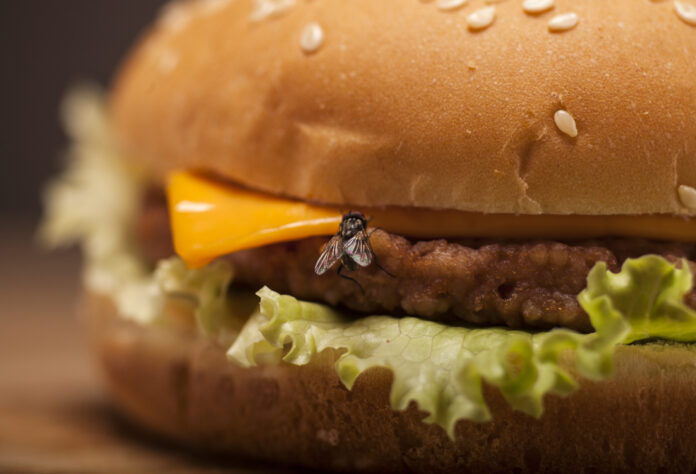
By now, you might understandably conclude that a fly landing on your food might be a good reason to toss it—but that’s not necessarily true. While researchers can prove that flies carry pathogens that could pose a health threat, most of them stop short of saying conclusively that flies can transmit diseases to healthy people. That’s because there’s no hard evidence that flies transmit pathogens through food that people consume.
On the other hand, some researchers hypothesize that a growing fly population could be associated with equally increasing bouts of diarrhea. So the risk of infection from microbes on food that are transmitted by one fly is low—although if a swarm of flies is crawling on your food, you certainly shouldn’t eat it.
And, if you’re immunocompromised for any reason, you might want to err on the side of caution and pass on any food that flies have landed on, especially if the insects have been hanging out there for a while.