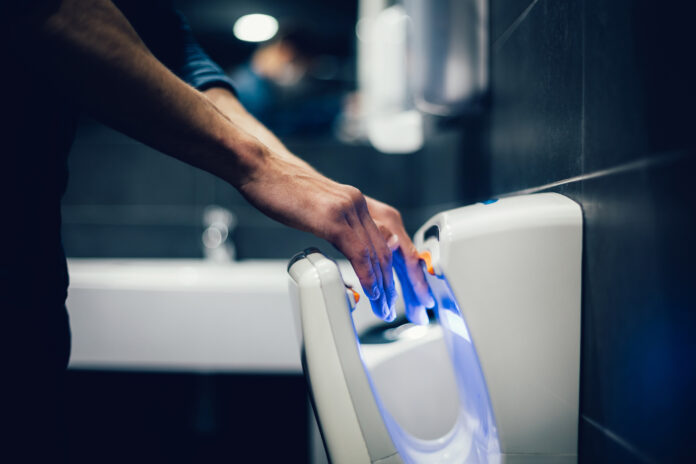
I’ve noticed that some public bathrooms now have hand dryers with cool blue lights. Are they more hygienic than regular hand dryers or even simple paper towels?
The blue light itself doesn’t have any hygienic properties, but other features of these new-generation hand dryers, if present, might—at least in theory. Since the Covid-19 pandemic, the cleaning industry has gotten on board with hand dryers in public restrooms that have HEPA filters and sometimes UV-C (ultraviolet-C) light, with blue LED lights on some of them just indicating the target area that’s being dried. That is, as some in the industry point out, the blue light isn’t killing germs but rather is just for show so you can see where the airflow is directed. It’s not UV-C light, because all UV is invisible. (UV-C is the shortest wavelength and highest energy portion of the UV light spectrum.)
So, given that the blue light isn’t doing anything, what about the UV-C, if present? According to Jim Malley, Ph.D., a professor of civil and environmental engineering at the University of New Hampshire who has been studying UV light for some 30 years, UV-C does have benefits. Overall, he says, “the right UV-C dose can act as a disinfectant. It damages DNA and RNA, preventing the organism from reproducing and infecting.” And there’s good evidence in recent studies that UV-C, in particular, can deactivate coronaviruses. But, according to Dr. Malley, the UV-C dose delivered by most small consumer UV devices, including one hand dryer his research team tested, is far too low to inactivate a significant amount of coronaviruses or other pathogens under normal usage.
Moreover, even if the dose is high enough, the UV-C in a hand dryer is not directly disinfecting your hands, says Dr. Malley. Direct treatment of the skin with UV is not allowed in the U.S. because it causes skin redness and skin damage. Thus, the machines are not shining any UV-C directly onto your hands. And while it’s well established that HEPA filters remove contaminants from air, their benefit in hand dryers is still theoretical.
At best, these machines may be filtering the bathroom air of viruses, bacteria, and fungi, so that fewer of them blow on your hands, but they are not directly destroying any germs on your hands. That is, they are sort of pre-treating the air inside the machine that then blows onto your hands. Says Dr. Malley, “What’s coming out on your hands has been filtered, and maybe treated with UV-C. That’s how these dryers work. The claims that go beyond that are mostly sales nonsense—and until there’s an independent third-party process or a regulatory agency that decides to do something besides register these hand dryers, the marketplace will remain the Wild West for claims.”
In fact, some of the claims on hand dryer websites about how the UV-C is supposedly working are nebulous and even ludicrous, including one company that vaguely advertises “100% sterilization.”
We found no published studies comparing these new hand dryers to conventional ones, so we do not know whether they do anything more. And studies comparing conventional hand dryers to plain old paper towels have not come to definitive conclusions because of the great variability in methodologies and conflicting findings. One study from over 20 years ago—which tested four different drying methods (using an electric dryer, using a cloth towel from a dispenser, using paper towels stacked beside the sink, or just letting hands dry naturally)—found no significant differences in bacteria counts on hands. And a 2021 critical review of 23 studies comparing electric hand dryers to paper towels concluded that “the breadth of scientific data does not support a uniform conclusion as to which drying method is safer or more hygienic.”
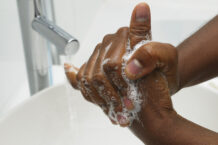
BOTTOM LINE: So, what should you do when it comes time to wash and dry your hands in a public bathroom? It’s pretty simple: First, just use soap and running water to wash up (scrubbing for at least 20 seconds, as the CDC recommends) and then dry your hands with whatever is available, making sure they are fully dry (germs transfer more easily to and from wet hands).