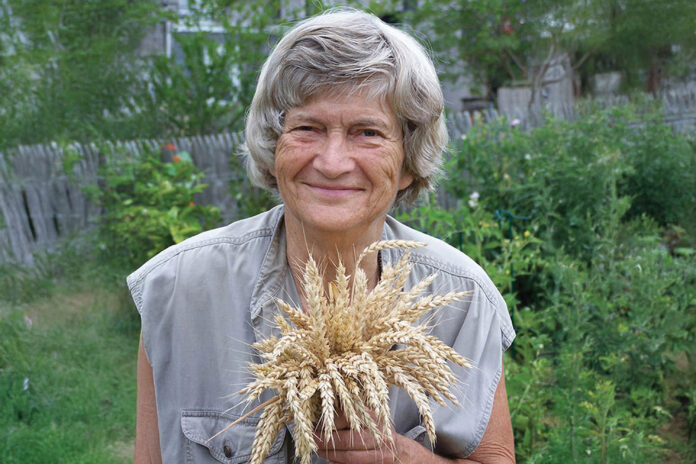
Before there was Michael Pollan, there was Joan Gussow—writing, teaching, and sounding the alarm about the industrial food system as early as the 1970s, three decades before The Omnivore’s Dilemma brought those ideas into the mainstream. She was making connections between food, public health, politics, ethics, and the environment at a time when few in academia—or the public—were paying attention. You likely have never heard of her, however.
Joan, the Mary Swartz Rose Professor Emerita of Nutrition and Education at Teachers College (TC), Columbia University, passed away this past March at the age of 96 at her beloved home in Piermont, New York. As an educator, author, nutritionist, public health advocate, food policy expert, and avid gardener, her work laid the foundation for the “farm-to-table” sustainable food movement that so many have since joined. But what makes her legacy personal to me is that I was lucky enough to have her as a professor and mentor as I earned my graduate degree in nutrition education at TC back in the 1990s.
Joan didn’t arrive at TC as a conventional academic. After working in publishing and raising a family, she received her doctorate in nutrition education in 1975, when she was in her late 40s, and eventually became chair of the graduate nutrition program. She taught nutrition, but not the kind that focused on micronutrients, calorie counts, and food pyramids. Her classroom was where science met ethics, where food was never just food.
More than her academic credentials, it was her convictions and moral clarity that made her a force. She questioned the food industry at a time when few thought or dared to, writing and speaking out about its growing adverse influence on children’s health. Her 1972 testimony before Congress on the perils of TV junk food advertising (“from Bugles to Funyuns, from Onyums to Screaming Yellow Zonkers”) got widespread attention and helped establish her as an authority on food policy.
In her legendary class Nutritional Ecology, Joan made those connections even more immediate. One early assignment was to track what we ate for a week and then try to trace where the foods came from and what the journey meant in terms of social, political, and environmental impacts: Were they locally and seasonally sourced—or produced in another state or country? How far did they travel? Who grew them, and did the farmers receive a fair living wage? What resources were used in producing them? Were they grown organically or with petroleum-based pesticides? Were they processed and excessively packaged? It wasn’t just a food journal we kept; it was an exercise in awareness that made me realize just how disconnected I was from the origins of the foods I had been so casually consuming.
Our rigorous reading list—which included Joan’s landmark 1978 book The Feeding Web—deepened that awareness. We learned about the global food trade and how something as commonplace as an avocado, a banana, a piece of chocolate, or a cup of coffee had far-ranging environmental, economic, and political trade-offs. Food decisions are never neutral—they affect soil, water, labor, biodiversity, and climate.
It was in Joan’s class that I also first learned something so fundamental: that food insecurity, hunger, and even famine are not usually related to agricultural failure and lack of food. Rather, they are more often the result of political and economic forces—war, poverty, corruption, inequity—that prevent food from reaching those in need.
The class involved some memorable—and stinky—pre-dawn trips, too. One was to the gritty Fulton Fish Market in lower Manhattan, so we could get a whiff of the vast wholesale seafood distribution system. Another was to Fresh Kills in Staten Island, which at the time was the world’s largest landfill, so we could see (and smell) exactly where our trash ended up.
Joan also taught us to scrutinize food labels carefully. She was skeptical of terms like “natural” and “organic” when they were used for marketing rather than as meaningful guidance. “Organic” Twinkies—really?
And she urged us to support local farms not just for freshness and taste, but to reduce dependency on fossil fuels, preserve biodiversity, keep farmland from being turned into strip malls, and provide financially for the farmers. Eating seasonally was not about being trendy—it was about aligning with the natural cycles of where we live, rather than trying to make nature cater to our appetites. In its strictest sense, that meant forgoing foods that don’t grow locally—including tropical fruits (like mangos and bananas), Brazil nuts, and coffee. Imagine that.
Joan planted seeds—literally and figuratively—that continue to grow in the work of those she mentored. Today, her ideas and influence are everywhere, in farm-to-table restaurants, in school gardens, in climate-aware food policy, in the growing movement for food sovereignty.
For me, her influence helped reshape how I live day to day. Because of her, I ask where my food comes from. I think about the hands that grew it, the soil it came from, and the systems that shaped its path to my table. I try to tread more lightly (Do I really need to put my veggies in a plastic bag at the supermarket? Do I need to buy a single-use bottle of water?). I try to speak up more often and write about these issues. I try to make choices that reflect the kind of food system—and the kind of world—I want to live in.
Today, as food systems face unprecedented challenges—from climate change to corporate consolidation to growing inequality—Joan’s legacy feels more vital than ever. She was ahead of her time, speaking out decades ago about issues that have only recently gained widespread attention. Her work reminds us that sustainability is not just about protecting resources but about honoring the deep connections between people, land, and culture. Joan, you will be remembered well.
There’s so much else to learn from Joan. To see clips of some of her talks and interviews, click here and here.