If you’re a driver, accustomed to all the safety features of today’s cars, it may be difficult to imagine a time when car occupants hurtled down highways without so much as a seatbelt for protection. Needless to say, modern cars are far safer than their counterparts of decades ago.
Unfortunately, when it comes to pedestrian safety, we’re moving backwards as a nation—and have been for over a decade.
Recent figures from the Governors Highway Safety Association (GHSA) paint a stark picture: In 2022, more than 7,500 U.S. pedestrians were struck and killed by a vehicle—the most in four decades. That fact alone is troubling, but it becomes even more so when you zoom out to see the bigger picture: Before 2010, pedestrian deaths had been reliably falling since 1980. Since 2010, however, pedestrian deaths have risen by 77 percent, wiping out all of the progress from prior decades.
So what happened in 2010 and beyond? Many things, but you might have one answer in mind now. The ubiquity of smartphones has been cited as a culprit, since the devices are a major cause of “distracted driving.” The federal government estimates that in 2021, distracted driving contributed to 8 percent of all U.S. traffic deaths.
It should be noted, though, that drivers aren’t the only ones vulnerable to distraction. How often do you find yourself caught up in your phone while walking down the street, standing at an intersection, or even crossing the street? I can admit it’s happened to me more than once. Venturing into a crosswalk immersed in a text could be disastrous.
Smartphones are far from the whole story, however. Americans’ love of big vehicles is likely playing a role, too. A study last year by the Insurance Institute for Highway Safety analyzed data on almost 18,000 crashes involving a single car and a pedestrian. It found that “tall” vehicles (hood heights more than 40 inches off the ground) were 45 percent more likely to cause pedestrian deaths, versus traditional cars with low, sloping hoods.
Those big vehicles may make occupants feel safer, but they pose two major hazards for pedestrians: Tall hoods obscure the driver’s view of people close to the vehicle, and when a pedestrian is struck, the injuries tend to be more severe.
In the GHSA report, passenger cars were involved in 35 percent of pedestrian deaths in 2021, while SUVs and pickup trucks were involved in 40 percent. In a telling statistic, deaths involving an SUV have more than doubled since 2012, while the number involving a passenger car has risen at a much slower rate (26 percent).
Not surprisingly, speeding and alcohol impairment (among both drivers and pedestrians) are also involved in many of these tragic deaths. While those dangerous behaviors have long been an issue, the GHSA report shows that the situation worsened after the start of the pandemic. The group points to a drop in traffic enforcement since 2020 as a factor.
There are many things that can be done to make our streets less hazardous for pedestrians. Local communities can, in addition to enforcing traffic laws, make their streets more walkable—with adequate sidewalks and better lighting and clear markings at crosswalks (as most pedestrian deaths happen after dark). Federal regulators could take steps to ensure that new vehicles are safer not only for occupants, but for pedestrians, too.
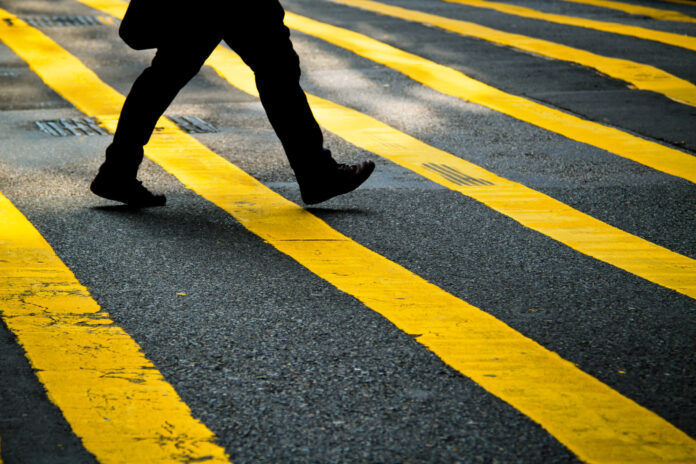
Individuals can do their part, as well: As a pedestrian, cross at designated crosswalks and always with the light, if there is one. Look both ways before crossing a street, and stay alert for vehicles and bicycles until you’ve made it to the other side. Try to make eye contact with drivers when entering an intersection, to make sure they see you (and maybe even wave at them). Watch for vehicles exiting driveways and parking garages. At night, if streets are not sufficiently lit, wear light-colored or reflective clothing; have a flashlight handy. As a driver, stay within the speed limit, and never drive when you’re inebriated (same goes for walking unless a sober companion is with you). And, of course, put your phone away when driving or crossing the street—something I’ve disciplined myself to do.
In general, keeping your eyes and ears open, whether you’re a driver or on foot, can go a long way in curbing thousands of needless deaths.