Recently a study came out that reported some encouraging news for older adults who have cataracts: Undergoing cataract surgery may not only improve your vision but also possibly reduce the risk of suffering a bone fracture.
Cataracts are a “clouding” of the eye’s natural lens, and they are exceedingly common: If you live to the age of 80, you have more than a 50/50 chance of developing a cataract in one or both eyes. Cataracts can make your surroundings look blurry, hazy, and less colorful, and make it harder to see at night or in low light. Research shows that cataracts (and other age-related vision problems) can also increase your vulnerability to falls—a leading cause of bone fractures in older adults.
So it makes sense that cataract surgery would help prevent some falls and fractures. However, the evidence has been mixed as to whether that’s true. The recent findings, which were published in the journal Ophthalmology, strengthen the case.
Researchers pooled the results of 16 independent studies conducted since 1989; altogether they involved over 4.7 million older adults with and without cataracts. This type of research design (called a meta-analysis) can be helpful when individual studies on a given subject have come to conflicting conclusions. Combining the data can give a more statistically powerful result and help identify reasons for inconsistencies among studies.
In this case, the researchers found that older adults with cataracts were about 50 percent more likely overall to suffer a broken bone over an average of 4.5 years. But among people with cataracts, those who underwent surgery were 27 percent less likely to sustain a fracture.
The study caught my eye, so to speak, because I’m one of the millions of Americans who has ever been diagnosed with cataracts—in both eyes in my case. To be sure, surgery is not always necessary. I was diagnosed with cataracts in both eyes about 15 years ago, and for most of that time they caused no problems with my vision.
That changed about a year ago, when I began to have some difficulty seeing at night and needed more light when reading. My ophthalmologist gave me a new glasses prescription and assured me that if and when the time came for cataract surgery, I’d know it. She was right. At first, my new glasses did the trick, but before long I realized my vision was growing appreciably worse. Street signs were hard to read, nighttime driving was becoming difficult, and even the closed captions on my TV were tough to follow. I knew it was time.
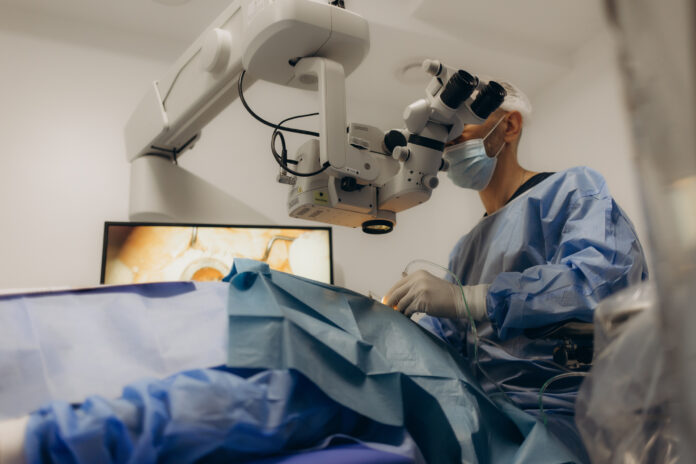
During cataract surgery, an ophthalmologist removes the natural lens from your eye and replaces it with an artificial one. The procedure is one of the most routine surgeries we have, with close to 4 million performed each year in the U.S. alone. And it has a high success rate: nine out of 10 people who undergo the procedure see better afterward, according to the National Eye Institute.
My father was one of the success stories. He had cataract surgery 25 years ago, at the same age as I am now. After his surgery, I recall him saying that, for the first time in decades, he felt younger. I am happy to report that I’ve had a similar experience. The world is brighter, colors are more vibrant, and images are crisper. Nighttime driving is much easier because the glare is gone and street signs look sharp again.
The surgery is not without risks and potential downsides. It is surgery, so there can be complications such as infection, bleeding, or discomfort. Some people have visual issues afterward, like seeing halos or dark shadows, and eye dryness is very common. For me, the only “con” has been that I now need glasses for reading (I never had farsightedness before). But I consider that a small price to pay for the improvements I’ve seen.
And like the bone fracture study suggests, clear vision may come with important health bonuses. Other studies have found, for example, that people report improved quality of life and better mental and emotional well-being after undergoing cataract surgery.
I am, of course, not trying to sell anyone on having the procedure. Cataract surgery is almost always elective, and the decision is up to you and your ophthalmologist. I simply want to share what I’ve experienced, in the hopes that it’s helpful to some of our readers. Sometimes you don’t realize how much you’ve lost, visually speaking, until you see clearly again. If your world is looking blurrier or a little duller than it used to, it might be worth a trip to your ophthalmologist.