Imagine if, any time you indulged in a piece of cake or a bowl of chips, you could know what those carbs were doing to your blood sugar levels in real time. Would you welcome the insight, feel guilt-ridden over your momentary weakness, or shrug it off?
It’s not an academic question. As of 2024, anyone can buy over-the-counter, wearable “biosensors” that will let them know, with a glance at a smartphone app, what their glucose (blood sugar) levels are up to—or down to—24 hours a day. The products, including Dexcom’s Stelo and Abbott’s Lingo, are being marketed as “wellness” tools for anyone who wants to improve their health.
Needless to say, that’s a pretty wide net—too wide, perhaps. We still have a lot to learn about the value of blood sugar monitoring for people who don’t have diabetes. It might do little for their health or, worse, encourage obsessive monitoring and needless anxiety.
The new OTC biosensors are versions of devices known as continuous glucose monitors (CGMs), which have been available for years (by prescription only) for people who have diabetes and take insulin injections to treat it. That includes people with type 1 diabetes, an autoimmune disease, and some with type 2 diabetes (the far more common form of the disease).
For them, CGMs are a game changer: People with insulin-dependent diabetes have to regularly check their blood sugar levels in order to adjust their insulin doses and keep their sugar levels within a healthy range. Back in the day, the only way to do that was with finger sticks to get a blood sample. CGMs free people from those painful sticks and alert them if their sugar levels are dropping dangerously low or soaring too high—situations where the devices can be life-saving.
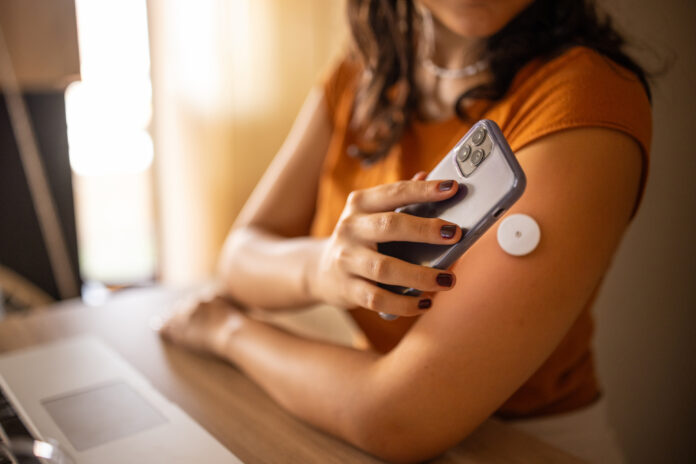
The OTC products, in contrast, are explicitly not for people who use insulin (they don’t feature alerts). Instead, they’re designed for adults who have diabetes (or “prediabetes”) and don’t need to use insulin, or for anyone who’s interested in tracking their blood sugar levels. Users attach a small biosensor, which contains a thin needle, to the back of the upper arm, and the sensor continuously streams blood sugar data to a smartphone app. (Technically, the sensors estimate blood sugar levels based on the amount of glucose circulating in the fluid around body cells, not in the blood itself.)
The idea is to provide personalized information about how blood sugar levels respond to different foods, physical activity, and even daily stressors, in both the short and longer terms. In theory, that could help someone make better choices throughout the day—perhaps passing on a sugary treat in favor of doing some squats.
That’s the theory, and the marketing message, anyway. Here’s the major caveat: We don’t know yet how to best use these products, or whether they actually fulfill their long-term (and vague) promises of improved health.
To be clear, there are some people who might find OTC biosensors useful. If you have prediabetes or type 2 diabetes and don’t qualify for a prescription CGM, you might talk to your doctor about whether an OTC version could help you get your blood sugar under better control. Remember, though, that biosensors are not directly measuring glucose levels in the blood—and are generally not as accurate as traditional finger sticks.
Another point to keep in mind: OTC means paying out-of-pocket: A single biosensor lasts for about two weeks before it needs to be replaced. For a one-month supply, the cost is $89 to $99, though small discounts are offered if you opt for a longer subscription.
If you do not have diabetes or prediabetes, we just don’t know whether there’s any benefit to having a steady stream of glucose readings at your fingertips. What do you do with that information? Blood sugar levels naturally spike after you eat, and it’s hard for the average person to interpret what those fluctuations mean. Some people might end up swearing off perfectly healthy foods simply because they don’t like what they (briefly) do to their blood sugar readings. This is a particular concern for people who already have anxieties around diet or body weight—the very individuals who might be drawn to using these devices.
More broadly, it’s also important to consider how much “data” you really want in your life. More is not necessarily better. Are you already using your phone to track your daily step count, or how many calories you’re burning? If you were to add blood sugar readings, do you think that would motivate you to move more or eat differently? Or would it start to become overwhelming?
I think that in time, we’ll learn more about whether and how these new products can fit into a healthy lifestyle. For now, most of us would be better served by the old-fashioned approach: See your doctor for routine checkups (which include blood sugar screening), get some exercise every day, eat plenty of vegetables, and save the cake and chips for an occasional treat.