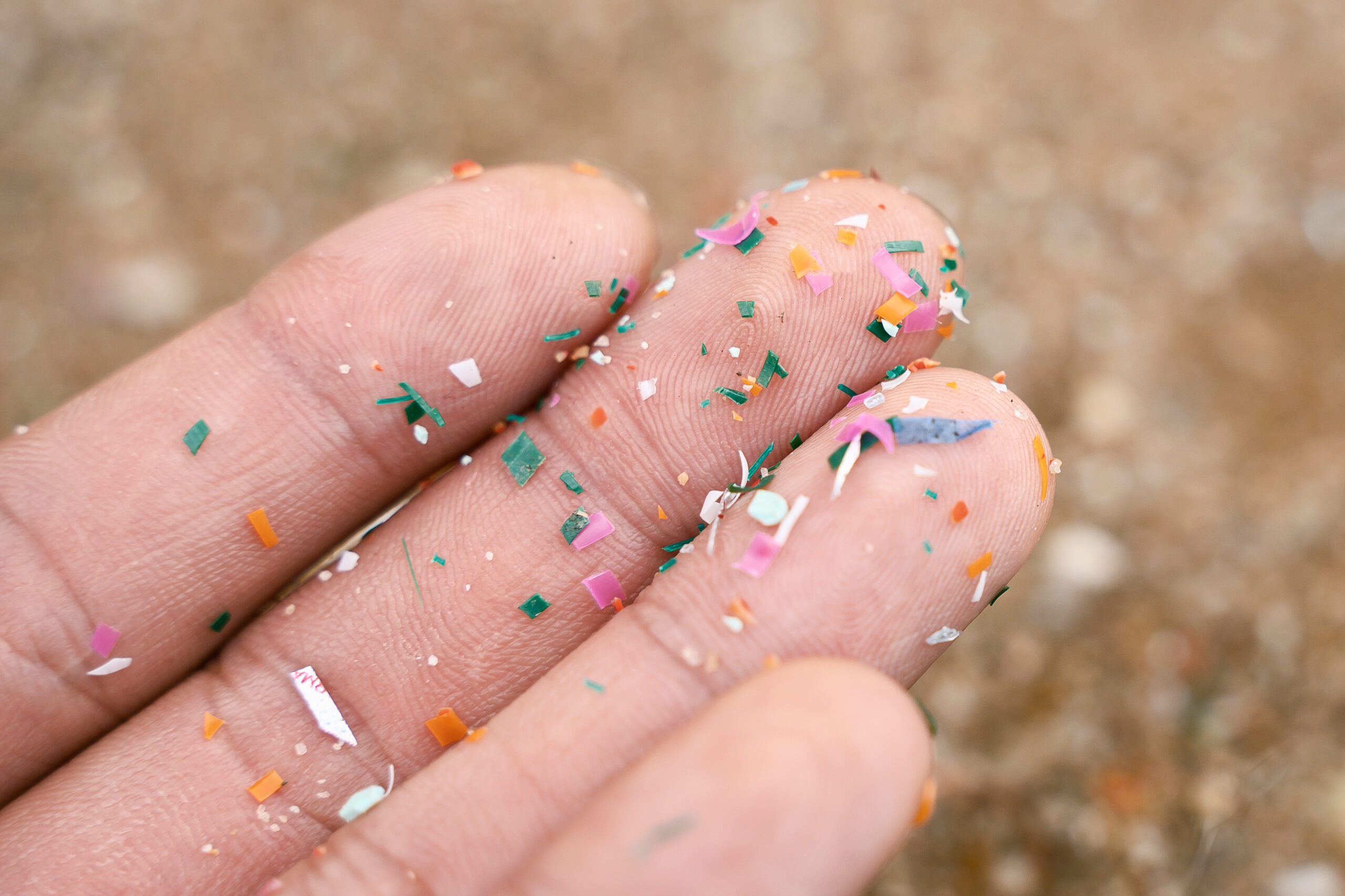
As the name suggests, microplastics are tiny pieces of plastic waste, which can be found almost anywhere. They’re less than five millimeters long (about a quarter of an inch), and they can even be smaller than the width of a human hair. Nanoplastics, another category, are even smaller particles. Primary microplastics are intentionally manufactured at these sizes, often as pellets for manufacturing or microbeads for personal care products or cleansers. Secondary microplastics are created from the breakdown of larger pieces of plastic, such as tires, packaging, textiles, and surfaces used in athletic fields and playgrounds.
Microplastics have been found in rivers, lakes, and oceans; in our food supply, including shellfish; and in the snow of the Alps and the sands of Hawaii. They’re in the water we drink and the air we breathe. Interestingly, although people are often concerned about microplastics in our water supply, between 4 and 23 times more are released to the land every year than into the water, according to a 2023 University of California report. Microplastics can also absorb or pick up toxins, which can be released when they enter our organs or bloodstream.
So, clearly, microplastics are ubiquitous. But are they actually harmful? The short answer: quite possibly.
“Research is still fairly preliminary, but the evidence is clear that microplastics are contaminating our bodies and are found in our brains, lungs, testes, and in the placenta,” says Tracey J. Woodruff, PhD, MPH, director of the Program on Reproductive Health and the Environment at UC San Francisco and the UCSF Environmental Research and Translation for Health (EaRTH) Center. “We have recently completed a systematic review and found evidence linking microplastics to cancer in the digestive tract and that they can adversely affect reproductive (by damaging sperm) and respiratory health.”
Microplastics can affect other parts of the body too. A 2024 study in the New England Journal of Medicine, conducted at three hospitals in Italy, investigated the presence of microplastics and nanoplastics in 257 people. All participants had a carotid endarterectomy (a procedure that removes plaque in the arteries in the neck, intended to reduce the risk of stroke). Nearly 60 percent of the participants were found to have polyethylene (a microplastic) in their carotid artery plaque, and 12 percent had measurable levels of polyvinyl chloride. At follow-up 34 months later, participants with micro- or nanoplastics in their carotid artery plaque were 4.5 times more likely to have a heart attack or stroke or to die than those without these substances in their plaque.
The researchers point out that their findings support data from observational studies that people who are exposed to plastics-related pollution are at greater risk for heart disease, but they also say that their own data do not prove that microplastics cause heart disease—other exposures or health behaviors may be involved.
Microplastics may have the potential to impact the bladder as well. A 2024 review article in the Journal of Exposure Science & Environmental Epidemiology looked at six studies that investigated microplastics and nanoplastics in the urinary tract of humans. Kidney, urine, and bladder cancer samples all showed evidence of microplastics. Twelve additional studies evaluated suggested that micro- and nanoplastics might damage or kill cells, increase inflammation, and alter cell-signaling pathways.
While preliminary, these results run counter to a World Health Organization (WHO) report that concluded that “there is currently no evidence to suggest a human health risk from microplastic-associated biofilms in drinking water.”
Another study in 2024, published in PLoS One, looked at both raw and treated wastewater at a treatment plant in Norway. The researchers found that foodborne pathogens—like salmonella, E. coli, and listeria—can bond to microplastics in the water, forming colonies in a sticky biofilm (called plastispheres). Although most pathogens are killed off during wastewater treatment, plastispheres give pathogens the ability to survive the process intact. These pathogens then have the potential to cause illness if the treated water is used for crop irrigation or drinking water.
Move over, microplastics
While it isn’t a realistic goal to completely eliminate all microplastics—“it’s tough to avoid what you can’t see,” Dr. Woodruff points out—it’s certainly possible to minimize your exposure. She recommends reducing the use of plastic in all walks of life, but especially single-use plastics. Dr. Woodruff and her team helped prepare a report for the California legislature on the health impacts of microplastics and strategies to mitigate exposure to them. You can find their recommendations at Toxic Matters. They recommend avoiding synthetic clothing (like polyester, nylon, and fleece), since they can shed microplastics. Dishwasher and laundry pods, which are known to shed microplastics into the water supply, are also best avoided.
Here are a few more easy ways to reduce microplastics in your everyday life:
- Store and heat food in glass containers. Plastic containers are convenient and easy—especially takeout packaging—but try not to store food in them, and don’t use them in the microwave. Heating plastic can accelerate the leaching of microplastics and chemicals into the food. Glass is a safer choice for both storing and heating food (as long as it specifies that it’s safe for oven and microwave use—check the bottom or the manufacturer information). Many glass containers come with plastic lids, which are fine to use, but take them off to reheat food. If you’re not using a container at all, aluminum foil is a better choice than plastic wrap for storing food.
- Handwash plastic items. Getting rid of all plastic items in your household probably isn’t practical—especially if you have children. But you can reduce the microplastics released from them by washing by hand instead of using a dishwasher. A 2023 study in Environmental Science and Pollution Research found that washing a plastic lunch box in a dishwasher exposed it to higher temperatures and longer washing times, which caused the release of microplastics. The abrasion caused by the water pressure inside a dishwasher can also break down plastic more quickly.
- Move away from plastic water bottles. Beverage containers are an easy place to transition away from plastic, and with good reason: A 2024 study partly funded by the National Institutes of Health used imaging techniques to look at three popular brands of bottled water. Researchers found that they contained approximately 240,000 tiny pieces of plastic (90 percent of which were nanoplastics). And just the act of opening the plastic cap can release 500 microplastic particles, according to a small 2021 study in the Journal of Water & Health. Glass and stainless-steel reusable water bottles are readily available and are a much better option.
- Use a water filter. Tap water typically contains far fewer microplastics than water in plastic bottles—but not none. A large 2017 investigative report found that 94 percent of tap water samples collected throughout the United States contained microplastics, compared with 72 percent in Europe. When choosing a pitcher or a filter that mounts to your faucet or under the sink, look for one that is certified by the National Sanitation Foundation to reduce microplastics.
- Dust and vacuum often. House dust is a mix of many things: soil, cloth fibers, hair, pollen, allergens, microorganisms, pet dander and fur, skin particles, cooking and home heating residue, to name just a few. It also contains microplastics, which can be inhaled. A 2022 German review article points to several studies worldwide showing high concentrations of microplastics in house dust samples and sporting areas, such as athletic fields with artificial turf. There’s not much you can do about exposure outside your home, but you can minimize your risk at home with regular dusting and vacuuming of both hard and soft surfaces. Make sure your vacuum has a HEPA filter.
BOTTOM LINE: “Plastics are a growing concern globally, and, given the impact to our health and the planet, they are an urgent problem we need to address,” says Dr. Woodruff. Obsessing over removing every bit of plastic from your life probably isn’t helpful—or even realistic—but following these tips to reduce your exposure wherever possible can certainly help lower the amount of microplastics that you consume and release into the environment.