
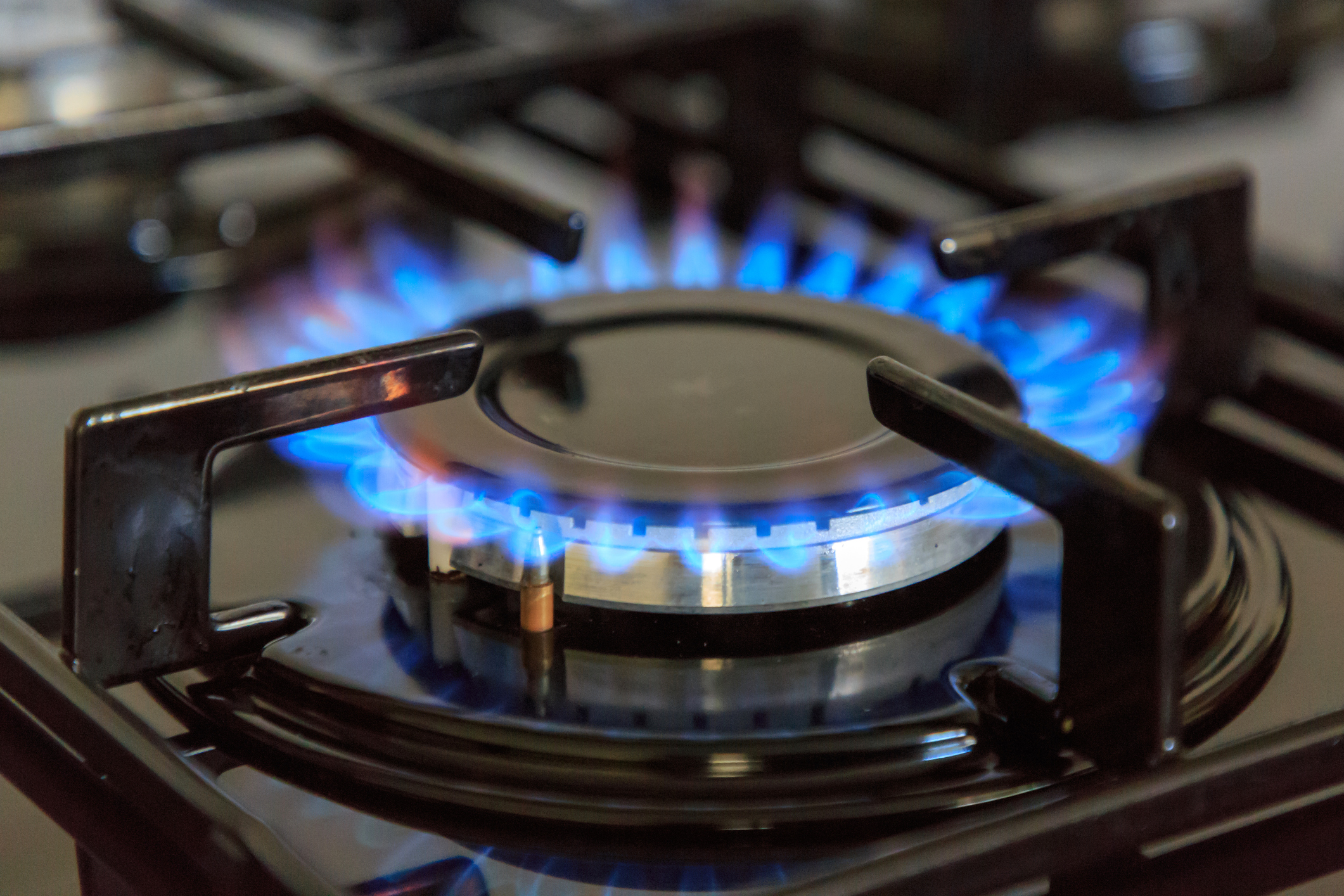
Many home cooks, like their professional chef counterparts, prefer a gas stove to a conventional electric one. These stoves are used in 38 percent of American households, according to the U.S. Energy Information Administration. Fast heating, quick temperature adjustments, and the ability to visually gauge heat levels via a real flame are all cited as reasons for the preference. But where there’s a flame, something is being burned—hopefully not your food, but natural gas, which releases a slew of pollutants that can be harmful to your health.
Why are gas stoves a concern?
Gas stoves tie into a natural gas line coming into your home or apartment building and run that gas to a series of burners. When a burner is turned on, the gas valve is opened, and the ignition switch lights a flame. As happens any time a fossil fuel is burned, pollutants like nitrogen oxide (NO), nitrogen dioxide (NO2), and carbon monoxide (CO) enter the air. In fact, gas burners release so much nitrogen dioxide that levels inside homes can exceed health-based, outdoor air quality standards when kitchen ventilation is not used. (Electric burners in general are less polluting.)
Other combustion pollutants from gas stoves include acrolein (a powerful irritant), polynuclear aromatic hydrocarbons, and ultrafine particles that can pass through defenses in our lungs into the bloodstream where other organs can be affected.
According to the American Lung Association, exposure to these pollutants can contribute to diseases including heart disease, stroke, asthma, chronic obstructive pulmonary disease (COPD), lung cancer, type 2 diabetes, premature birth, and an increased risk of respiratory infection.
The hazards are highest for people who spend the most time cooking, including workers in restaurants, and for those with health conditions such as asthma and COPD that make them particularly sensitive to air pollutant exposures. As with many illnesses, children, pregnant people, and those with lung disease are most likely to experience ill effects.
We often spend time near gas-burning cars and grills, but there’s a simple reason that gas stoves have the potential to cause more harm. The late Kirk Smith, PhD, MPH—who was a professor of global environmental health in the School of Public Health at UC Berkeley, a Nobel Prize recipient, and a member of the Wellness Letter editorial board—once cited what he called “the rule of 1,000.” This means that pollutants released indoors, including from gas stoves, are 1,000 times more important in causing human exposure than the same pollutants outdoors.
One of the most commonly cited studies to date, from early 2023, found that nearly 13 percent of childhood asthma cases in the U.S. could be attributed to use of gas stoves in the home. The study analyzed data from the 2019 American Housing Survey, which included statistics on gas stove use in nine states.
As one New York City working group put it, “Burning fossil fuels in residential buildings for cooking and heating is a significant source of pollution that contributes to climate change and negatively affects human health. Gas burning stoves are a main contributor to poor indoor air quality.”
Why are gas stoves still being sold?
Despite the potential for harm, gas stoves are still present in many homes, and you can still buy them in stores. Why haven’t they been banned? The answer has to do with another harmful product that is still available for sale by consumers: cigarettes. In fact, the ways the natural gas industry went about trying to convince the public that its product was safe are being referred to as “tobacco tactics.”
Just as tobacco companies did in the 1950s, the American Gas Association (AGA, representing the natural gas utilities) embarked on a “long-range information program” in the 1970s—even using one of the same public relations firms that had helped the tobacco industry. The goal was to show that gas stoves were as safe as electric. AGA funded research that seemed to find no evidence of harm from gas stoves. It pointed to alleged design flaws in the research and areas of uncertainty in impartial research studies in an effort to say that the science on this topic is unclear.
Health organizations are not convinced by AGA’s research. In a 2022 policy statement, the American Public Health Association called gas stoves “a public health concern,” and the American Medical Association “recognizes the association between the use of gas stoves, indoor nitrogen dioxide levels, and asthma.”
But many consumers and lawmakers did buy into AGA’s distortion of the data. The group successfully used its industry-backed research to promote the sale of gas stoves, as well as to combat the efforts of policymakers to regulate the sale of new gas appliances.
Although the gas industry may have dodged a bullet so far on the potential health risks its stoves may cause, the current concern over the role that natural gas emissions play in climate change may be harder to evade. The U.S. has set a goal of net-zero emissions across all economy sectors by 2050 (meaning that anything that pollutes the planet must be offset by something that reduces pollution). Politicians looking to ban fossil fuels for their climate-change effects see the health risks of gas stoves as an easy way to strengthen their argument.
Some local governments in California and New York State have already banned the installation of gas appliances in new construction. But in January 2023, the U.S. Consumer Product Safety Commission (CPSC)—which has the authority to enact safety regulations or ban products that don’t meet public safety standards—clarified its position to say that no one is proposing seizing gas stoves that are being used in homes now, and the group is not considering a ban or new regulations on new gas stoves. Rather, they are offering up to an $840 rebate for some households that switch from gas to electric, as part of President Biden’s Inflation Reduction Act. And electric induction stoves rival gas versions in terms of offering quick heating and precise temperature control.
How to mitigate your risk
- Use your vent hood. Even a moderately effective range hood can substantially reduce your exposure to pollutants, according to Brett Singer, PhD, who leads the Indoor Environment Group at Lawrence Berkeley National Laboratory. The key, he says, is to have—and use—a “venting” hood over the stove that exhausts to the outdoors, with the vent going through a duct in the wall or up through the roof—as opposed to a recirculating range hood that just sucks air through a grease screen and blows it back into the kitchen. Some high-end versions of these non-venting hoods have carbon filters that remove some pollutants, but it is much more effective and reliable to blow pollutants to the outdoors. If you have an over-the-range microwave oven, that also should vent to the outside.
- Vent early and often. Don’t wait until you burn something to turn on your hood or exhaust fan. Rather, make a habit of flipping the switch before you start cooking, whether your range is gas or electric and whether you are using the cooktop or the oven. And leave the fan running at least until you finish cooking.
- Check the specs before upgrading. If your kitchen has a venting hood but you have your eye on a better model, pay attention to the noise level when set at medium speed. Some models have very high airflows but are too noisy for most people, so they end up not turning them on.
- Let in some fresh air. If your kitchen doesn’t have a venting hood or other exhaust fan, look into having one installed. Or at bare minimum, put a fan in an open window, blowing outward. Portable air cleaners can also help in removing some, but not all, cooking-generated pollutants.
- Install a carbon monoxide alarm. These inexpensive safety devices—which should already be on every floor of your home—can alert you if your stove is malfunctioning and leaking dangerous carbon monoxide into the air.
- Consider other cooking methods. Even if you’re not ready to switch to an electric range, go gas-free whenever possible. Microwaves, toaster ovens, electric griddles, and air fryers cook without combustion.
BOTTOM LINE: If you own a gas stove, don’t panic. The mitigation measures mentioned above can significantly reduce your exposure to combustion pollutants. And if you don’t have preexisting lung issues or are not in a high-risk group, your risk is likely minimal. But it’s worth keeping in mind the American Lung Association’s official recommendation to “transition away from the use of fuel-burning appliances to protect both health and the environment.”