Whether it’s Zumba, ballet barre, boot camp workouts, or something else, a new fitness fad seems to always be just around the corner. One of the latest trends: wall workouts, where you use the wall as a prop.
Promoters post loads of wall exercises on social media and on websites, where they make tantalizing claims—that these are full-body workouts that will enable you to shed pounds (fat) and sculpt your body like nothing before. That you will get svelte and model-like results in just 30 days. That it’s so easy (and fun), your mom will reclaim her younger body in a short time.
Pilates? Not quite
Many of the videos call the workouts Wall Pilates—though the wall is not part of true Pilates, an exercise method developed by Joseph Pilates in the early 1900s. Pilates—which focuses on flexibility, core strength, body awareness, and stability of the pelvis and back, as well as posture and controlled breathing—uses equipment like the Reformer, while some exercises are done on a mat. True Pilates is not an aerobic workout, either, as wall Pilates is implied to be. Still, wall workouts—like Pilates—emphasize body alignment and core strength, using the wall to help with balance, posture, and alignment.
The push and pull
For people who are not active or have mobility issues, using the wall as a guide and for support can be useful and may help prevent a fall while exercising. And, as noted, wall exercises, when done properly, can engage your core (ab) muscles.
An obvious advantage, not to be overlooked, is that you most likely can find a wall in your home that works for this purpose. So it’s an easily accessible prop—one you don’t have to purchase (unlike such props as kettlebells, stability balls, ballet barres, and foam rollers used in other “trendy” kinds of exercise). Wall exercises can also add variety to your workouts and may replace some exercises that are normally done on the floor (such as push-ups and regular planks).
Some wall exercises—those that involve moving your arms, legs, or hips—will build strength in a dynamic way. But others, such as a static wall sit, are isometric (where you hold a pose and don’t move). Though isometric exercises can build some muscle endurance, especially if you are rehabilitating an injury, they don’t work your muscles through a full range of motion—something you need in daily activities, such as carrying groceries up stairs, lifting your grandchild, and putting items on a high shelf, or other activities like weeding your garden.
And how much of an aerobic workout you will get is questionable. Some types of exercise are either primarily aerobic (such as jogging or biking, to burn calories and strengthen your heart) or strength training (such as lifting weights, to build muscle tone)—and an optimal exercise program involves both over the course of the week. Claims that wall exercises are aerobic enough to burn calories and fat and shed pounds are an exaggeration. Clearly, if you’ve been sedentary and now you’re doing any sort of exercise (including wall exercise), you’ll burn calories—but whether that translates into weight and fat loss, we haven’t seen any studies documenting that.
Keep safety in mind
As with other solo exercise at home, you don’t get feedback to assure that you are doing the movements in proper alignment, like you would when working out in a Pilates studio or with a personal trainer or physical therapist. Such feedback helps you get the most benefits, without injury. Doing exercises against the wall may look like a no-brainer, but you need to make sure your head, neck, shoulders, hips, and knees are all aligned. It’s not always possible to have that kind of body awareness while exercising without feedback from a trained professional.
BOTTOM LINE: You can start your wall workout with any or all of the four exercises described in the box below. If you already do aerobic exercise and strength-training (using weights, for instance), these wall exercises can be a good addition to your overall fitness regimen. But if you have any biomechanical problems or previous injury, it’s always a good idea to talk first with a healthcare professional, such as a physical therapist or a personal trainer, who may suggest variations on these or recommend other wall exercises to better accommodate your particular needs. And if you have any serious medical conditions, like uncontrolled hypertension or heart disease, consult with your doctor before starting any exercise program.
Do these several times a week, in combination with other strength-training and aerobic exercise. How many repetitions (reps) and sets to perform of each depends on your level of fitness—you can start with 10 reps and two or three sets, resting between sets. Remember to breathe during your exercise session; holding your breath may increase blood pressure in some people.
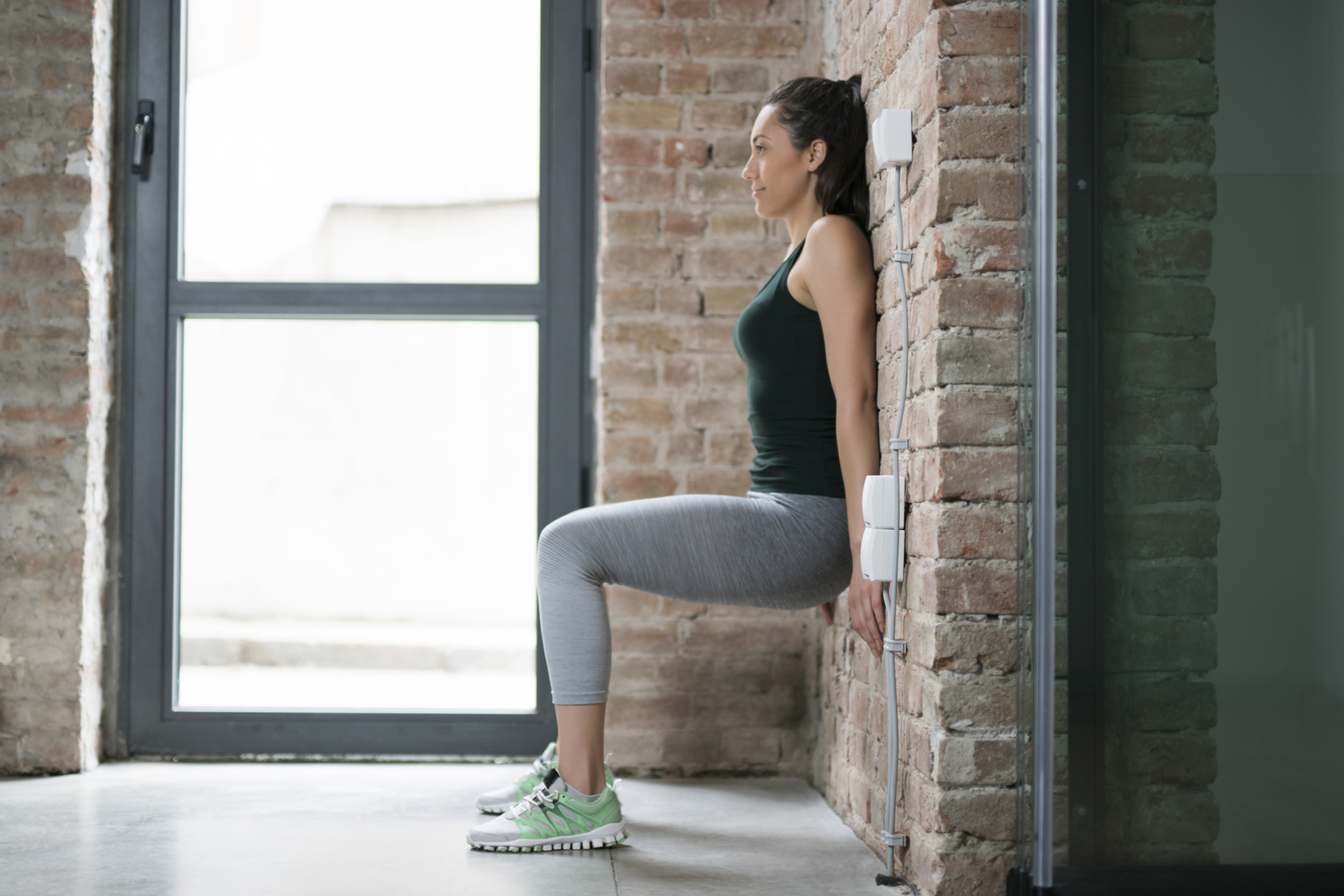
Muscles used: quads, glutes, hamstrings, abs, lower back
Instructions: Stand with your back against the wall, making sure your feet are away (about a foot) from the wall and hip-width apart. Then slide a little way down the wall—you can go a quarter way down and see how that feels—keeping your back and butt in contact with the wall. Make sure your knees are in line with your big toes. The soles of your feet should be flat on the floor. Also make sure that you are engaging your core. Try to hold for 15 seconds or so, then push back up to your starting position. Repeat.
Muscles used: chest, shoulder, triceps
Instructions: Face a wall, feet slightly apart, and place your palms on the wall shoulder-width apart and slightly above your shoulders. Then step back a bit from the wall (feet still slightly apart) so that your arms are extended straight. Keeping an erect posture, flex at the elbows so that your chest is directed toward the wall. Then push through your palms in order to extend your arms to the starting position. This is sort of like doing a push-up against the wall. Repeat.
Muscles used: abs/obliques, hips, glutes, lower back
Instructions: Facing the wall, place your forearms against the wall, with your elbows bent and at shoulder level. Make sure you are not shrugging your shoulders. Then lean into your forearms while maintaining an erect posture. With your forearms remaining in place, slowly walk your feet a little bit back from the wall, making sure to engage your core and keep your heels on the floor. Your lower back should have its natural curve (do not stick your butt out). Try to hold this position for about 15 seconds (but work your way up over time, if you can, to 60 seconds). Slowly return to the starting position. Repeat.
Muscles used: glutes, abs, hamstrings
Instructions: Lie on your back near a wall with your feet facing the wall; place your arms at your sides. Put the soles of your feet on the wall so that your feet are positioned at the width of your hips. Your thighs should be perpendicular to the floor with your legs positioned at a 90-degree angle. Press your feet into the wall as you engage your core and your glute (butt) muscles, raising your hips slightly off the floor. Don’t arch your back. Hold for 15 seconds or so, then lower yourself back to the floor. Repeat.