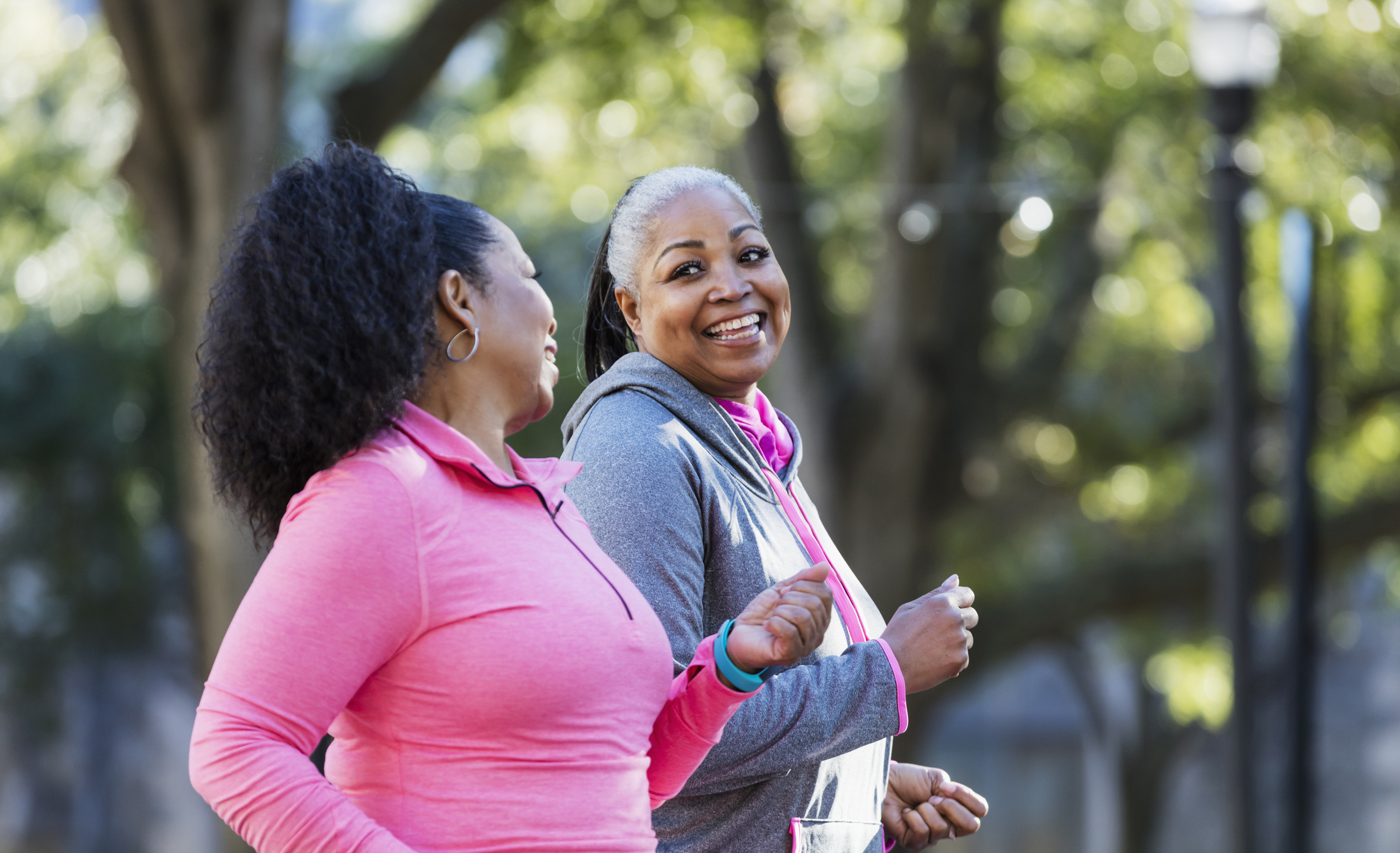
Of all the ways to stay fit, walking is the easiest and safest, and is a great way to enjoy nature or city streetscapes. And after your walk, you know you’ve done yourself some good. A brisk walk (usually 3½ to 4 miles per hour, depending on the length of your stride) burns nearly as many calories as running the same distance at a moderate pace and confers similar health benefits.
Many studies in people with a variety of conditions, notably heart disease, diabetes, and prostate or breast cancer, have linked walking (and physical activity in general) with better health outcomes. Even slow walking and short walks may provide some benefits.
Here’s a small sampling of research about walking from the past few years:
- Metabolic benefits. Mile for mile, brisk walking can reduce the risk of developing high blood pressure, diabetes, high cholesterol, and heart disease as much as running, according to a large observational study in Arteriosclerosis, Thrombosis, and Vascular Biology. The farther people ran or walked and the more calories they burned, the greater the reduction in risk. Of course, it takes much longer to walk a mile than to run it, so you need to spend more time walking to get the same benefits as you would running.
- Reduced risk of heart failure. Walking at least 40 minutes two or three times a week at average or brisk pace was associated with a reduced risk of developing heart failure in postmenopausal women over a 10-year period, according to a 2018 observational study in the Journal of the American College of Cardiology, which analyzed data from almost 90,000 participants in the Women’s Health Initiative.
- Healthier arteries. Sitting for long periods has many adverse effects on the body, including endothelial dysfunction—a reduced ability of arteries to relax and contract, which decreases blood flow and may increase long-term cardiovascular risk. Walking can help counteract that, as was seen in a small study of 15 people, average age 36, in Physiological Reports in 2019. Participants sat at desks for four hours on three days, under three scenarios in random order: sitting without getting up; taking a two-minute walk every half hour; or taking an eight-minute walk every two hours. Uninterrupted sitting resulted in reduced blood flow in a main artery in the leg, while the longer walks prevented this (the shorter walks helped less).
- Better blood sugar control. Increased daily walking may help control blood sugar in sedentary overweight or obese people with elevated levels, according to a small Thai study in Diabetology International in 2018. Over three months, the middle-aged participants increased their walking to at least 10,000 steps a day, which resulted in lower blood sugar as well as reduced blood pressure and waist circumference (though there was no control group).
- Less low back pain. A review and meta-analysis of randomized trials in Disability and Rehabilitation in 2017 found that walking was as effective as other forms of exercise (including back-specific workouts) at reducing pain and disability and improving quality of life in people with chronic low back pain.
- Improved knee osteoarthritis. People with knee osteoarthritis often avoid exercise, thinking it will make their condition worse, but exercise can be one of the best treatments. Among many studies that have shown this, a 2019 study in the American Journal of Preventive Medicine of 1,560 people with lower extremity (mostly knee) osteoarthritis found that moderate physical activity (including walking) for at least one hour a week over four years was associated with a significant reduction in disability, compared to being relatively inactive.
- Enhanced brain function. A clinical trial from Duke University, published in Neurology in 2018, found that among 160 older adults with cognitive impairment, those who walked briskly (or cycled) for 35 minutes three times a week for six months had significant improvements in executive function (the ability to plan and prioritize), compared to those who did not exercise.
- Better mood and stress reduction. Studies show that both walking and mindfulness (heightened attention and nonjudgmental awareness) can improve mood, and combining them (mindful walking) can have a synergistic effect, according to a study in Psychology of Sport and Exercise in 2018. What’s more, a study in Health Promotion Perspectives in 2018 found that brisk walking can improve mood as much as a short bout of meditation, compared to just sitting. And walking in a scenic locale may improve mood and reduce stress (as measured by blood levels of cortisol, a stress hormone) more than indoor treadmill walking or simply watching a video of outdoor scenery, according to a 2020 study in Environment and Behavior.
- Increased creativity. A series of four studies appearing in 2014 in the Journal of Experimental Psychology, entitled “Give Your Ideas Some Legs,” found that students experienced a boost in creative thinking during and right after walking, compared to sitting. Walking, especially outdoors, “opens the free flow of ideas,” presumably via both physical and psychological mechanisms, the researchers suggested.
BOTTOM LINE: Other types of exercise may be as beneficial as walking, and more strenuous workouts may yield additional benefits, but the simplicity of walking makes it a great option. You need no equipment or special clothing, and you can do it just about any time, alone or with family or friends. Start by adding several short walks (even just five minutes) to your daily routine.
If you need more encouragement to walk, check out the U.S. Surgeon General’s 72-page report “Step It Up.” If you’re interested in what makes walking good for thinking, there’s some more food for thought from this past issue of The New Yorker.
- Walk most days. Try to walk for at least half an hour a day, or one hour every other day. If done briskly, that could burn more than 1,000 calories per week. If you can’t work that into your schedule, try more frequent, shorter walks; see next bullet.
- Consider breaking up your walks. Brief walks done throughout the day can be as healthful as longer walks. For instance, a study in the Journal of the American Heart Association in 2018 found that accumulating short sessions of moderate activity such as brisk walking throughout the day reduced mortality rate as much as doing the same amount of exercise in longer sessions.
- Count your steps. Get a simple pedometer, wearable fitness device, or step-counting smartphone app to see how many steps you take a day. Aim initially for 3,000 to 5,000 steps a day and then try to increase your goal. An observational study in JAMA Internal Medicine in 2019 found that participants in the Women’s Health Study (average age 72) who walked an average of 4,400 steps a day over a four-year period had a 40 percent lower mortality rate than those who walked the least (2,700 steps). Mortality rate continued to decline up to about 7,500 steps a day, plateauing after that.
- Note how intensely you are working out. Federal guidelines recommend “moderate intensity” activity for 150 minutes a week or “vigorous” exercise for 75 minutes a week. Walking at least 100 steps per minute constitutes moderate exercise for most people, and at least 130 steps per minute is vigorous exercise, according to a small study in the International Journal of Behavioral Nutrition and Physical Activity in 2019.
- Swing your arms. Vigorous arm pumping allows for a quicker pace and provides a good workout for your upper body. Bend your elbows 90 degrees and pump from the shoulder. Move your arms in opposition to your legs. Keep your wrists straight, your hands unclenched, and your elbows close to your sides.
- Vary your routine. Speed up for a minute or two out of every five minutes, for instance. Or alternate doing one faster mile with two slower miles. Vary your terrain as well. Walking on grass, gravel, or trails burns more calories than walking on a track or on pavement.
- Walk up and down hills. Combine hill walking with your regular flat-terrain walking as a form of interval training. When walking uphill, lean forward slightly—it’s easier on your legs. Walking downhill can be harder on your body, especially the knees, and may cause muscle soreness, so slow your pace, keep your knees slightly bent, and take shorter steps.
- Try walking poles. To enhance your upper-body workout, use lightweight, rubber-tipped trekking poles, which are sold in many sporting-goods stores and online. This is like cross-country skiing without the skis. It works the muscles of your chest, arms, and abs, while reducing knee stress. People taller than 6 feet should use poles that are at least 51 inches long; most adjust- able trekking poles are suitable for people of shorter height. You should be able to grip each pole and keep your forearm about level as you walk.
- Use hand weights, but carefully. Holding weights can boost your caloric expenditure while walking, but they may alter your arm swing and lead to muscle soreness or even injury. Start with 1-pound weights and increase the weight gradually to no more than 2 or 3 pounds. Don’t grasp the weights too tightly, as this could increase blood pressure; strap-on wrist weights are another option and can prevent this. Ankle weights are not recommended because they increase the risk of injury.
- Try backward walking. This can be demanding, since it’s a novel activity for most people. If you’re doing it outdoors, choose a smooth surface and keep far away from traffic, trees, potholes, and other exercisers. A deserted track is ideal. Try to go with a partner who can alert you to obstacles or other potential dangers and help pace you. Skip this activity if you have balance problems.