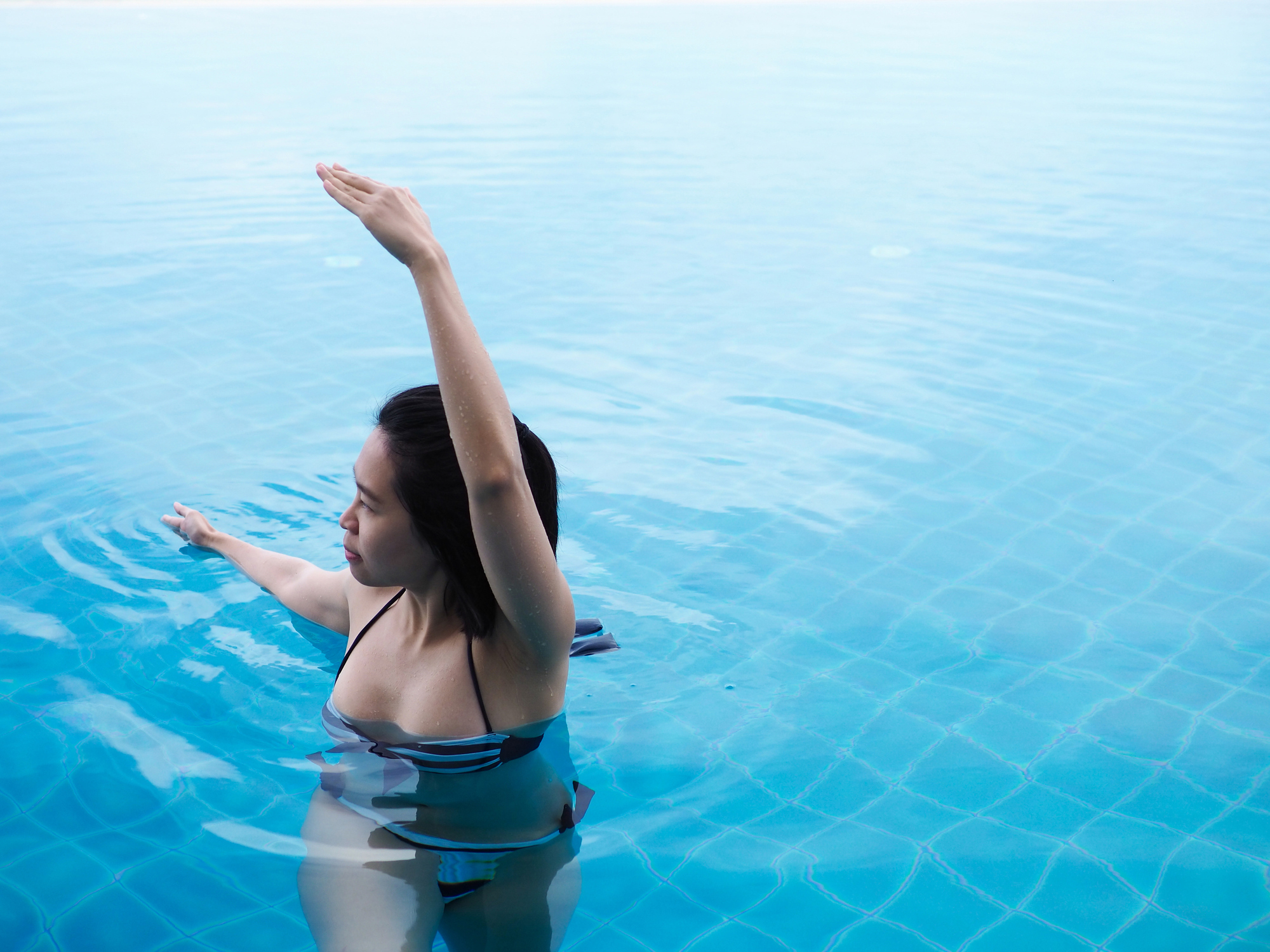
Water yoga—also called aqua or aquatic yoga—is just what it sounds like: yoga done in waist- or chest-deep water, typically in a pool, while you focus on your breathing and engage in various meditative practices. The idea is that the practice mimics yoga on land but with the water, which is more viscous than air, providing the resistance instead of the air and the gravity felt on land. That is, your muscles get a workout as they work against the resistance the water provides. In this type of yoga, some poses are understandably adapted for the water. For example, without modification, “downward-facing dog” would become “drowned dog”!
Transitioning from land to water
Even if you already do land-based yoga, there’s still a learning curve with practicing your poses in water. Because water is shifting much of the time, you might find it difficult to balance at first in certain poses (like tree pose), especially if you’re a newbie to any kind of yoga. Holding onto the pool wall can help until you gradually learn how to gain balance in the water, whether you are doing standing or moving poses. And as you get better at it, you will be improving your core strength since you need strong core muscles for balance.
Water yoga can be done by almost anyone, no matter your age or fitness level, and by people with physical limitations such as from arthritis, Parkinson’s disease, and multiple sclerosis. Pregnant women and people who are obese or who have had knee or hip replacement may find it easier to exercise in water than on land. Being in water at least waist deep reduces the impact on your joints because your body’s buoyancy partly counteracts your weight. That means that your water yoga workout will be a gentle, low-impact one and that many yoga poses will be easier to do. If you already do yoga, you can enjoy water yoga as a novel activity where you practice poses that you are already familiar with but in a different way—or you may even be able to get into poses that were difficult for you on land.
Water yoga benefits
Can water yoga improve balance, coordination, range of motion, or bone health? Can it lift mood, reduce blood pressure, or have other health benefits? There’s little research to say for sure, especially compared with the large body of evidence showing such benefits for land-based yoga. In fact, we found only two English-language studies looking at potential health benefits of water yoga—and one of them is unpublished.
- In a study from India in the International Journal of Yogic, Human Movement and Sports Sciences in 2019, researchers divided 45 young women who were obese into one of two yoga groups—water or land-based yoga done twice a week for 90 minutes for two months—or a control group that did not do any type of yoga. Both exercise groups had significant reductions in LDL (“bad”) cholesterol and increases in HDL (“good”) cholesterol, compared with the non-yoga group.
- An unpublished study presented at the International Aquatic Fitness Conference in 2014 involved 21 pregnant women in Greece who participated in a single water yoga session for about 45 minutes. After the session, the women showed significant improvements in blood pressure as well as in mood. But given the lack of journal peer review for the study and its poor design (notably the lack of a control group), it’s unknown if the benefits reported were due to the exercise or simply to the women immersing themselves in warm, relaxing water—or to a combination of the two, or to other factors altogether. Not much can be concluded from the findings except that water yoga may boost mood in the short term and could be an exercise option for pregnant women, especially if they might otherwise be sedentary.
A paucity of studies doesn’t mean water yoga doesn’t have benefits similar to those of land yoga—only that this specific exercise practice hasn’t been sufficiently tested to tell. Studies on other kinds of water-based exercise, such as water aerobics, have generally shown a range of positive outcomes, from increased strength, balance, and bone health (not necessarily through increased bone mineral density but through improvements in other markers of bone health) to better cardiorespiratory fitness and mental health.
According to the National Association of Complementary and Alternative Medicines (NACAMS), water yoga can help improve flexibility, strength, and endurance in people with limited mobility or other physical difficulties, presumably based on a body of evidence for water exercise in general. NACAMS also notes that doing yoga breathing exercises in chest-high water gives the diaphragm a better workout, which may increase lung capacity and have other respiratory benefits.
Get wet
If you want to try water yoga, you can check if your local “Y” or community center has classes. Some aquatic centers and health clubs also offer water yoga instruction. Some facilities cater specifically to pregnant women. The classes are typically 30 to 45 minutes, with the water temperature best set at 86°F to 90°F. (Water temperature may be set warmer in classes that are part of medical therapy.)
In a class, you’ll see how regular yoga poses are modified for the water. Take the warrior III pose as an example: On land, you need to use effort to keep your leg up. But when you are in water, your leg just floats, allowing you to better focus on other details, like aligning your hips. On the other hand, a pose like the triangle on land isn’t very difficult for yoga practitioners, but you have to work your core more in the water to remain upright.
Once you understand the basics, you can try water yoga on your own, assuming you have access to a pool. Special equipment isn’t necessary but can be used. For instance, if you’re doing the corpse pose, where you lie on your back, a kickboard or foam noodles can help keep you afloat. But depending on the pose, the pool wall may be all you need, if anything. There are many web resources for building your own water yoga workout routine, including this database of poses.
Keeping it safe in the sun
If the pool is outdoors, wear sunglasses and a broad-spectrum, water-resistant sunscreen (with SPF of at least 30). UV swimwear with built-in SPF protection, including long-sleeve tank suits, can also protect you from the sun. To avoid direct sun even more, stay on the shadier side of the pool if there is one. If you’re prone to getting overheated, work out in the early morning or evening when it’s cooler. Whether indoors or outdoors, have a water bottle accessible so you don’t get dehydrated. To reduce the risk of falling as you get in and out of the pool, wear water sandals or shoes that have good traction; some shoes also provide cushioning and support during your workout if you need it—for example, if you have neuropathy or any other condition affecting your feet. If you have an open wound, don’t go in the pool until it’s healed.
BOTTOM LINE: If you have access to a pool, you can give water yoga a try. Despite the lack of studies, clearly this is a low-impact activity, so if you have joint or overuse issues, it might be something you could tackle with little fear of injury or re-injury, though, of course, you should never force a joint into a position, and you should ease up on any pose if you feel pain. Despite its overall safety, if you have severe mobility or cardiac issues, seek your doctor’s okay before starting out, as you would with any other exercise regimen. For regular yoga enthusiasts, water yoga may be a way to add more variety to your usual practice. And it may, at the very least, be a nice way for anyone who likes water to limber up and relax.