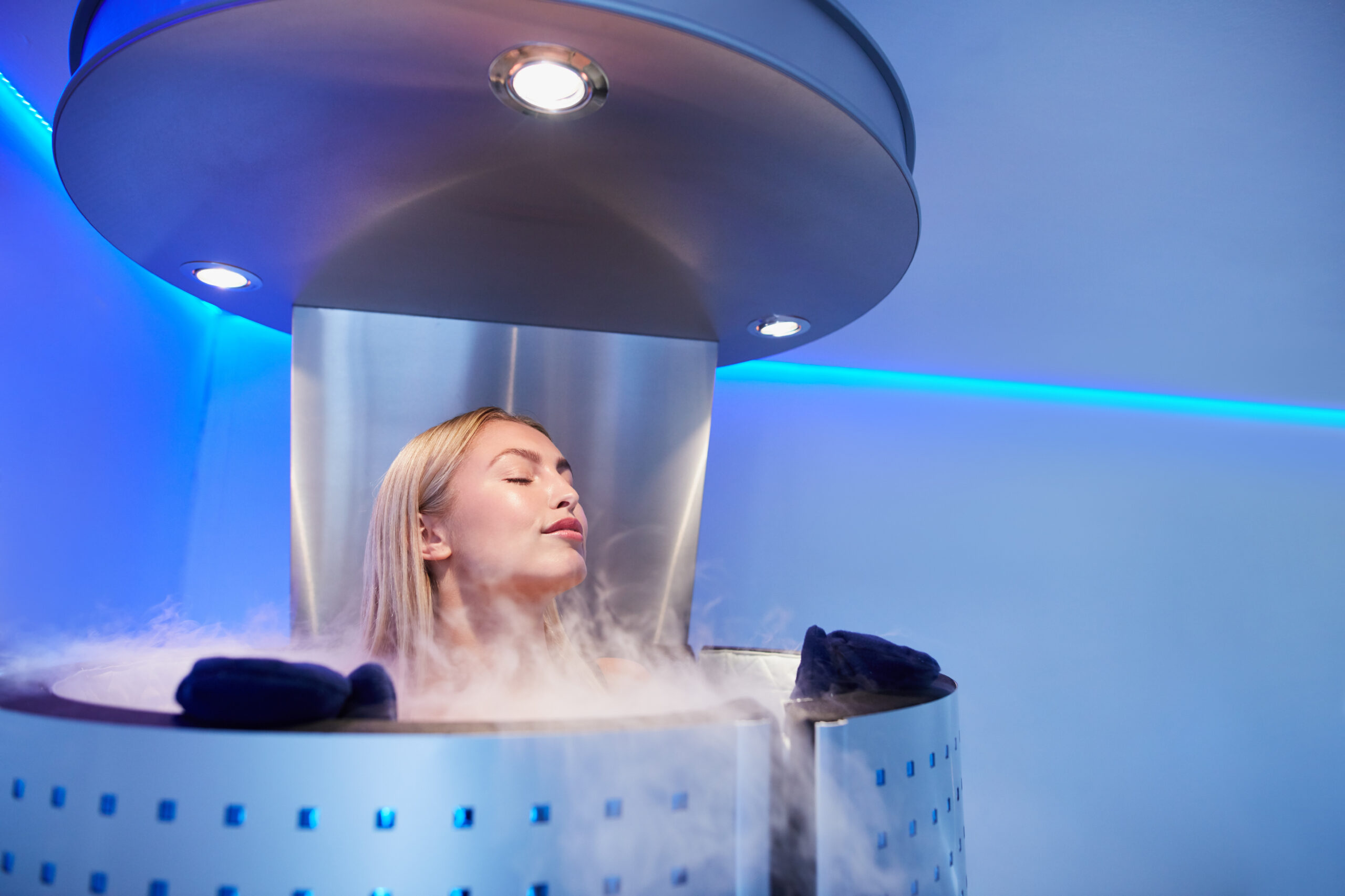
If you’ve passed a day spa, wellness center, or health club recently, you may have seen signs promoting a treatment called whole body cryotherapy. Or maybe a freestanding cryotherapy center or mobile unit has popped up in your area. This trendy practice (literally “cold therapy”) involves immersing all or most of your body (everything but your head) in a chamber of ultra-frigid air—usually between –160ºF and –265ºF—for about three minutes.
The claimed benefits span everything from losing weight, enhancing libido, and improving sleep to treating a diverse range of health conditions, including depression, chronic pain, multiple sclerosis, eczema, fibromyalgia, arthritis, and Alzheimer’s disease. Some celebrities and professional athletes have touted whole body cryotherapy as an anti-aging tool or a way to ease post-workout soreness; the New York Knicks reportedly have their own cryotherapy machines for players to chill in after practices and games.
Whole body cryotherapy (which, for simplicity, we’ll refer to as cryotherapy here) dates back to the late 1970s, when a rheumatologist in Japan began using it on his patients with rheumatoid arthritis after observing that their symptoms tended to improve when they spent winter holidays in the mountains. It has also been used for several decades in Europe and parts of Asia as a treatment for arthritis and other inflammatory conditions.
Does it work?
There’s some preliminary evidence suggesting that cryotherapy may be a useful add-on treatment for people with certain conditions, including rheumatoid arthritis, depression, multiple sclerosis, and eczema. It may work in part by reducing inflammation, dampening transmission of pain signals between nerves, or altering levels of certain hormones. But most of the randomized trials of the therapy have been small (or very small), some had no control group, and they have used different methodologies, making the results difficult to generalize. None of the participants were blinded, either, meaning that they knew they were getting the cold treatment, which could have biased the results. Plus, the studies haven’t typically followed participants afterward to see how long any observed benefits may last. Here’s a sampling of some research:
Rheumatoid arthritis. A systematic review published in Expert Review of Clinical Immunology in 2014 pooled six studies of cryotherapy involving 257 people with this joint-damaging autoimmune disease. It found that the treatment decreased pain scores and disease activity in the affected joints. But the included studies varied broadly in methodology (such as number of sessions, length, and temperature in the chamber), and most lacked a control group. A randomized controlled trial of 50 rheumatoid arthritis patients in Reumatologia in 2019 found that adding a 20-day course of cryotherapy (one session per day) to a conventional rehabilitation program of physical therapy and exercise reduced pain and stiffness about as well as adding 20 sessions of water exercise. A similar small trial in 2015 in BioMed Research International found that cryotherapy improved pain and fatigue and reduced some markers of inflammation comparably to traditional physical therapy interventions (such as ultrasound and electrical stimulation) when added to a regular program of exercise.
Chronic pain. A review paper in Pain and Therapy in 2021 evaluated 25 studies (most randomized controlled trials) from 2000 to 2020 that used cryotherapy for chronic pain, including from musculoskeletal conditions such as osteoarthritis and fibromyalgia, in addition to rheumatic diseases and multiple sclerosis (see below). The authors concluded that the overall evidence “suggests that both non-local and local cryotherapy can be considered low-risk and easy treatment options to add in the management of chronic pain in carefully selected patients,” but they also pointed out limitations of the research, including a lack of standardization in the studies (in terms of temperature used, duration of each treatment, and number of sessions) and that cryotherapy was sometimes used alongside standard pain treatments, making it hard to know what role cryotherapy may have played in any reported benefits.
Depression. In a randomized controlled trial of 60 people in Poland with depression and anxiety disorders, published in 2008, adding cryotherapy (one session a day for 15 days, two to three minutes each) to existing antidepressant medication was more effective than medication alone at reducing participants’ scores on standard scales of depression and anxiety. More recently, an Australian trial in Frontiers in Psychiatry in June 2020, which included 56 people with a depression diagnosis, found that cryotherapy (10 daily two-minute sessions) reduced depression scores and improved self-reported mood and quality of life, as measured at the end of the 10 days, more than a sham treatment in a cool but not cryogenic chamber (–75ºF vs. –160 to –250ºF).
Multiple sclerosis. In a study of 48 people with this neurological condition, published in 2016 in Acta Neurologica Scandinavica, participants had improved physical function and reported less fatigue after 10 daily three-minute sessions of cryotherapy. Improvements were greater in participants who reported more fatigue at the beginning of the study. But, notably, there was no control group.
Eczema. In a research letter in JAMA Dermatology in 2008, 18 adults with eczema stopped using any medication (including topical steroids, oral antihistamines, or UV light therapy) and underwent three cryotherapy sessions per week for four weeks. On average, their skin symptoms improved over the study period, and they reported less itching and less trouble sleeping due to skin discomfort. The benefits lasted in some participants for at least four weeks after the treatment ended. A few participants experienced mild frostbite. The authors concluded that adding cryotherapy to eczema treatment might help reduce the need for steroids and UV treatments that can have harsher side effects.
Other. We couldn’t find good evidence to support cryotherapy as a tool for weight loss, fat burning, or treating asthma, Alzheimer’s disease, or some of the other conditions for which it’s been promoted.
A balm for sore muscles?
A number of studies have looked at the effects of cryotherapy on muscle soreness and recovery after intense exercise, with mixed results. A 2015 review by the Cochrane Collaboration examined four randomized clinical trials involving a total of 64 participants and found “insufficient evidence” to determine whether one or more sessions in a cryotherapy chamber reduced self-reported muscle soreness or improved subjective recovery after exercise, compared to resting or standing in a chamber at normal temperature.
In contrast, a review of 16 studies involving 224 people in the International Journal of Sports Medicine in 2017 concluded that cryotherapy may reduce soreness and return athletes to pre-exercise strength faster than rest or no treatment. But the studies varied widely in type of exercise and number of cryotherapy sessions—plus the research in both this review and the 2015 Cochrane review was almost entirely done in highly trained male athletes or physically active men, so it’s not clear if the results would apply to women or other groups.
Nor is it clear how cryotherapy compares to less extreme forms of cold therapy commonly used by athletes after exercise like icing or a cold-water bath, since results have been mixed there as well. For instance, a small study in the International Journal of Sports Physiology and Performance in 2017 found that a three-minute post-exercise cryotherapy session at –166ºF was less effective than a 10-minute soak in 50ºF water at reducing muscle pain and improving muscle recovery (objective and perceived) in 10 young men with sore hamstrings.
On the other hand, a small Chinese study in the Journal of Athletic Training in 2020 found that cryotherapy yielded better recovery effects than cold water immersion and contrast-water therapy (alternating cold and warm water) in 12 male runners, with the authors concluding that cryotherapy is “a useful nonpharmacologic and noninvasive therapy for promoting muscle recovery.”
Safety concerns
In a warning to consumers in 2016, the FDA cautioned that it has not approved or cleared any cryotherapy device and that the practice poses potential risks, including frostbite, burns, fainting, and even asphyxiation (if liquid nitrogen is used to cool the chamber, which can deplete the level of oxygen in the air). Indeed, in 2015, a spa worker in Nevada who used the tank when the facility was closed died of asphyxiation after being accidentally locked in for 10 hours. The death prompted the state to issue recommendations for the safe use of cryotherapy chambers, including that they should not be used by pregnant women or people with certain health conditions, including hypertension, a history of heart attack or stroke, or a seizure disorder. Nor should sessions exceed three minutes, once a day.
The FDA has also cautioned that “despite claims by many spas and wellness centers to the contrary,” the agency “does not have evidence that whole body cryotherapy effectively treats diseases or conditions like Alzheimer’s, fibromyalgia, migraines, rheumatoid arthritis, multiple sclerosis, stress, anxiety or chronic pain.” Moreover, the FDA has neither cleared nor approved any whole body cryotherapy device as safe and effective for treating medical conditions.
BOTTOM LINE: If you are considering trying cryotherapy for a medical condition such as rheumatoid arthritis, depression, or multiple sclerosis, discuss it with your doctor first. For post-exercise soreness, there’s no reason to believe cryotherapy will ease painful muscles better than less-extreme types of cold therapy, like an ice bath. Don’t expect it to “cure” anything, and never use it in place of an existing treatment. Even if you just want to try it for fun or out of sheer curiosity, check with a medical professional beforehand. And certainly avoid it if you have one of the conditions referenced in the Nevada health department warning. Expect to pay around $40 to $100 per session, depending on the facility. The facility should provide protective garments such as a face mask, gloves, slippers, socks, undergarments, and a warm headband or earmuffs.