
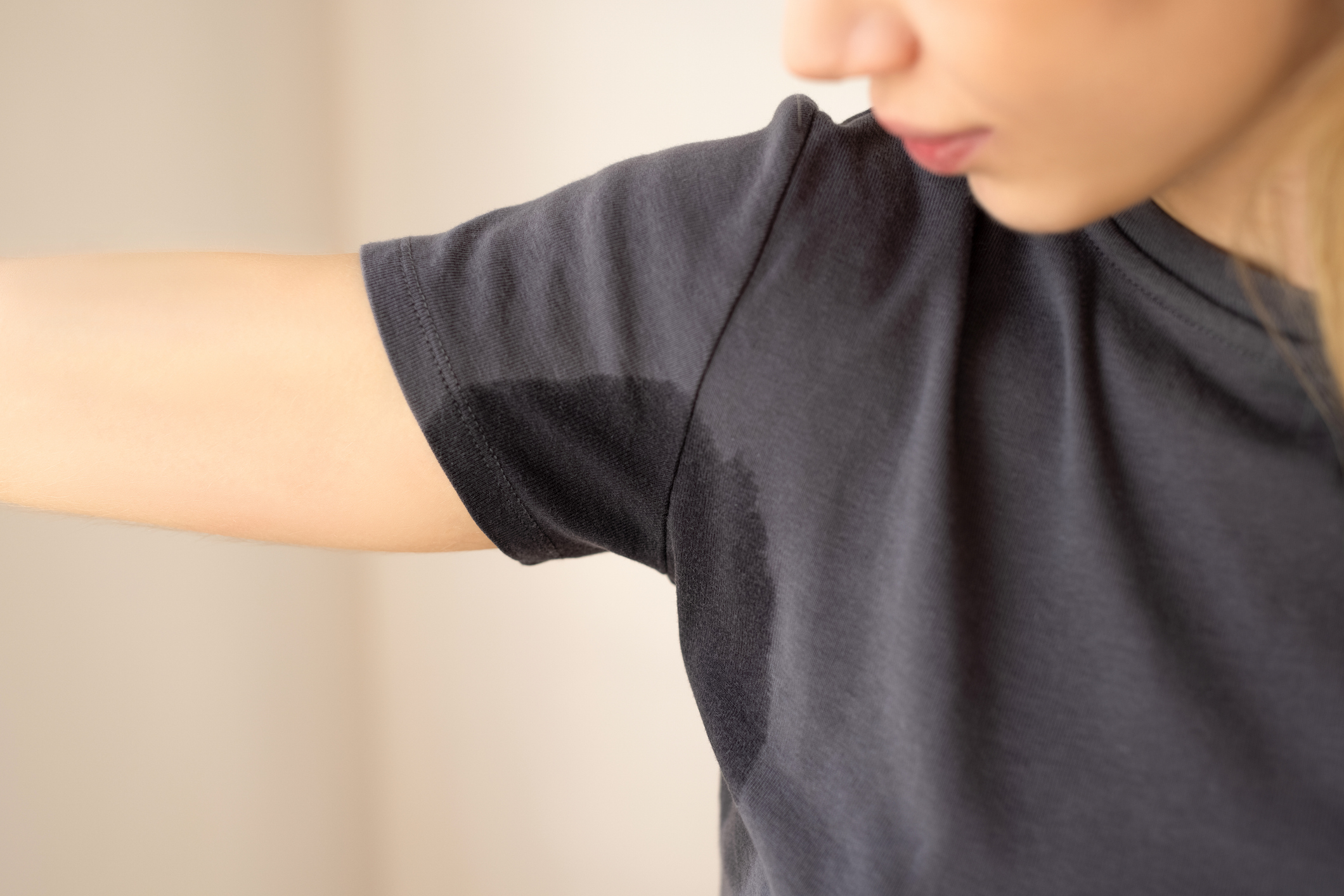
Heat waves that make June feel more like July or August. Higher year-round temperatures that extend summer weather well into fall. Even people who live in northern latitudes are finding themselves perspiring for a much greater portion of the year. And those who sweat year-round—no matter the temperature—may feel even less comfortable these days as well.
Sweating is a necessary evil, of course. It’s the body’s way of cooling us when the air temperature increases to a level we find uncomfortable, when we exert ourselves through exercise or physical work, when a fever breaks, and when we’re feeling emotions like anxiety, fear, or sexual arousal.
Where sweat originates depends on the cause. If it’s to regulate heat, eccrine sweat glands—located all over the body, including the feet and palms—secrete moisture. If the body is responding to emotional or nervous stimuli, the apocrine sweat glands—located largely in the armpits, groin, and around the navel—step in. In either case, the evaporation of sweat removes heat from the skin’s surface and helps us feel cooler.
What is sweat?
It should come as no surprise that sweat released from both types of glands is mostly made up of water. Sweat also contains small amounts of sodium, potassium, chloride, and other minerals that, among many other functions, help regulate blood pressure and maintain normal fluid levels throughout the body. However, apocrine sweat also contains proteins and fatty acids, and it tends to mix with oil and dirt on the skin. Bacteria feed on organic particles in this type of sweat and release foul-smelling compounds, resulting in body odor.
But many people may notice that they sweat more than seems necessary, given the air temperature and their exertion level. Also called hyperhidrosis, excessive sweating can cause damp armpits, body, face, hands, and feet—or several of these at once—for no obvious reason. Hyperhidrosis is likely hereditary, and it may result from an overactive nervous system.
Hyperhidrosis can cause discomfort and anxiety in social situations. No one likes to shake hands with someone who has sweaty palms, and having sweat spots in clothing or sweat dripping from one’s forehead can be embarrassing. While not life-threatening or medically concerning, excessive sweating could cause dehydration and skin rashes like jock itch and athlete’s foot.
How sweet it isn’t
Excessive sweating usually follows one of two patterns. Primary focal hyperhidrosis often starts in childhood or adolescence. “Primary” means that it’s not due to another medical condition; “focal” indicates that it typically occurs in only one or a few areas of the body, such as the underarms, hands, feet, and forehead. It typically occurs equally on both sides of the body, at least once a week (although usually more frequently), and often begins soon after waking.
In secondary hyperhidrosis, the excessive sweating is caused by a medical condition (such as diabetes, an overactive thyroid, frostbite, or a head injury), a medication, or a supplement. Menopausal hot flashes and obesity can also set off excessive sweating. With secondary hyperhidrosis, a person usually sweats excessively over their entire body, and it can occur while awake or sleeping.
Managing your sweat
Treating hyperhidrosis depends on where it’s originating and why. If your doctor determines that your sweating is indeed excessive, a number of treatments could help:
Antiperspirants. Many of us use a daily antiperspirant, deodorant, or combination product. If you’re using just a deodorant—which only fights odor from sweating—it might be time to add an antiperspirant to the mix. Antiperspirants help plug your sweat glands, so your body produces less sweat. Antiperspirants can be used under the arms as well as on the hands, feet, or hairline, and even in folds of the skin such as the groin or bra line. But some can cause skin irritation, so it’s important to find a brand that works for you.
If basic over-the-counter antiperspirants aren’t working for you, consider trying clinical-strength versions (also available over the counter). They’re usually more effective than standard varieties but without the potential skin irritation of prescription-strength antiperspirants. If your doctor determines that you do in fact need a prescription, you can work together to find one that will help reduce sweat without irritating your skin.
You may have noticed a lot of ads lately for a newer line of products known as “whole-body deodorants.” They are marketed as odor blockers for areas beyond just the armpits, like the face, hands, and groin. And while many of them also promise “sweat control,” they’re not true antiperspirants. They don’t work to block sweat production the way antiperspirants do. Instead, they usually contain an ingredient (like starch) to absorb moisture. A true whole-body antiperspirant doesn’t exist, and that’s a good thing—our bodies do need the ability to release sweat.
Iontophoresis. Also known as the “anti-sweat-machine,” this type of at-home treatment involves soaking your hands or feet in a shallow pan of water. A low-voltage electrical current is sent through the water and the surface of your skin to stop the sweat glands from functioning. It can be time-consuming and often requires six to 10 initial treatments, plus maintenance treatments once per week or month.
Botulinum toxin injections. In 2004, the U.S. Food and Drug Administration (FDA) approved the use of botulinum toxin (Botox) injections for excessive sweating in the armpits. While Botox is probably best known for blocking muscles in the face that cause wrinkles, it can also temporarily block the secretion of a chemical that triggers the body’s sweat glands. Doctors also use Botox injections off-label to treat sweating on the head, hands, and feet. A 2021 review article in the International Journal of Dermatology found that in 10 randomized clinical trials, Botox injections provided a significant benefit in reducing underarm sweating. The treatment is relatively low cost (possibly covered by insurance) and simple to administer. Side effects (including muscle weakness) are usually mild and temporary.
miraDry. This noninvasive treatment, performed with a handheld device in a doctor’s office, was cleared by the FDA in 2011 for the treatment of excessive underarm sweating. It delivers electromagnetic energy to eliminate or damage the sweat glands. Because the sweat glands don’t grow back, one treatment is sometimes sufficient, although a second treatment after three months is often recommended. The device is only approved for treatment under the arms, where there is enough underlying fat to safely absorb the electromagnetic energy—miraDry cannot be used on the hands or feet.
Cloth wipes. Qbrexza prescription wipes are approved by the FDA to reduce sweating under the arms in people ages 9 and older. They contain an ingredient called glycopyrronium tosylate that works to reduce the amount of sweat the body makes. The wipes are a long-acting treatment, meant to be used once daily.
Oral medications. Several types of prescription medications are used to treat excessive sweating. The most common are anticholinergics, which block the nerves that activate sweat glands. Beta blockers and benzodiazepines can be useful for people whose sweat is triggered by anxiety. Side effects of these medications can include dry mouth and eyes, blurry vision, heart palpitations, and sedation, and they may not be safe to combine with other prescription medications.
Skin patch. A newer treatment is the Brella SweatControl Patch, cleared by the FDA in 2023 for excessive underarm sweating in adults. The patch is applied in a doctor’s office for approximately three minutes. The interaction between the sodium in the patch and the water in underarm sweat creates a small amount of heat, which damages the sweat glands. Patients usually see a reduction in sweat production within three to five days after treatment, and the results last two to four months.
Surgery. It’s possible to treat severe hyperhidrosis surgically by removing the sweat glands or the nerves that trigger sweating. However, these methods are usually considered only if other, less-invasive treatments have failed. All surgery carries risk, and any treatment that reduces or eliminates your ability to sweat may leave you feeling like you can’t tolerate heat.
BOTTOM LINE: If you sweat excessively, for whatever reason, it’s worth a visit to your primary care doctor or dermatologist—particularly if you’re having a diminished quality of life. Medications and self-care measures can reduce your sweating and help you to feel comfortable and confident, no matter the temperature.