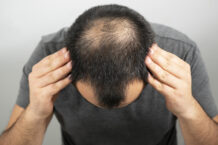

Minoxidil applied directly to the scalp is FDA-approved to treat hair loss, but a fair number of people discontinue the topical after trying it. It can cause itching. It sometimes irritates the scalp. You have to apply it twice a day, and that can be a pain because you have to get past the hair and right down to the top of the scalp. And there’s often several weeks of hair shedding before things start to go in the right direction, causing people to become discouraged and discontinue treatment. Furthermore, minoxidil applied topically is sticky, giving the hair an undesirable texture.
But perhaps most importantly, topical minoxidil doesn’t work for everyone. It is converted to its active form by enzymes in the outer sheath surrounding the hair follicle, and some people appear not to have enough enzyme activity there to make a meaningful difference.
Enter oral minoxidil, taken as a pill. Dermatologists have been prescribing it off-label. It, too, causes some initial hair shedding, but by all accounts it does a better hair-restoring job for many people than the topical version. Why is not known for certain, but it may be that enzymes in the liver and blood do some of the enzyme-converting work, bypassing any possible follicle-converting enzyme deficiencies. How did doctors start trying oral minoxidil on their patients?
A brief history of minoxidil
Minoxidil’s ability to help reverse hair thinning was discovered by accident. The drug was originally approved to reduce blood pressure in 1979, especially for people whose hypertension was not responding to other therapies. But excess hair growth on the face and body—medically termed hypertrichosis—was an unintended side effect.
Fast forward to 1988, when the FDA approved a topical version of minoxidil for balding men; in 1992, it was approved for women experiencing female pattern hair loss. That helped, but not everyone saw appreciable benefits, and not everyone was willing to put up with the inconvenience and side effects.
Since then, particularly in the past decade or so, dermatologists have started prescribing oral minoxidil for hair restoration. It probably took a while because using minoxidil to treat high blood pressure comes with some serious risks—notably the risk of pericardial effusion, which means fluid can collect between the heart and the sac around the heart (the pericardium). That, in turn, puts undue pressure on the heart and makes it difficult to pump blood normally. Related side effects include tachycardia (high heart rate), swelling in the lower legs, and exacerbation of angina pectoris—chest pain due to coronary artery disease.
But the standard dose for minoxidil to treat hypertension ranges from 10 to 40 milligrams. To reverse hair loss, researchers have been experimenting with much lower oral doses, ranging from 0.25 to 5 milligrams daily. It seems like a range that for most people is generally safe and effective, with doctors tending to initially prescribe the lowest dose possible.
The evidence for oral minoxidil
There are no high-quality, double-blind, placebo-controlled studies on oral minoxidil. And there may never be any. The drug, a generic, is cheap, so there is little financial incentive to test it in expensive research trials. But several less rigorously conducted studies point to significant improvements in hair thickness with oral minoxidil, with a very small risk of side effects at the low doses prescribed. In fact, three different analyses, each of which pooled several studies, all point in the same direction.
A 2020 study, published in the International Journal of Dermatology, looked at more than 19,000 people from 10 trials and case analyses (admittedly, almost all of them men in a single trial that had no untreated “control” group). The researchers found that daily low-dose minoxidil generally had a significant impact on hair thinning, and there was better compliance than was seen with the topical version of the drug. For androgenetic alopecia, the most common type of hair loss in both men and women, clinical improvement (defined as objective evidence of decreased hair shedding and increased hair density and length) was seen in 61 to 100 percent of participants who took minoxidil, depending on the study. Notably, women tended to need a lower dose than men to show improvement.
Additionally, there was a “minimal side effect profile,” the researchers reported. The most common adverse effect was hypertrichosis (which can easily be taken care of with grooming techniques). A few people also experienced postural hypotension, meaning that blood pressure dropped when they did things like stand up quickly. That can cause dizziness or wooziness.
Similar results were found in a 2021 analysis in the Journal of the American Academy of Dermatology that looked at more than 600 people across 17 studies. One of those studies was conducted on 148 women taking 0.25 to 2 milligrams of minoxidil a day. The drug led to slight improvement in hair loss in 118 of them and marked improvement in 23. Again, hypertrichosis was the predominant side effect, affecting 25 of the women. But in that study and others in this particular analysis, the hypertrichosis was “mild” and “easily manageable.” Two women developed tachycardia and one developed pedal edema, which is swelling in the lower legs.
A third study, this one a systematic review in Dermatologic Therapy in 2020, of 442 patients in 14 studies, found that low-dose minoxidil showed good clinical response rates in the vast majority of participants. In one of the studies evaluated, oral minoxidil led to clinical improvement in 70 percent of the women taking it, compared to improvement in 46 percent of women who applied topical minoxidil.
This analysis found, too, that excess hair growth was the predominant side effect for the oral drug, occurring in almost one out of four participants. There were also a few cases of lower-leg swelling, tachycardia, and postural hypotension. And there tended to be mildly lower blood pressure in general. The higher the dose, the more probable the side effects. Again, women needed less oral minoxidil than men to have a beneficial effect.
If you want to consider oral minoxidil
Because of the small possibility of serious side effects from taking oral minoxidil, your dermatologist should go over your medical history with you to make sure there are no blood pressure, cardiac, or kidney issues; you may also be referred to your primary care doctor if any testing is needed. And while on the drug, you might be scheduled for checkups more often and for an EKG here and there to make sure that minoxidil hasn’t contributed to any other heart problems. But for most people who can’t or don’t want to deal with topical minoxidil, oral minoxidil is almost always a benign treatment with results ranging from mild to more dramatic. One note: If you stop taking oral minoxidil, hair loss will resume, just as with the topical.