Meat from animals is a great source of protein—and a regular part of many people’s diets. But it can be expensive to produce and unappetizing to those who believe animals should not be used as food. From an environmental perspective, production of animal foods uses a disproportionate amount of land, water, and energy resources.
To appeal to people trying to minimize or eliminate meat consumption for any of these reasons, researchers and food companies have spent decades developing meat substitutes. With varying degrees of technological success and consumer embrace, the offerings have included products made with such plant-based proteins as soy, wheat gluten, beans, seeds, and jackfruit. Newer-generation products like Impossible and Beyond burgers better mimic real ground beef but are highly processed combinations of ingredients including pea and soy proteins, cocoa butter, and canola, sunflower, avocado, and coconut oils.
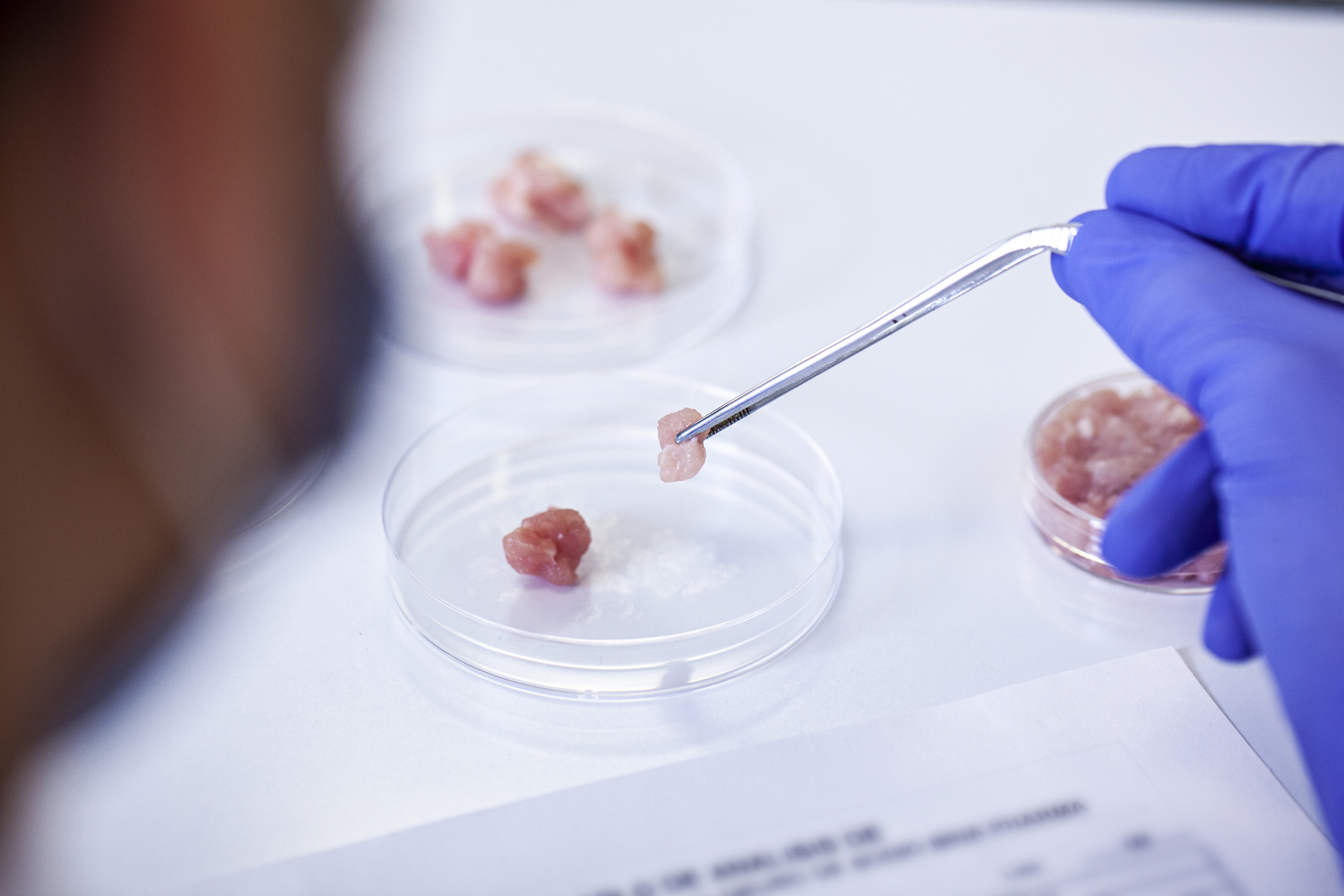
The newest entry into the “meat” category is lab-grown meat, also called cultivated meat. It’s made from stem cells and then shaped to look like a cut of meat. Companies from around the world have successfully grown beef, chicken, duck, and fish using this technology. This type of meat won’t appeal to vegans, since it does start out with stem cells from a living animal, but it could be an option for many who are looking to move outside the traditional food chain.
The world’s population is on the rise—triple what it was in the middle of the 20th century. It stands at more than 8 billion people currently and is expected to increase to 9.7 billion by 2050, with a peak of nearly 10.4 billion in the mid-2080s. Despite an increased interest in vegetarianism and veganism, many of those people eat meat—and a lot of it.
Between 1998 and 2018, global meat consumption grew by 58 percent, because of both population growth and increased demand, fueled by changing consumer preferences and rising income levels. The world currently eats 360 million tons of meat per year.
Debuting in restaurants
In June 2023, Upside Foods (based in Berkeley, California) and Good Meat (based in Alameda, California) became the first two companies to receive USDA approval to sell cultivated meat in the U.S. The companies had been racing to get to the market for years and are just the first among a handful of companies all competing for the same goal: bringing lab-grown meat to the masses.
Upside Foods uses its cultivated chicken cells to create large sheets of tissue, which are then formed into cutlets and sausages. The chicken was served exclusively—though only briefly—at a three-Michelin-star restaurant called Bar Crenn in San Francisco. Good Meat turns cells directly into forms like cutlets, nuggets, shredded chicken, and satays. Its cultivated chicken launched at China Chilcano, a Washington, D.C., restaurant owned by José Andrés, the chef and humanitarian who started the nonprofit World Central Kitchen (though reservations at the restaurant are paused now).
Reviews from food reporters and restaurant critics say that lab-grown chicken tastes…well, like chicken. One way it differs from the real deal is that it is unusually uniform—no chewy or fatty bits. And because Good Meat’s chicken arrived at the restaurant where it was served in precooked form, it may not have taken on as much of the flavor of a marinade as traditional, raw chicken does. But overall, reviewers have not objected to the flavor or texture of these lab-grown meats.
How the meat takes shape
Growing the meat begins with the collection of stem cells from a living animal through a simple needle biopsy that does not harm the animal. The cells, which can replicate on their own, must be grown in a medium, however, and nearly all the companies use a medium known as fetal bovine serum, which is sourced from live calf fetuses that have been removed from the mother during the slaughter process (and subsequently die). Fetal bovine serum has been used in many types of cell growth since the 1950s.
Produced from blood extracted by puncturing the fetal heart, the serum contains growth factors for the stem cells and typically needs to be replenished throughout the meat-growing process, necessitating an ongoing supply of calf fetuses. Several companies have already moved away from using fetal bovine serum, and many more (including Good Meats and Upside Foods) are developing serum-free cell culture media. The removal of fetal bovine serum will enable these companies to call their meat ethical and slaughter-free.
Some advantages of lab-grown meat include the ability to better control its nutrition content. For instance, the meat could perhaps be created with a more healthful profile of fats and be fortified with vitamins and minerals. Scientists might also be able to limit potentially harmful compounds found in meat such as L-carnitine. The meat would also carry significantly less risk of microbial contaminants than meat from slaughtered animals.
The challenges of lab-grown meat
Before these products can be widely sold, manufacturers need to be able to produce them at scale and at a cost that is palatable to consumers. In May, Good Meat became the first company to begin retail sales—in Singapore, where the product contains only 3 percent cultivated chicken, combined with plant protein, to make it more affordable.
And although this technology may eventually be better for the environment, preliminary, not-yet-peer-reviewed research from the University of California, Davis, suggests that the carbon footprint of lab-grown beef may be worse than that of traditional beef. The reason: the high levels of energy and ingredients required to purify the media in which the cells are grown. As companies scale up production and make their processes more efficient, the carbon footprint may become smaller. But for the moment, lab-grown meat isn’t fulfilling the initial promise of being more environmentally friendly than traditional meat.
Another challenging aspect of this emerging technology is how to regulate it. For starters, is it an agricultural or a pharmaceutical product? To help address these issues, the USDA and FDA have teamed up to oversee cellular agriculture and provide guidelines for safety, procedure, marketing, and labeling, but they will likely face many hurdles from industry and other groups. In fact, in a nod to the cattle industry, Florida and Alabama recently banned the production and sale of cultivated meat, and other states may follow.
Similar to the veggie “burger” name debate, another area of contention with lab-grown meat is whether it can even be called “meat” at all. The traditional meat industry is challenging the use of the term, saying it is misleading and that cell-cultured proteins should have their own standards of identity, different from beef and other meats.
Mass appeal?
In addition to being called lab-grown or cultivated meat, these products go by several other names, such as cell-based or cell-cultured meat, cultured meat, in vitro meat, and cellular agriculture—none of which sound particularly appetizing. Researchers speculate that its commercial success may hinge on public perception, and a name can make or break a product. Other terms are clean meat, slaughter-free or animal-free meat, and craft meat. Some startups are reportedly not happy with the term “lab-grown” and, not surprisingly, do not want their products referred to as artificial, synthetic, or fake meat, either.
Cost is another crucial factor. The first lab-grown burger debuted in London in 2013. The 5-ounce beef patty cost about $330,000 to produce and was funded by billionaire Sergey Brin of Google. A British company, Ivy Farm, said in 2022 that it could produce a similar one for under $50. It’s unclear how much lab-grown meat will retail for: An Oklahoma State University study “optimistically” projected that the wholesale cost of lab-grown meat would be $28 per pound—plus markups for retail and restaurant availability, of course.
Cultivated meat has a long way to go before it is widely accepted, says Ed Blonz, PhD, a nutrition scientist and member of our editorial board. “Customer curiosity will drive sampling, but until the overall value for it approximates that of the real stuff, it will remain a second-tier consumer product.”
BOTTOM LINE: These high-tech new meats provide protein sources that eventually may take a much smaller toll on the environment and would reduce the number of animals killed for food. Some may even be safer and healthier than traditional meats—beef grown without the use of antibiotics, for instance, and cell-based tuna that is free of mercury. If the technology continues to develop—and if regulations keep pace—such foods may indeed become the wave of the future, though even a ripple is welcome when it comes to feeding a meat-loving world without the drawbacks of traditional meat.
People who strictly observe Jewish dietary laws only consume food that is certified as kosher (a Hebrew word meaning “fit” or “proper”), and those who follow the Islamic faith exclusively eat foods that are halal (Arabic for “lawful” or “permissible”). Kosher and halal both involve specific conditions for how food is sourced, processed, and prepared—and lab-grown meat has the potential to be an option for both groups.
To determine whether Good Meat’s products could be considered halal, the company asked three scholars of Sharia law in Saudi Arabia to review documentation of how the meat is being made. They ruled that it can be, if certain conditions are met. According to Good Meat’s press release, the scholars said cultivated meat is permissible to eat if:
- The cell line is from an animal that is permissible to eat, such as a chicken or cow (not a pig)
- The animal that the cell line is extracted from is slaughtered according to Islamic law
- The nutrients fed to the cells are permissible to eat and do not include any substances that are forbidden to be eaten such as spilled blood, alcohol, or materials extracted from pigs or animals that have not been slaughtered according to Islamic law standards
- The cultivated meat is edible and does not harm human health, confirmed by specialists such as a country’s food regulatory agency
Importantly, Good Meat’s chicken cell line and production processes do not currently meet all these criteria, but the company is working to comply now that it has this guidance.
Regarding kosher meat, a Tel Aviv–based company called SuperMeat received certification from the world’s largest kosher certification agency (Orthodox Union Kosher). Like halal foods, kosher foods must be slaughtered in specific ways. SuperMeat has removed the issue of slaughtering methods by sourcing its cell line from a fertilized egg, rather than from a live animal. The company is hoping to start selling its cultivated chicken in the U.S. in early 2025.