Our early human ancestors ate berries at least as far back as the Stone Age. There is evidence that in Siberia, prehistoric people stored berries in icy pits, presumably to ensure a winter supply. Thousands of years later, Native Americans made good use of berries by not only eating them fresh and cooked, but also drying them to eat through the winter. Early settlers, who learned about berry foraging and preserving from the Native Americans, developed a knowledge of the many varieties growing wild in woods and fields. Today, wild varieties are still gathered by enthusiasts, but most of the berries in markets are cultivated.
In common usage, “berry” refers to any small edible fruit—usually juicy, colorful, sweet or sour, and without a pit, though it may have small seeds. This is how we are using the term. However, the botanical definition of berry is a fleshy fruit derived from the ovary of a single flower. Botanically speaking, tomatoes, avocados, eggplants, grapes, watermelons, and bananas are all berries, whereas blackberries, raspberries, mulberries, and strawberries are not.
Fiber, phytochemicals, and more
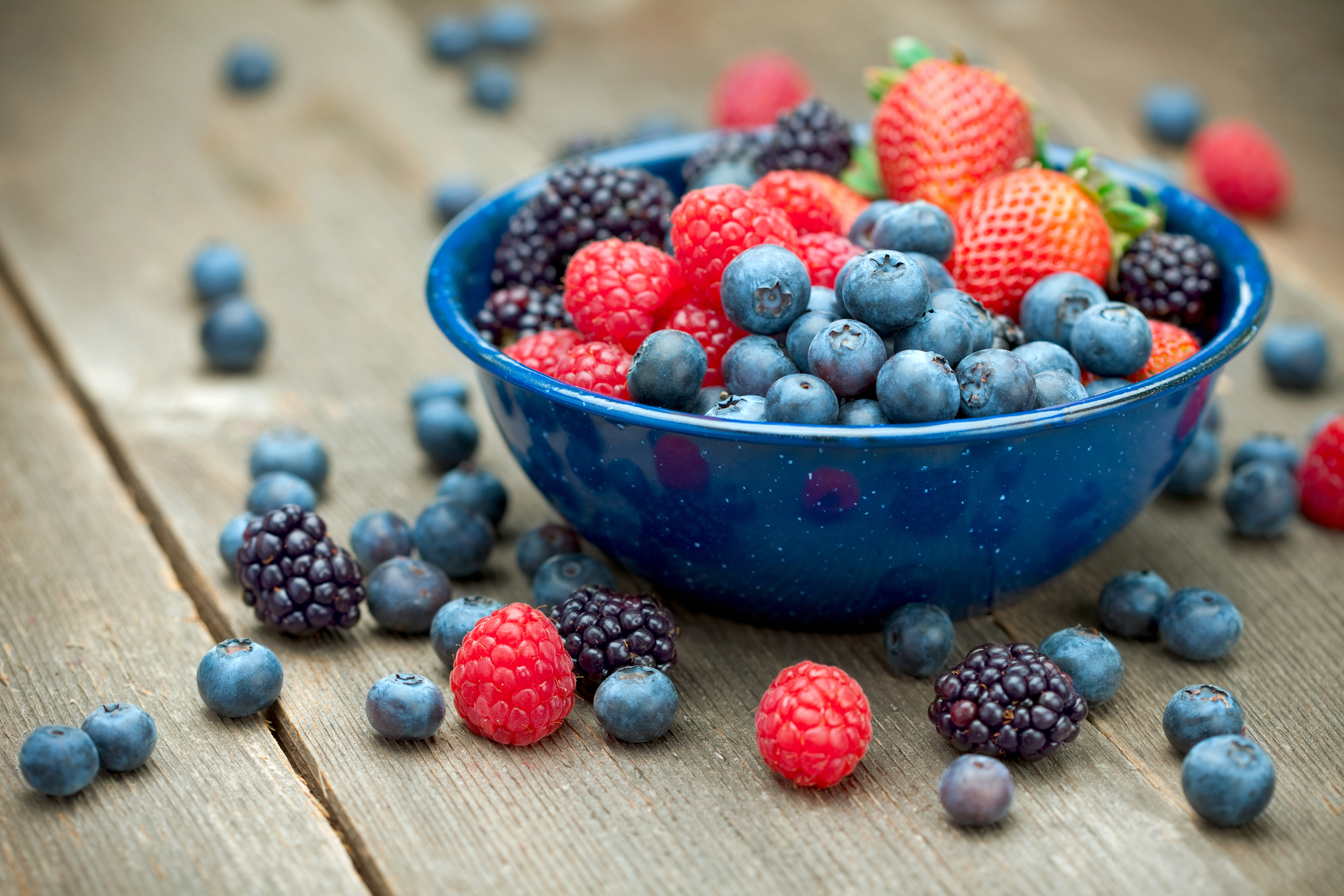
Berries generally provide vitamin C, potassium, beta carotene (which converts to vitamin A in the body), folate, fiber (both soluble and insoluble), and other healthful plant substances—and you can’t go wrong by choosing any of them. But some stand out more than others in certain nutrients or phytochemicals. For instance, black berries and raspberries are particularly good sources of fiber, with 8 grams per 1cup serving, compared to 4 grams in blueberries and 3 grams in strawberries (still good sources). Strawberries are tops in vitamin C, with 85 milligrams per cup (nearly 100 percent of the daily recommendation), though black berries and raspberries are also excellent sources, with about 30 milligrams per cup.
But what sets berries apart from many other fruits are their flavonoids and other polyphenols, a class of plant substances that have antioxidant and other potentially healthful properties. Raspberries, for in stance, have notably high levels of two flavonoids, quercetin and kaempferol; raspberries and blackberries are particularly rich in ellagic acid. Berries with deep red, blue, or purple coloring indicate the presence of anthocyanins.
Berry benefits
A number of randomized controlled trials—considered the gold standard for studying causal relationships—have looked at the effects of specific berries on various health outcomes, with overall positive results. Together with lab studies (which have identified anti-inflammatory, anticancer, immune-regulating, and other properties of berries), they suggest that bioactive compounds in these fruits may offer an array of potential benefits when eaten as part of a healthful diet, including reduction in risk of diabetes and heart disease.
Here’s a sampling of some clinical studies from more recent years. Note that they are mostly small and short term, and most were financed by agriculture promotion groups or private industry; longer, independent studies would be needed to determine if any berry benefits are genuine and persist over time.
- A study of 113 obese older men (ages 50 to 75), published in the American Journal of Clinical Nutrition in 2019, found that those who consumed the equivalent of one cup of blueberries a day (in freeze-dried powder form) for six months had improvements in blood vessel functioning, compared to those in a placebo group who consumed a similar looking and tasting placebo powder. The blueberry eaters, especially those not taking a statin, also had increases in HDL (“good”) cholesterol. A half cup a day of blueberry equivalent was not associated with significant improvements, however. And no changes were seen in insulin resistance or blood pressure.
- In a study in Obesity in 2019, 21 over weight or obese people with prediabetes and insulin resistance and 11 metabolically healthy people consumed red raspberries (one or two cups) or no berries with their breakfast on three separate days. When the prediabetic group ate the berries, especially the larger amounts, they had improved post-meal glycemic control compared to when they didn’t eat the berries and com pared to the healthy control group, and they didn’t need to produce as much insulin to control their blood sugar.
- A study in Nutrients in 2018 of 27 overweight or obese men found greater fat burning and improved insulin sensitivity when they consumed blackberries (21 ounces) daily for seven days in conjunction with a high-fat diet, compared to when they consumed a gelatin-based placebo.
- In a 2017 study in Nutrients of 17 people with knee osteoarthritis, significant improvements in constant, intermittent, and total pain were seen when they consumed a freeze-dried strawberry beverage (50 grams a day) for 12 weeks, compared to when they consumed a placebo beverage for another 12 weeks. They also had reductions in some biomarkers of inflammation and cartilage degradation.
- In a study in Nutrients in 2016, 12 airline passengers were given either an elderberry extract or a placebo starting 10 days before their overseas flights and continuing for five days afterwards. No significant differences were found in the incidence of colds between the elderberry and placebo groups (12 versus 17), but those taking the supplement had shorter and less severe colds. Elderberry has traditionally been used for the common cold.
’Tis the season (or not)
Strawberries in January, blueberries in March, raspberries in November? You can buy fresh berries all year round at many supermarkets—but they’re not likely to taste very good if they are not in season at the time. That’s because the berries are typically shipped long distances, and to survive transportation, they are harvested two or three days before they are fully ripe, says Marvin Pitts, horticulture professor and a berry crop specialist at Cornell University. If harvested when already ripe (when they are most flavorful), the berries would be injured during transport, such as by the jostling of the trucks. Some fruits (like apples) get sweeter over time even after they’re harvested because starch in the fruit is converted to sugar. But berries have negligible starch to be converted to sugar and thus don’t get sweeter after picking. And whatever sugar they have at the time of harvest actually declines over time. So you end up getting berries that are not full of flavor.
Better is to buy fresh berries when they are in season in your area—and that varies by berry and region. A good website for finding out the seasonality of berries in your state is the Seasonal Food Guide, with data from the Natural Resources Defense Council. If you live in California, say, you can see that blackberries are in season from May through September, but if you live in New York, they are at peak only in August and September. Meanwhile, raspberries are in season in Missouri, for instance, from June through October, but strawberries only from late May through August.
If you still desire berries year round, consider buying frozen ones instead of of-season fresh ones. Berries destined for freezing are typically harvested at their peak ripeness and processed within a few hours. You can also extend the season and enjoy berries all year by freezing fresh, seasonal berries yourself (see inset). Unsweetened dried berries are another good option for year-round berries.
Beyond blueberries
If you eat a variety of berries, you will get an array of nutrients and phytochemicals. Less-common berries include boysenberries (a type of blackberry), gooseberries (tart grapelike fruits related to currants), mulberries (sweet tart berries that grow on trees, not vines), ohelo berries (slightly sweet berries native to Hawaii), salmonberries (sweet berries from the Pacific Northwest), and thimble berries (fragile berries that resemble small thimbles). These may be more available at farmers markets or as juices, jams, or dried (watch out for added sugar in them, as well as in any canned berries). Though cranberries are often only thought of in the fall, they can be enjoyed all year long; they are extremely tart, however, and difficult to eat without an added sweetener.
- Select your berries carefully. They should be plump, firm, and dry, not crushed, withered, or mixed with twigs or other debris. Size doesn’t matter, but color does. Choose blueberries that are deep blue-purple, not red. Look for bright red strawberries with green caps attached. With some exceptions (like golden raspberries), green and yellow berries are unripe.
- Refrigerate berries, but don’t wash them until you eat them to slow spoilage. Eat fresh blueberries within a week; consume raspberries and blackberries sooner, because they are even more perishable.
- Freeze extra berries. If you wash them first, make sure they are thoroughly dry; toss any that are mushy, discolored, or moldy; and cut off the green tops of strawberries. Arrange the berries on a baking tray or cookie sheet in a single layer and put in the freezer for no more than a day (longer than that can result in freezer burn). Seal the berries in plastic freezer bags after removing the air inside, and lay the bags flat in the freezer if possible. They will keep for about 10 months to a year (put a date on the bag to keep track) and are best used in smoothies or in cooking.
- Watch out for berry juices, which are increasingly available but are expensive and are often mainly grape juice. Watch out also for syrups in canned berries, which add empty calories. Berry jams retain only minuscule amounts of vitamin C and are mostly sugar. Dried berries may also have fewer nutrients and added sugar.
- Add fresh, frozen, or dried berries to salads, cereal, yogurt, smoothies, pancake or muffin batter, and grain dishes.