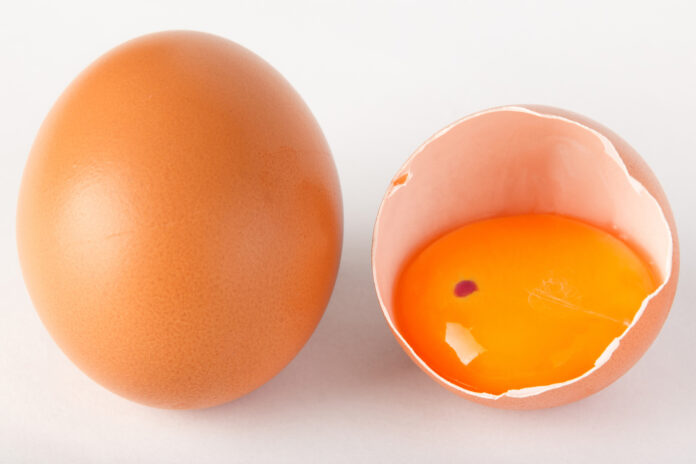
What causes the blood spot I occasionally see when I crack open an egg? Is the egg safe to eat?
Contrary to popular belief, a blood spot on an egg’s yolk does not mean the egg is fertilized. It is not a chick embryo. Rather, the spots occur when small blood vessels rupture as the yolk is released from the hen’s ovary. A blood spot actually indicates that the egg is fresh—it will dissipate over time as the egg ages.
On rare occasions, you may find brown or gray “meat spots” in the white (albumen) of the egg, which occur when tissue from the hen’s reproductive tract breaks off during egg formation.
In either case, the egg is safe to eat. You can stir the spots into the rest of the egg or, if that’s unappetizing, you can remove them using the tip of a knife. If the white of an egg is diffusely pink or red, however, throw it out, since this indicates that the egg is spoiled due to bacteria.
The chance of finding blood or meat spots is slim, since they are nearly always detected through a process used in USDA egg grading called candling. This involves rotating the eggs over a bright light to look for imperfections inside. (Candling was originally performed with candles.) Eggs found to have these spots are not marketed, though some slip through. Brown eggs tend to have more blood spots, and the spots are harder to detect during candling due to the darker shell.
By the way, it’s true that, in the past, eggs more often came from hens that mated with roosters, which increased the chance that a blood spot indicated that an egg was fertilized. But hens don’t need roosters to lay eggs (they do so naturally, and according to the amount of light)—and today, most eggs sold in grocery stores come from “virgin” hens. Moreover, if an egg happens to be fertilized, the cold, non-incubated environment in which it’s kept will not support development of a chick.