
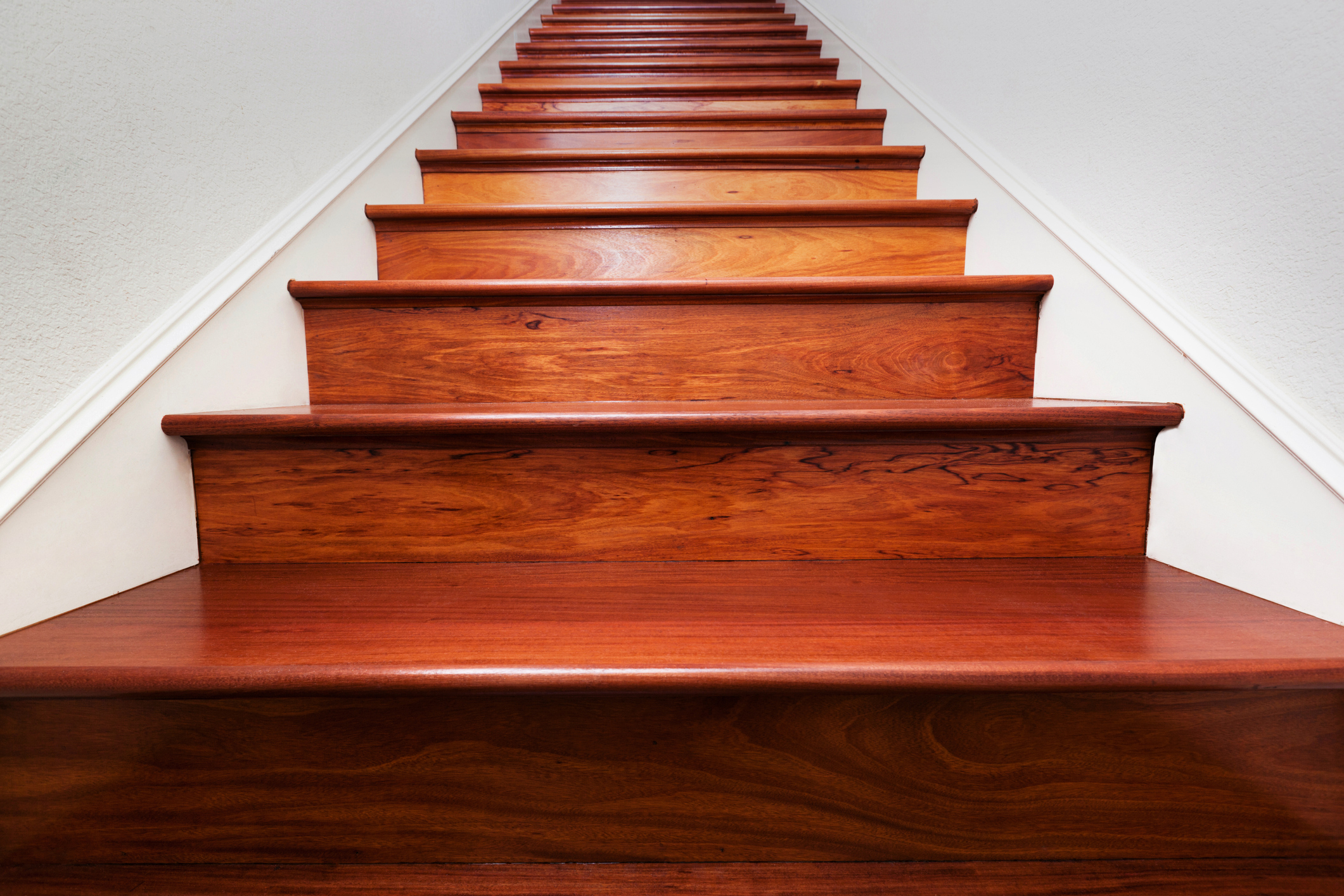
Looking for a workout routine that doesn’t require equipment or a gym membership? Consider stair climbing, which is a good way to improve cardiorespiratory fitness, strength, and agility as well as burn calories (5 to 10 calories per minute).
You can start with 25 steps or so and gradually increase the number you climb. Your goal can be a certain number of steps or flights of stairs or a set amount of time going up and down. To make it more interesting and boost fitness even more, you can do interval training on the stairs—alternate stepping at a slow to moderate pace with brief intervals at a fast pace. If you go to a gym, you can use a stair-climbing machine. And since even short bouts of exercise accumulated during the day can have health benefits, if you live or work on a higher floor, consider taking the stairs instead of the elevator.
However you do it, watch your posture: Keep your back erect or bend slightly forward from your hips. Pumping your arms and making an effort to push off the ball of your foot with each stride will increase the workout.
Note: Stair-climbing workouts can be very strenuous, so start out slowly and gradually increase the time and intensity. As with any strenuous exercise, if you are sedentary and have a chronic medical condition, arthritis of the knee or other lower extremity, or biomechanical problems, it’s prudent to consult a healthcare provider or physical therapist about the advisability of stair exercise.
Should you avoid holding on to the railing?
You may want to keep a light hand on the railing, especially if your sense of balance isn’t good or if you’re trying to increase your speed. If you use the railing to pull yourself up the stairs, you get an upper-body workout. Some people who do challenging stair-climbing workouts pull themselves up by the railing in order to go faster and take some strain off their legs. Some use a single hand on the railing, while other climbers use both hands in a more difficult but propulsive hand-over-hand technique.
Should you swing your arms?
Only if your sense of balance is good enough to not need to hold on to the handrail. Swinging your arms not only helps propel you up the stairs, but also gives your shoulders, chest, back, and arms a workout.
Is climbing two steps at a time more beneficial?
It will give muscles in your legs (notably the quadriceps) and buttocks a more strenuous workout and will burn more calories per minute. But the longer stride can be risky if you have knee problems, poor balance, or short legs (it can lead to a groin injury). You can vary your workout by switching from single-step to double-step climbing.
Is walking down stairs also beneficial?
Yes. Going up stairs is more strenuous, but going down has its own benefits and is a good form of “eccentric exercise,” in which muscles are lengthened by the load they are contracting against. When going down stairs, the front thigh muscles (quadriceps) perform eccentric contractions to support the body on each stair—an action that’s especially good for building up muscles. But going down can be hard on your knees, so don’t overextend or lock them. If you go down stairs (or downhill) a lot, you can put excessive strain on the knees or develop sore quadriceps, though the soreness will decrease with practice.
A small study in the European Journal of Sport Science in 2021 involved older people who were divided into three groups: walking up stairs, walking down stairs, or walking down stairs while wearing a weighted vest—three times a week for either three or six weeks. Those in the latter group had the most improvement in leg muscle mass.
And an earlier study in Medicine & Science in Sports & Exercise in 2017 also found that walking down stairs can be even more beneficial than going up in some ways. It had 30 healthy but sedentary obese older women (ages 60 to 82) engage in progressive aerobic training on five flights of stairs (22 steps per floor), either by going only up or only down (they took an elevator to go the other direction), twice a week for 12 weeks, gradually increasing the number of flights per week. Both groups benefited, but while women going up stairs got more of an aerobic workout, those going down stairs had greater improvements in blood pressure, blood cholesterol, blood sugar, bone density, and functional fitness.
Of course, in the real world, people generally go up and down stairs, which gives leg muscles a more balanced workout. Many stair-climbing machines (and elliptical trainers) allow you to reverse your motion, but that doesn’t replicate walking down stairs.
Are you better off repeatedly going up and down, say, 2, 5, or 10 flights (assuming you’re in a building that tall)?
We could find no controlled studies comparing the benefits of such stair-climbing patterns. You can experiment with different numbers of flights up and down to see what suits you. Going up 10 flights can tire your legs more than shorter ascents, though this will depend on whether you’re used to it or not, how many times you go up and down, how quickly you go, and how long you rest in between.
Is more always better?
Not necessarily. While some studies have involved doing dozens of flights a day, others have found that fewer flights provide benefits, too. In a very large observational study in Atherosclerosis in 2023, for instance, climbing more than five flights a day (about 50 steps) was linked with a significant reduction in cardiovascular disease over a 12.5-year follow-up period, compared with no stair climbing. But climbing 11 or more flights a day was not associated with further benefits. Another study found that participants who reported climbing more than five flights a day at home, compared to no stair climbing, had a lower risk of all-cause and cancer mortality—but higher amounts did not reduce risk any more.
Does speed matter?
Many studies have shown that climbing stairs quickly, rather than going slowly for a longer time, can provide more cardiovascular benefits. For instance, a 2021 randomized trial in Frontiers in Sports and Active Living had a small number of older people with heart disease participate in one of two different exercise routines: a traditional routine involving a combination of stationary cycling, walking, and/or working out on a treadmill for at least 30 minutes or so—or a stair-climbing routine that was high-intensity interval training and took significantly less time (participants climbed six flights at a vigorous pace three times and then walked between bouts). Both exercise groups showed improvements in aerobic fitness, but those in the high-intensity stair-climbing group exercised for a mere 10 minutes or so per session—just one-third the time of the other group.
How does climbing stairs differ from using a stair machine?
There are many differences, but it would depend, in part, on the design of the machine and how closely it mimics real stair climbing. Using a stair machine generally puts less stress on hips, ankles, and knees than real stair climbing, which could be an advantage if you have arthritis or biomechanical problems. On the other hand, real stair climbing tends to allow these joints to move through a fuller range of motion than using stair machines, which is a plus. Also, because it involves greater impact, real stair climbing would have greater bone benefits. In addition, with machines, you mimic only climbing up and not going down, so you don’t get to work your quads eccentrically. Holding on to the handrails will reduce the intensity of the workout.
Besides the benefits already mentioned, studies have found that stair climbing (like all forms of aerobic exercise) can improve health in a multitude of ways (though more robust studies are needed).
- Blood sugar. In a very small study in the journal Muscles in 2023, 16 people with type 2 diabetes either climbed stairs after eating meals or kept to their normal routine. The stair climbing involved two rounds of climbing to the second floor, each followed by returning to the first floor. After 12 weeks, there was a significant improvement in glycemic control in the stair-climbing group, compared to the control group.
- Metabolic syndrome. In a study of 782 older men and women in Holland, stair climbing from self-reports of the participants was correlated to the incidence of metabolic syndrome, which is defined as having abdominal obesity, high blood pressure, abnormal blood lipids, and high blood sugar. As reported in BMC Public Health in 2021, the researchers found that those who said they climbed stairs daily were less likely to have this condition than those who reported not climbing stairs.
- Cholesterol. In a study in the International Journal of Environmental Research and Public Health in 2021, 50 sedentary women who climbed stairs five days a week for eight weeks—either at home or in the gym—showed a reduction in LDL (“bad”) cholesterol and triglycerides (blood fats), as well as a boost in aerobic fitness and improvement in body composition, compared to a control group that didn’t climb stairs.
- Healthy blood vessels and blood pressure. In a study in Menopause in 2018, 41 postmenopausal women with hypertension did either stair climbing (192 steps, two to five times a day, four days a week) or no exercise for 12 weeks. The stair group had significant reductions in arterial stiffness and blood pressure.
- Brain health. In a 2016 study in Neurobiology of Aging, researchers correlated lifetime physical activities and education level of 331 healthy people (ages 19 to 79) with brain volume as seen on MRI scans, which decreases with age. Besides higher levels of education, higher amounts of daily stair climbing were associated with decreased “brain age.” This was an observational study, so it merely shows an association between stair climbing and brain health and does not establish causality.