
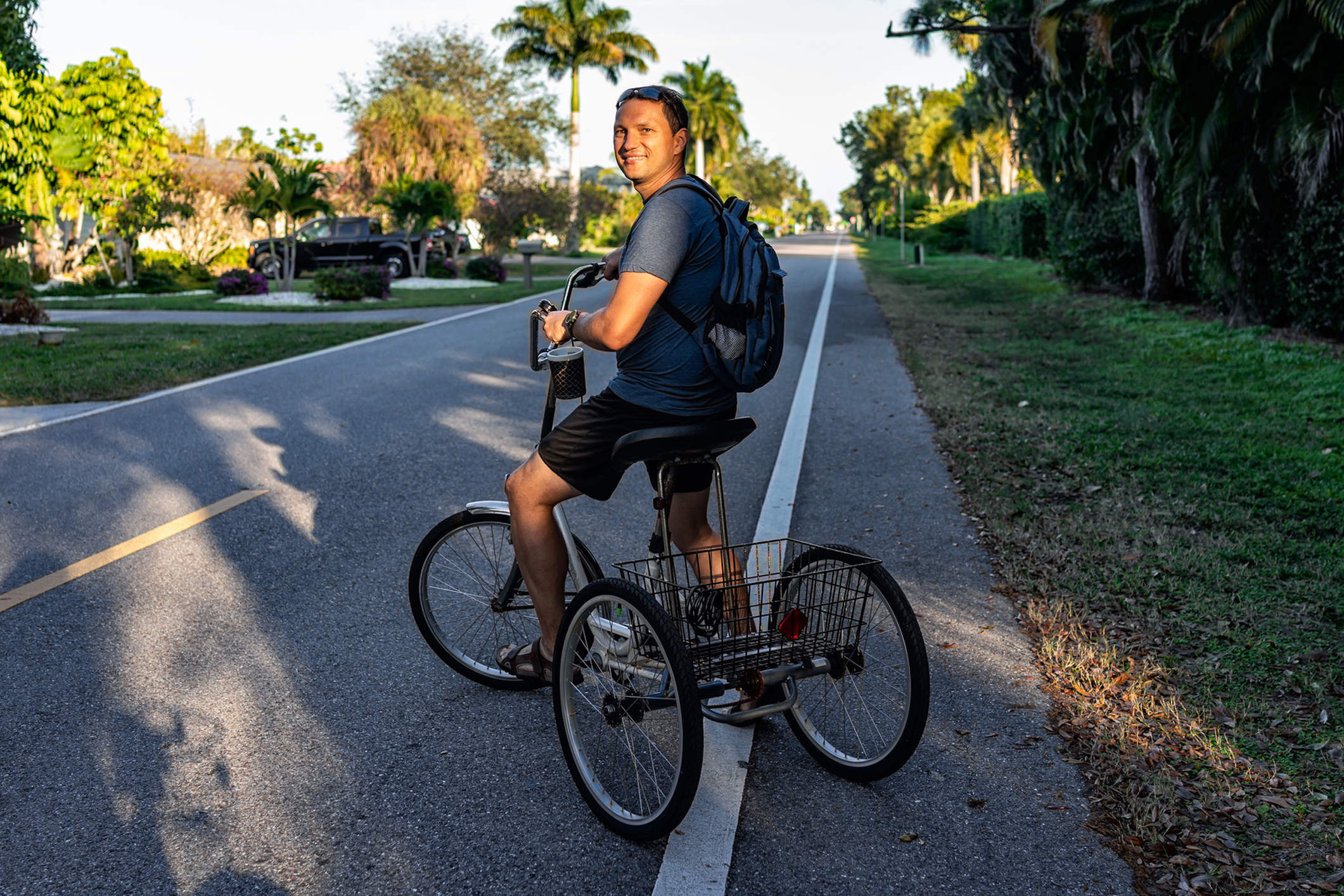
You probably haven’t considered riding a tricycle since kindergarten. But tricycles for adults—referred to as trikes—are far different from what you might buy your kids, nieces or nephews, or grandkids. These three-wheeled “bicycles” come in various styles—upright, semi-recumbent, and recumbent—with either two wheels in the rear (more typical) or two in the front, and with different features (including a variety of handlebars, seats, gears, and brakes) and accessories (like baskets).
Trikes are designed for recreational use, exercise, commuting, transporting loads, or just for fun; some are made for people with disabilities; some are electric. In other words, there is a trike out there with your name on it, should you choose to forgo a traditional two-wheeler.
Why ride a trike?
Two-wheeled bicycles are not for everyone. If you have never felt comfortable on a regular bicycle in terms of balance or coordination, you may prefer a trike. In particular, you may want to opt for a recumbent or semi-recumbent trike—where you pedal with your legs in front of you and are reclining to various degrees—if riding any kind of upright bike (two- or three-wheeled) gives you back or neck pain (usually from leaning forward). If you have knee problems, such as from arthritis, recumbent bikes reduce forces on knee joints. They also decrease the pressure on your hands and wrists. With recumbents, your back is supported, and the seat, which can be like a sling, tends to be much more comfortable; you may even feel like you’re sitting in a lounge chair. The wide seat distributes your weight over a greater area so there’s minimal pressure on your butt and groin area.
Same same but different
You’ll need to make some adjustments, however, if you’re accustomed to two-wheeled bikes. Getting on the trike, especially a recumbent one, requires that you gently lower yourself to the much lower seat without tilting the bike. Riding a recumbent trike also takes some time to get used to, not only because it’s lower to the ground and because of the leaning-back body position, but also because your arms hang down at your sides as you steer. The steering typically involves two levers rather than a single handlebar in front of you, with one lever on either side of you and sometimes one below the seat.
Because of their geometry, trikes can also be more cumbersome when making sharp turns, especially at high speeds. And unlike on a bicycle, with an upright trike—depending on its dynamics and your speed—leaning into a turn could make it more likely to tip. It’s best to keep your torso centered and do a little weight shift opposite of the curve when turning. Of course, when riding any kind of bike, you should slow down at turns.
A worthy workout?
Can a three-wheeler give you the same level of exercise as a two-wheeler? There are no published studies looking at adult tricycles, but there’s no reason to think that you wouldn’t be able to get an equivalent workout. After all, it’s not a matter of the number of wheels on the bike that determines how many calories you burn, for instance, but rather the cycling intensity, which is determined by the weight of the bike, the resistance (whether you’re cycling uphill or on level terrain), and the cadence (how fast you pedal).
Regarding muscle strengthening, an upright bike (whether two- or three-wheeled) works more muscle groups because in the upright position, your core and upper body are more involved. With a recumbent tricycle, you’re leaning back, so neither your abs nor much of the rest of your upper body is as engaged. Also, you can’t stand on the pedals or lean on the handlebars as you can on a conventional bicycle, so, again, fewer muscles are involved. But no matter—if riding a trike gets you out on the road exercising, that’s what counts most.
How to pick a trike
It’s a good idea to go to a shop that will let you test ride different types of three-wheelers before you lay down your credit card. If shopping online, carefully check the return policy, and be aware that most trikes require some assembly when purchased this way. Here are some things to consider when selecting a trike:
- Price. Prices range from a few hundred dollars to several thousand. One brand of recumbent trike with 30 speeds lists for $4,899. Electric trikes range from about $1,000 to $2,500 or more.
- Your cycling purpose or goals. If you plan to mostly ride around the neighborhood to run errands, for example, you may want an upright trike with a large basket. If you plan on long distance rides and want to go faster, an aerodynamic recumbent may be more your thing.
- Recumbent or semi-recumbent. If you want a more comfortable bike that’s easier on your joints, you can opt for a recumbent or a semi-recumbent, which vary widely in design even within each category. Some sit lower to the ground than others, and your legs are either straight out in front of you, parallel to the ground (recumbents) or pitched both down and out front (semi-recumbents). Recumbents have either two wheels in the front (tadpole trikes) or two wheels in the rear (delta trikes), and this wheel placement affects how stable they are when turning and how maneuverable they are in tight spaces.
- The type of seat. These vary on all types of bikes. On recumbents, some seats can be adjusted in their angle; some are like a breathable mesh hammock (which may be comfortable especially in hot weather); and some support your neck and back more and are cushioned. Uprights can have narrow or wider and more cushy seats. Ultimately, your best seat choice depends on what you find most comfortable during your test rides.
- The kind, or number, of gears. What to choose depends on the terrain you intend on cycling. Low gears make it easier to pedal over hilly terrain; for flat terrains (without headwind), a single speed may do. If you expect to be doing a lot of uphill biking on a trike, or if you live in a region that can be windy, you may need to get more low gears than you would with a bicycle.
- The weight of the bike. If you will need to lift the bike often, such as to transport it in your car or to store it, you might want a lighter aluminum or titanium (most expensive) one, compared to a heavy steel-framed bike. Heavier bikes tend to be sturdier and more stable but also slower.
Safety notes: To reduce the risk of a car hitting you, especially with the lower-to-the-ground recumbent trikes, it’s a good idea to attach a tall, vertical fiberglass rod with a colorful flag so motorists can easily spot you. And, of course, no matter how many wheels your bike has, wear a helmet for safety.
Pros:
- Trikes are more stable than two-wheeled bikes, which makes them easier to ride for many people.
- You don’t have to keep pedaling to maintain balance as you ride. And, when you stop, you don’t have to balance the bike since with three wheels, there’s no tipping over as you slow down. Even someone who has never ridden a bike can pretty easily ride an upright trike.
- If you need to transport heavy loads (such as groceries), three-wheeled bikes, because of their geometry, are able to carry more gear in a stable manner compared with two-wheelers.
Cons:
- Recumbent trikes put the rider lower to the ground, making it harder for motorists to see them in traffic. Many trikes are also wider than two-wheeled bikes, which may be more problematic in a narrow bike lane or cause a rider to stick out into traffic more.
- If you’re on a trike and you must walk it because of a rough surface, this is more difficult to do compared with a two-wheeled bike.
- Trikes are typically heavier and bulkier than two-wheelers, though some are foldable. Consider that if you need to store the trike in your home or garage.
- If you’re using the trike to run errands or commute, it’s more challenging to lock it to a bike rack due to its wider size.
- When riding a recumbent, your feet can more easily slip off the pedals if you hit a pothole or bump, compared to an upright, and this can cause injury. To prevent this, consider buying foot straps for the pedals.