I use soap made with Moroccan argan oil, but I’m wondering if the oil is also edible. If so, is it a healthful oil?
Body care products containing argan oil—from soaps to shampoos to lotions—are certainly trending these days. But yes, the oil, which is derived from the fruit of a spiny tree native to Morocco, is indeed edible.
Moroccan folk medicine has long relied on argan oil and other parts of the tree to treat a host of illnesses and conditions, including high cholesterol, diabetes, fever, intestinal disorders, lung infections, and skin and hair problems. But published human studies on the possible health benefits of consuming argan oil—some dating back nearly two decades—have mostly involved blood lipids, as discussed below.
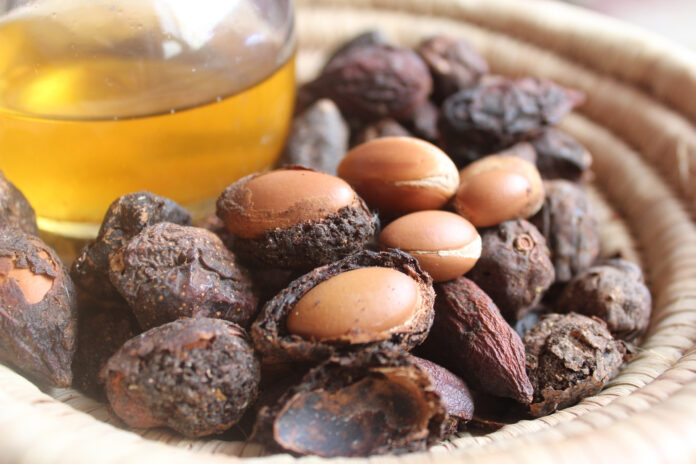
Argan oil is produced from the small kernels (seeds) found inside the fruit’s hard pits (often referred to as nuts). The oil used for cosmetic purposes is made from unroasted kernels, while food-grade argan oil is made by cold-pressing roasted kernels. The oil is mostly unsaturated, made up predominantly of oleic acid (the same monounsaturated fatty acid in olive oil) and linoleic acid (the polyunsaturated omega-6 fatty acid found in most vegetable oils, including corn, soy, and sunflower oil).
In fact, argan oil is overall quite similar chemically to olive oil, since the main fatty acid in both is oleic acid. The fruit even looks somewhat like a large olive. Argan oil also contains various polyphenols, including flavonoids and terpenoids, that have antioxidant properties.
Here’s a look at some studies on argan oil and blood lipids:
- In a study in Clinical Nutrition and Metabolism in 2004, the lipid profiles of 62 healthy people who regularly consumed argan oil were compared with those of 34 healthy people who did not consume the oil. Those in the argan oil group were found to have significantly lower LDL (“bad”) cholesterol levels.
- In another small study, published in the British Journal of Nutrition in 2012, 40 people in Algeria were assigned to either an intervention group that consumed 15 grams (about one tablespoon) of argan oil a day or to a control group that didn’t consume the oil. After a month, the argan oil group had lower total and LDL cholesterol levels and lower blood triglycerides (other fats in the blood), as well as higher vitamin E levels (argan oil contains some vitamin E) and better antioxidant status. The authors concluded that they showed “that argan oil is able to positively modulate some surrogate markers of CVD [cardiovascular disease], through mechanisms which warrant further investigation.”
- But another study, in Annals of Nutrition and Metabolism in 2005, did not find an LDL-lowering effect from argan oil. It compared the effects of argan oil (25 grams, almost two tablespoons, a day) to the same amount of olive oil in 60 healthy Moroccan men who consumed butter as a pretreatment. Participants in both oil groups had similar increases in HDL (“good”) cholesterol after three weeks—but only the olive oil treatment resulted in reduced LDL cholesterol, while only those in the argan oil group had reductions in triglycerides.
A note about cosmetic use. You may love the way argan oil feels and smells and think it’s doing wonders when you apply it to your skin and hair. But there’s limited evidence it has any special properties beyond other oils—and at least one review paper did not find any significant evidence that argan oil improves hair quality. In any case, many argan products don’t contain as much argan oil as you may think. The ingredient may not be at the top of the ingredient list, as in this shampoo (where it ranks ninth and below “parfum/fragrance”), or the product may contain additional oils and lubricating ingredients.
BOTTOM LINE: Use argan oil in food if you like the nutty flavor, keeping in mind that there’s no solid evidence that it has greater health benefits for blood lipids or other conditions than other unsaturated oils, most notably olive oil. Larger and better-designed studies are needed. Culinary argan oil isn’t cheap, either, with prices of up to $35 or so for a small 8-ounce bottle. And remember: If you intend to ingest argan oil, only use food grade, not cosmetic grade. Don’t use argan oil in cooking—it burns easily. Rather, you can use it as a dip or spread for bread, an ingredient in salad dressings, or to drizzle over fish or rice, for instance. You can find food-grade argan oil in many health food stores and online.
If you want to try argan oil on your skin, start with only a tiny bit to make sure your skin doesn’t react. And if you have a skin condition such as psoriasis, seborrheic dermatitis, or eczema, it’s best to speak with your dermatologist first before applying argan oil to your skin or scalp.
The argan tree, which can live at least 200 years, is cultivated in Morocco. The trees are important ecologically because their deep roots protect the land from wind and water erosion and also make the trees resistant to drought.
Through UNESCO, the United Nations has declared the argan tree forests of Morocco a biosphere reserve (a site that’s important for sustainability and biodiversity conservation) and, in 2021, established May 10 as the International Day of Argania (the scientific name of the argan tree is Argania spinosa). The trees are especially important to the native Amazigh population of North Africa, whose economy depends on them, especially their oil.