Because I have dense breasts (and a family history of breast cancer), I’ve been getting regular breast ultrasounds in addition to yearly mammograms. But now I see there is an option of getting an automated breast ultrasound rather than conventional handheld ultrasound. Does the automated way do a better job of finding lesions? Are there any disadvantages?
As we’ve reported, greater breast density is not only a risk factor for developing breast cancer, but it also makes it tougher to detect small tumors on a mammogram. Dense breasts contain more glandular or fibrous connective tissue than fat, and that tissue appears as white areas on mammograms. The problem is, so, too, do tumors.
So women with dense breasts—which describes nearly half of women over age 40—often have an ultrasound in addition to standard mammography screening.
Automated breast ultrasound (ABUS, for short) is a newer form of ultrasound, but it has been around for a while. Over a decade ago, the FDA approved it as a screening tool for women with dense breasts, to be used along with mammography. This was based on research showing ABUS to be capable of detecting tumors missed on mammograms of women with dense breasts. (The approval was not based on any evidence, however, that ABUS is better than handheld ultrasound or that it saves women’s lives—two outcomes that have not been adequately studied.)
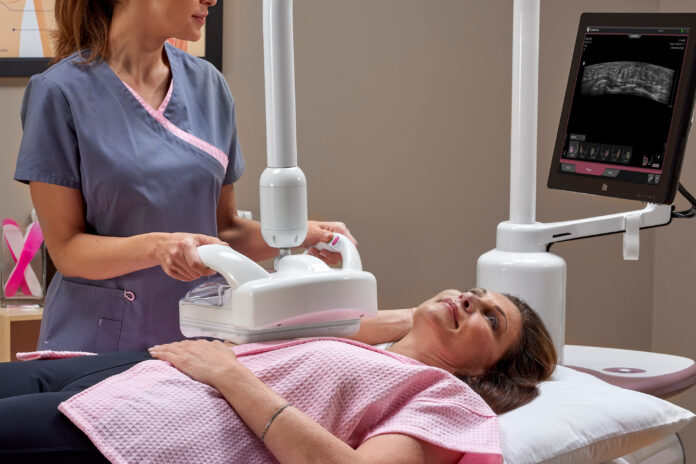
The exam itself, which takes about 15 minutes, is fairly simple. The ABUS machine consists of a base with a monitor, plus an arm with the ultrasound transducer that sends out sound waves. The transducer, which is padded and curved, is placed on your breast as you lie on an exam table. It sends the sound waves into the breast tissue, creating “echoes” that are translated into images. Compression of the breasts during the exam may cause some discomfort. In contrast, handheld ultrasound—as it sounds—is done by a technician who moves a smaller transducer over each breast after applying a gel.
ABUS clearly has some advantages over handheld ultrasound: It produces digital 3D images that are stored—meaning they can be read more than once and compared with any previous exams. With handheld ultrasound, the technician is looking for abnormalities in real time, so it’s more dependent on that individual’s experience and skill.
But is the new-fangled better than the old-fashioned in supplementing breast cancer screenings? It’s not clear.
There’s little research directly comparing ABUS and handheld ultrasound for screening. One study published in 2021 in the Brazilian Journal of Gynecology and Obstetrics hinted that ABUS was better at picking up tumors: It involved 440 women with dense breasts undergoing supplementary screening with either automated or handheld ultrasound. Overall, ABUS detected cancer at a rate of 4.5 per 1,000 women, versus 2.3 per 1,000 with handheld.
The study was done at a single Brazilian medical center, however. Whether those findings translate broadly is far from clear. And on balance, research so far suggests the two forms of ultrasound are comparable in their ability to enhance tumor detection when used along with mammography screening.
A 2019 review in the Journal of Breast Imaging pulled together a few dozen studies that assessed ABUS or handheld for supplementary screening (but did not directly compare them). On average, studies using handheld had a cancer detection rate of 2 to 2.7 per 1,000 women, while the average for ABUS was 2.5 per 1,000.
What is clear is that adding either type of ultrasound to standard mammography can detect more small tumors in women with dense breasts. A 2023 Cochrane review summed up the state of the evidence: Across four studies involving over 60,000 women with dense breasts, supplemental ultrasound picked up an additional two or three cancers per 1,000 women, versus mammography alone, over one to two years.
The downside of supplemental ultrasound is that it increases the chances you’ll be called back for further testing, possibly a biopsy, for a suspicious finding that turns out not to be cancer, and this can cause undue stress.
The Cochrane report also highlighted an important point: We don’t yet know whether supplemental ultrasound, whatever the method, ultimately saves more lives than mammography screening alone. That kind of evidence takes a long time to gather. Fortunately, breast cancer caught at an earlier stage is very treatable, and women often live for many years after a diagnosis.
Because the ultimate value of ultrasound in saving lives is still not known, major medical groups like the American Cancer Society do not yet have specific screening guidelines for women with dense breasts. Instead, it’s up to women and their doctors to decide whether to supplement mammography with ultrasound (or take another approach).
Similarly, the type of ultrasound you may have comes down to what your doctor recommends and what’s available in your community. Many medical centers now have ABUS, but it is not necessarily offered at the facilities in your area. It’s also more expensive than handheld ultrasound, so you would want to find out what your insurance covers ahead of time. (Medicare Part B, for instance, covers breast ultrasound when ordered by a healthcare provider as “medically necessary,” but there may be out-of-pocket costs.)
What is most important is that you talk with your doctor about your screening options, decide what’s best for you, then continue screening at regular intervals.