
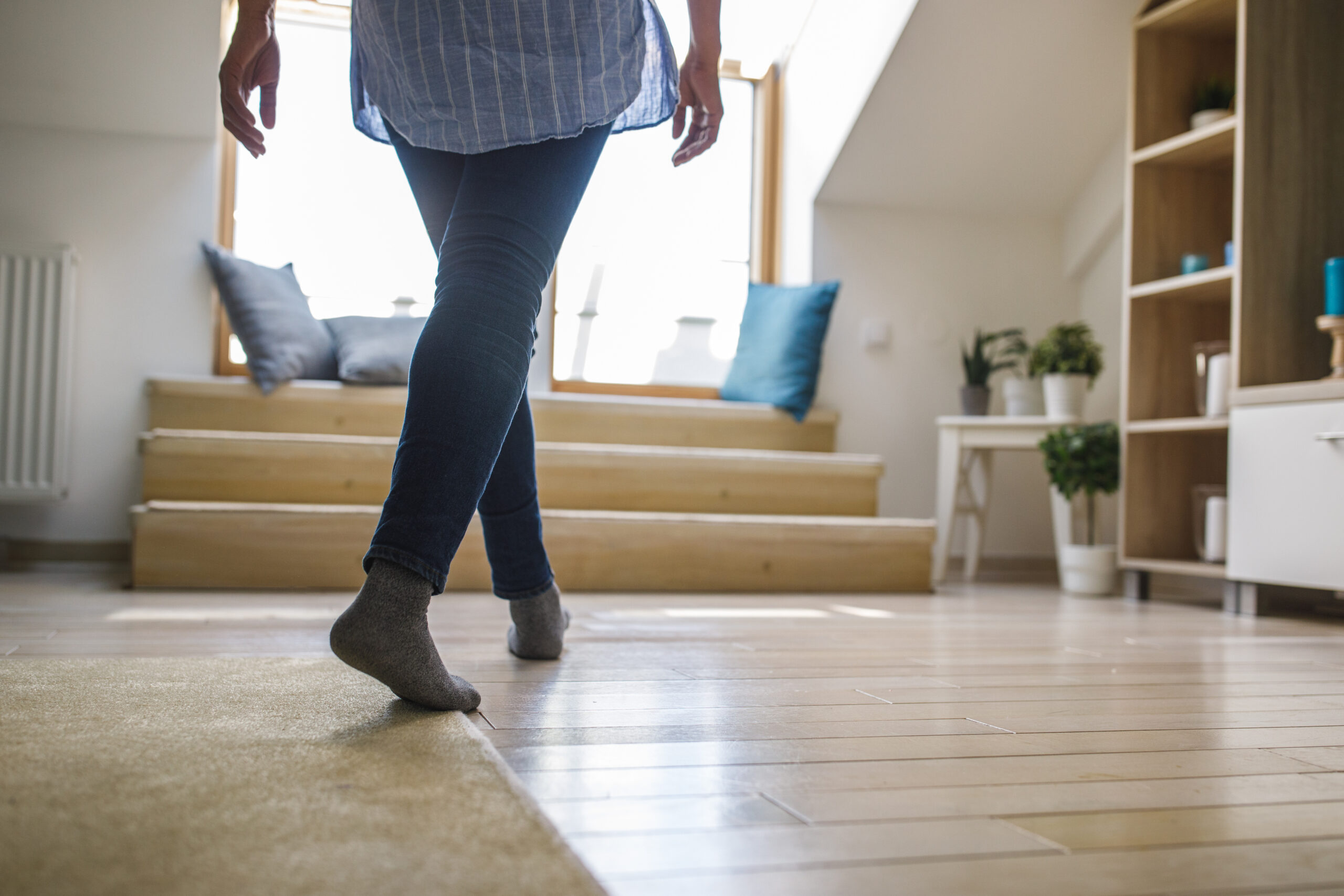
If you spend hours on end sitting, here are your marching orders: Get up and take a five-minute walking break every half hour. Exercise physiologists at Columbia University deemed this to be the optimal ratio of sit-to-walk time for heading off some of the most harmful effects of prolonged sitting, which include an increased risk of cardiovascular disease. Such exercise “snacks” are good for your mood and energy level, too, the researchers also found.
In the small study, which was published in Medicine & Science in Sports & Exercise in early January, 11 generally healthy but sedentary middle-aged and older participants (in their 40s to 60s) spent eight hours sitting in ergonomic chairs in a lab, getting up only to do one of five assigned activities for the day, which involved “light” walking on a treadmill (2 mph at 0% incline) for one or five minutes every 30 or 60 minutes—or doing no physical activity at all for the entire time (save for getting up to go to the bathroom). During the course of the day, participants had their blood pressure measured every hour and their blood sugar every 15 minutes, as indicators of cardiometabolic risk factors.
This was a so-called crossover study, such that all participants engaged in each of the four interventions and the no-activity control group over five separate days.
Here are the main findings:
- Only the five-minute walking break for every 30 minutes sitting resulted in significantly lower blood sugar, compared to the control group.
- Taking a walking break of any duration reduced systolic blood pressure (4–5 points), compared to sitting all day; even just a one-minute break every 60 minutes was beneficial.
- Compared to the control condition, all walking breaks, whatever the duration and frequency, had positive effects on mood—but the best result was from walking five minutes every 30 or 60 minutes.
- Walking one or five minutes every 30 minutes, or five minutes every 60 minutes, reduced fatigue, compared to the control condition. Walking only one minute every 60 minutes was not enough.
Various health organizations, including the American College of Sports Medicine and the World Health Organization, have recommended a decrease in sedentary behavior. Likewise, the Physical Activity Guidelines for Americans advise not only increasing physical activity but also decreasing sedentary time—that is, sit less, move more—but few studies have quantified the recommendation as this one did. Among the most interesting findings was that “short, relatively infrequent sedentary breaks are sufficient to mitigate the blood pressure increases incurred with prolonged sitting.”
Of course, this was just one small slice of time in a small group of mostly healthy adults, so it’s not possible to generalize the findings to real-life conditions over time or to people of different ages or different fitness levels or those with preexisting medical conditions. Also, the study didn’t test all possible sitting/walking combinations, and it’s very possible that less frequent but longer walking breaks (such as 10 minutes every 60 or 90 minutes) or other activities (such as doing squats) would also be effective. Perhaps they would be even better.
In addition, while it’s not clear what benefit there is in reducing blood sugar in a group of nondiabetic people whose levels are already within normal limits, the significant decrease in that measure found in the study may be more important for those diagnosed with diabetes or prediabetes.
Still, the study serves as yet another nudge to take more frequent breaks from sitting, for both your physical and mental well-being. If you tend to be a couch (or desk) potato, getting up for five minutes every 30 minutes may be more than you’re used to—but we don’t think that’s too much to ask to improve not just your blood pressure and blood sugar but also your mood and fatigue level. It’s the least you can do for yourself—literally.