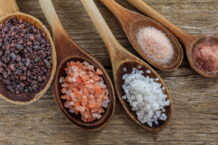

Americans eat way too much salt. That’s a problem since sodium, which makes up 40 percent of salt (sodium chloride) by weight, is associated with elevated blood pressure and other health issues. On average, we get 3,400 milligrams of sodium a day, which is nearly 50 percent more than the 2020–2025 Dietary Guidelines’ recommendation for adults to limit sodium to no more than 2,300 milligrams a day.
Most of this sodium comes from processed foods and foods prepared in restaurants or other establishments, not from the saltshaker at the table. In 2021, the FDA released voluntary guidelines for commercial food operators to reduce sodium in their products—but since these are not enforceable by law, whether and how much this will lower consumers’ sodium intake is yet to be seen. That means, at least for the foreseeable future, that the burden still lies largely with consumers to seek ways to reduce the sodium in their own diets.
Readjusting your taste buds
People eat overly salted foods because they are typically exposed and habituated to them from an early age and so come to both like and expect the taste. Foods that have less salt are often considered too bland. The good news, as several studies have found, is that if you incrementally lower the amount of salt you consume, your taste buds can adapt to the change without too much difficulty. In fact, over a relatively short time, foods that you once found to be too bland will become tasty, and those you once thought were seasoned just right will taste too salty.
The key is to make the adjustment gradually—though there is no hard and fast rule as to how gradual “gradual” is. The number of days (or weeks) it takes to retrain your palate is all over the place in studies.
In the most recent study to look at changing preferences for salty foods, 19 people with hypertension received education about a low-sodium diet and got individualized attention focusing on what was preventing them from lowering their sodium intake and how they could best achieve their goals, whether eating at home or in restaurants. After 16 weeks, the participants reduced their daily sodium intake by some 30 percent. More to the point, they increased their liking for lower-sodium foods (though it appeared they still had a predilection for salty foods). And it took just three weeks for most of the participants to adjust.
This very small study was presented at the scientific congress of the European Society of Cardiology in May 2022 and is a pilot study, so the results are considered preliminary. But earlier studies have had similar findings.
For instance, a study in Food Quality and Preference in 2015 looked at the effectiveness of a relatively quick (over four weeks) versus a more gradual (over 14 weeks) sodium reduction for retraining one’s salt palate. Both groups consumed tomato juices with incrementally lower concentrations of sodium to get them to the same low-sodium goal at the end of the periods mentioned. While some variations were seen between the two groups based on their motivation to lower their salt intake (as assessed before the study), in the end, both groups increased their liking for the lower-sodium juices (though they still preferred the saltiest one).
Of note, this downward shift in preference for salt was experienced not in the context of an overall low-sodium diet. Rather, as the study concluded, “the approach of reducing sodium in one to a few foods at a time may be an alternative yet equally effective means by which to reduce dietary salt intake.”
In another small study in Food Quality and Preference—this one lasting only eight days—participants were divided into three groups that ate soup with different levels of sodium each day. One group consumed less than one ounce of a no-salt soup sample; another group consumed a 9.5-ounce bowl of the same no-salt soup. A third (control) group consumed three ounces of soup with a typical high salt content. Both no-salt groups increased their liking for these options after their third exposure (in just three to five days). “These data suggest,” the study encouragingly concluded, “that simple exposure to the taste of the no-added-salt soup was sufficient to increase liking to a level equivalent to the initially more preferred salt level.”
Some older studies from the 1980s have shown that taste preferences for salt decrease after being on a low-sodium diet (for instance, 30 to 50 percent less sodium) for some two to three months. Meanwhile, a patient education handout from UpToDate, an evidence-based clinical resource, spells out a time frame of only 10 to 14 days, based on its recent review of the literature.
BOTTOM LINE: If you need to lower the salt in your diet for health reasons, don’t despair thinking that you’ll end up eating flavorless, bland, insipid foods forever. Gradually reducing the salt in your soups, stews, cottage cheese, salad dressing, and other foods (whether ready-made or prepared at home) should retrain your taste perception within two to three months max, if not much sooner. If you eat canned or other packaged foods, you can eventually get to your lower-sodium target level by mixing them with reduced-sodium, low-sodium, or no-salt-added versions in various proportions (see box below).
Other diet changes can also have a major impact on your sodium intake, such as reducing the portion sizes or the number of times you eat prepared or packaged salty foods. When dining out, ask that the chef not add any extra salt. Or choose lower-sodium options all around, whether it’s cheeses, crackers, salad dressings, or soups. At home, when cooking, rather than relying on salt, use onions, garlic, and the like; herbs and spices, such as dill and curry powder; citrus juice (or slices or zest); or flavored vinegars and infused oils. You can find many tasty lower-sodium recipes online, including at the Mayo Clinic and EatingWell websites.
Here’s an example of how you can lower the sodium of a common food, cottage cheese, that has more sodium than you may realize—about 350 to 450 milligrams per half-cup serving. (It’s easier than it may sound.)
- Start by mixing six tablespoons of regular cottage cheese with two tablespoons of a no-salt-added version (eight tablespoons = a half cup).
- After a week or two of getting used to this combination, mix together four tablespoons of each.
- By the third or fourth week, mix two tablespoons of regular cottage cheese with six tablespoons of no-salt-added.
- That’s not a bad place to land, but you could take it even further and go for all no-salt-added cottage cheese, which you can liven up with your own sweet or savory additions—such as crushed pineapple, applesauce, apple butter, cinnamon, nuts or nut butter, salsa, eggs, or veggies (like roasted peppers or cucumbers and tomatoes with a drizzle of olive oil)—to take the place of salt. Just make sure your additions aren’t high in sodium (or added sugar).