
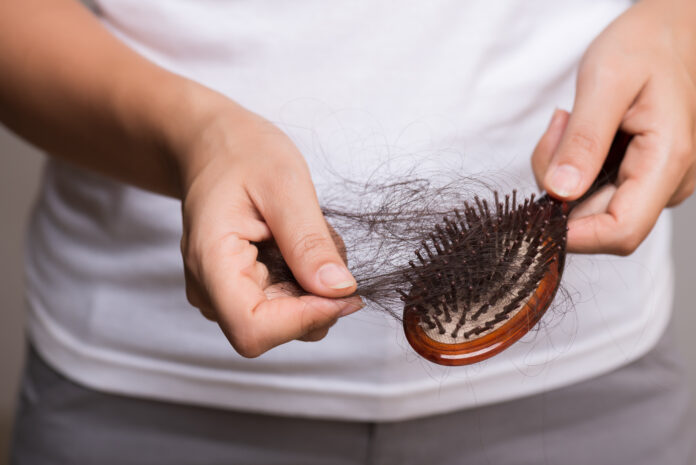
My hair seems to be coming out by the handful these days. What might be causing that? Could it be stress?
This sounds like a condition medically termed telogen effluvium (and sometimes called stress-induced alopecia), which is different from hereditary male or female pattern hair loss or alopecia areata (an autoimmune condition that causes bald spots). The good news is that the excessive shedding is usually temporary.
It’s normal to lose about 50 to 100 hairs a day as part of the normal cycle of growth and shedding, with each strand of hair going through three distinct phases: anagen (the active period of growth, lasting for several years); catagen (a transitional period of a few weeks, during which time the hair follicle shrinks); and telogen (the “resting” phase that lasts a few months, during which hair sheds). After the telogen phase, the process starts anew with a new hair. At any given time, about 85 to 90 percent of a healthy person’s hairs are in the anagen phase, about 3 percent are in catagen phase, and about 5 to 10 percent are in the telogen phase.
But some shock to the system—whether physical or psychological—can interrupt the normal hair cycle and push a much larger percentage of anagen hairs into the telogen phase, resulting in telogen effluvium and more hair falling out than usual. This can occur, for instance, after giving birth, crash dieting, recovering from an operation or illness, having a high fever, stopping birth control pills, or being under a lot of stress—which many people have certainly experienced during the Covid-19 pandemic. Other psychological stressors include losing your job, getting divorced, or caring for a sick loved one. Other physical stressors are nutrient deficiencies (such as of iron or zinc) or the use of certain medications.
Interestingly, the increased hair loss typically occurs several months after the stressor, which explains the lag between the event and when you may notice excess shedding. But as the body readjusts, the shedding stops, and hair returns in about six months to its normal fullness—though long-term stress can lead to chronic telogen effluvium.
Another possibility is that you haven’t been losing more hair than usual but have simply been noticing it more. Perhaps you have let your hair grow longer, so the shed hairs are easier to see and accumulate more in the shower drain or in your brush or on your pillow.
If you don’t think any of the above explanations are the likely cause of your recent hair loss, see your doctor or a dermatologist. Sudden or excessive hair loss can also be a sign of a medical condition, such as hypothyroidism, that needs evaluation but which, when treated, should return your hair to its normal growth phases.