
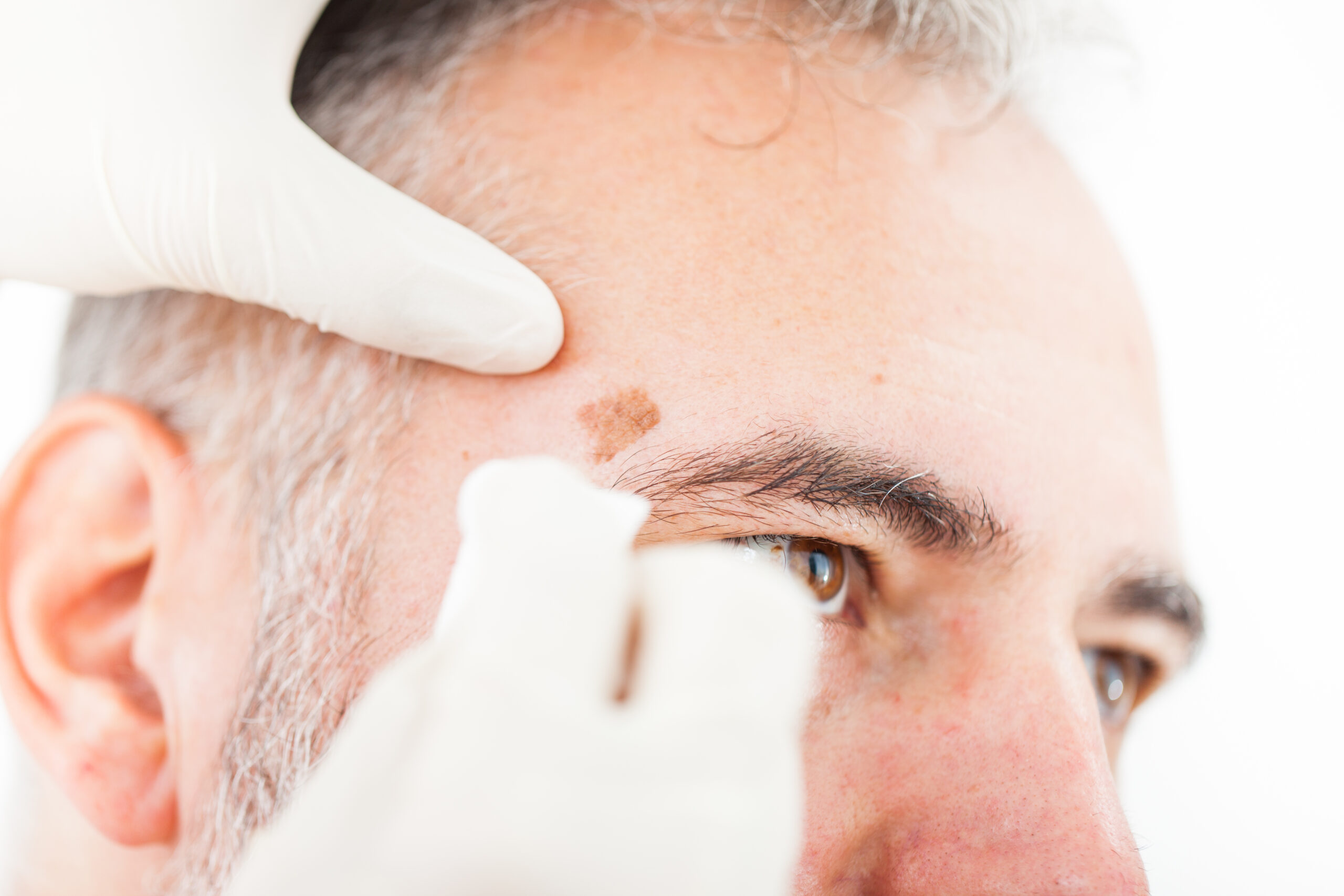
An estimated one in five Americans will develop skin cancer in their lifetime, making this cancer, as a whole, the most common one in the U.S. On a daily basis, that translates into some 9,500 diagnoses, with rates of many types of skin cancer continuing to rise, including the most frequent ones—basal cell carcinoma and squamous cell carcinoma. Melanoma is rarer but much more deadly if not caught early.
A standard treatment for skin cancer involves excising the tumor, along with a wide enough margin around it to ensure that all the cancerous cells have been removed. The limitation of that approach is that after the tissue is removed and then analyzed postoperatively, only a very small fraction of the margin is actually examined. Thus, even if the margin samples look clean, that doesn’t mean all of the cancer cells have been removed, and regrowth can occur.
In addition, because a significant amount of normal tissue around the tumor is removed, this may lead to a less-than-desirable cosmetic effect and is problematic in places where there isn’t much extra skin for “margin room,” notably on the nose, lips, and ears and around the eyes.
A better way
An in-office procedure called Mohs micrographic surgery—which was pioneered by Dr. Frederic E. Mohs in the 1930s, though it didn’t enter mainstream medicine until decades later—addresses the concerns noted above.
It involves a doctor, usually a dermatologic surgeon trained in the procedure, progressively removing thin layers of skin, akin to peeling an onion. The excised tissue is then examined under a microscope during the procedure rather than after the patient leaves, as occurs in standard excisional skin cancer surgery—with the Mohs surgeon acting also as the pathologist. If cancer cells are detected, the doctor then goes back and takes off another thin layer at the very same spot.
This is repeated as many times as necessary (often all the cancer is removed on the first, or at least the second, try), and the patient goes home assured that virtually every cancer cell was caught. In addition, the increased precision allows for better cosmetic results.
Mohs surgery is typically used on the face, but it can also be done on the hands, feet, genitals, and other areas where the goal is to preserve as much healthy tissue as possible and minimize scarring. Some Mohs surgeons work in tandem with plastic surgeons for even better cosmetic results, especially for procedures done around the eyes.
When to go for Mohs
Mohs can successfully treat many skin cancers. In a 2019 review in the Journal of Cutaneous Medicine and Surgery, researchers at several Canadian universities and cancer research centers looked at evidence on the effectiveness of Mohs surgery by combing through studies published between 1970 and 2017. Among the 21 studies reviewed, a randomized controlled trial showed that for basal cell carcinomas that had returned and needed to be removed again, the 10-year recurrence rate was nearly four times higher for conventional excisional surgery than for Mohs surgery.
Another study cited in the review found significantly smaller surgical defects (holes left after the procedure) with Mohs than with standard surgery; when closed up by the surgeon, smaller surgical defects result in scars that are shorter in length.
According to guidelines published in 2019 by the Canadian Agency for Drugs and Technologies in Health, Mohs surgery is recommended as a first-line treatment for high-risk primary or recurrent basal cell carcinoma and may be considered an option for high-risk primary or recurrent squamous cell carcinoma. It may also be considered for removing melanomas in situ—melanomas that are still in the epidermis (the top layer of the skin) and have not yet become invasive. (This is called stage 0 melanoma or sometimes described as a “precancer.”)
In general, the American Academy of Dermatology says, Mohs is a good option not only for early-stage melanoma but also for basal cell or squamous cell carcinomas that are aggressive or large; appear in an area with little tissue to spare, such as an eyelid; or were treated previously by conventional surgery and have returned. And it’s appropriate for certain rarer types of skin cancer.
BOTTOM LINE: If you have a skin cancer, ask your dermatologist about all the different treatment options available. Commonly, skin cancers are destroyed by cutting (curettage) or burning (electrosurgery) or even with topical chemotherapy, all of which have advantages and disadvantages. If it’s advised that yours be cut out, however, Mohs may be preferable to standard excisional surgery, depending on what type of skin cancer it is and how important a good cosmetic outcome is for you. Your dermatologist should refer you to a doctor trained through an accredited Mohs fellowship.
Here’s what to know and ask beforehand:
- Is the doctor a fellowship-trained Mohs surgeon? Will he or she be doing the actual procedure? (Mohs surgery at medical centers is often performed by fellows still in training and supervised by the attending surgeon.)
- Is the doctor’s practice dedicated exclusively to Mohs procedures? Be wary of “part-time” Mohs surgeons, who see lots of patients for other skin problems.
- Schedule a consultation first. Make sure your referring doctor has sent a biopsy report and photographs of the site. Let the surgeon know if you are on blood thinners.
- Be aware that the whole procedure, including wait times between stages, can take anywhere from two to seven hours, because the surgeon may be working on multiple cases at a time. To avoid longer wait times, try to schedule the first or second appointment of the day.
- Be aware that the procedure can be much more expensive than a standard skin cancer excision. Find out if your insurance will cover it and have the procedure pre-approved.
- Weigh all your options first. Mohs surgery is not necessarily the best one or needed in all cases.
- By the way, though the procedure was named after the pioneering Dr. Mohs, it is also now referred to as MOHS, an acronym for Micrographic Oriented Histological Surgery.