
Every so often, some research comes along that makes me pause—not because the finding is necessarily so surprising, but because it shows how subtly our everyday decisions can be shaped.
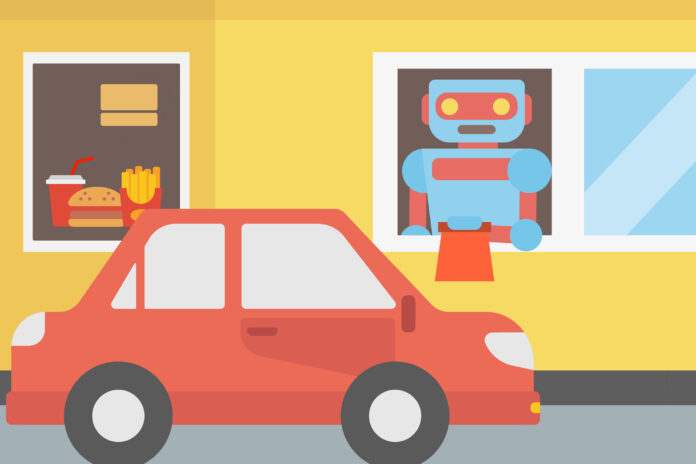
A new study, published in the International Journal of Hospitality Management in April, looked at a growing feature of fast food restaurants: customers placing drive-through orders by speaking to a voice-activated artificial intelligence (AI) system instead of a human employee. In these systems, the AI listens, records, and processes the order.
That technological change may sound rather inconsequential in today’s age of automation, but the study suggests it could have health implications.
In simulated drive-through scenarios used in the study, participants interacting with voice AI were more likely to choose more indulgent foods (a cheeseburger-and-fries combo) than participants interacting with a human voice, who were more likely to opt for the healthier combo (grilled steak salad and fruit).
Why would the entity on the other end of the drive-through speaker influence what ends up in your take-out bag? As the researchers explain, interacting with voice AI requires more mental effort than speaking with an actual person. Without the usual cues of conversation—tone, timing, visual feedback—people must work harder to communicate clearly, resulting in a brief dip in mental energy known as cognitive depletion.
And when mental energy dips, that affects our decision making. Foods that are indulgent and immediately rewarding may become more appealing and harder to resist than healthier choices that require more deliberation and restraint. Anyone who has ever opened the kitchen cabinet after a long day and reached for the chips instead of the fruit knows the feeling.
Another possible explanation came to mind while I was reading the study, though the researchers didn’t mention it. A second finding of the study was that participants were less likely to opt for the more indulgent foods in simulations that used a human-like avatar instead of just voice AI. That aligns with the plausible hypothesis that even brief interaction with another person can make us more conscious of how we present ourselves. When ordering from a human—or even a human-like avatar in this case—people may be subtly encouraged to choose something that’s healthier. Speaking to a completely nonhuman system removes that small social pressure, making it easier to order whatever is most appealing at the moment.
I found this research intriguing—but I should confess something: The last time I ate fast food myself was decades ago. As a young adult, I occasionally stopped at such establishments on long road trips or late nights with friends, or even for a quick meal during my hectic medical school days. Over the years, those trips stopped, replaced by cooking at home or choosing restaurants where the meal—and the pace—encourages a bit more mindfulness.
Still, fast food remains a major part of the American food landscape, and the study highlights an important point that goes beyond burgers and fries—technology, it turns out, “may not be neutral,” according to one of the authors. “Even small design features—like whether customers interact with a human, an AI voice, or AI with an avatar—can change decision making in meaningful ways. It helps explain why AI systems may unintentionally encourage indulgence.”
The lesson isn’t to fear or avoid technology but to recognize that interacting with it—whether ordering food, shopping online, or using apps for health information, for instance—can subtly influence the choices we make, often without us being aware. This matters for a couple of reasons.
First, as automated systems in daily life become more commonplace (think self-checkout at the supermarket), we have little choice but to interact with them. Such tools can be convenient, but they may also demand a bit more mental effort. Second, when we are tired, distracted, or frustrated by technology, we often make decisions without much thought—perhaps picking less nutritious food, buying something we didn’t plan to, or simply going with the easiest option.
One practical strategy to avoid being nudged in an unhealthy direction is to decide in advance. If you know what you intend to order or buy before interacting with an automated system, it will have less power to sway you. Another helpful habit is to slow down. A brief pause before confirming your choice gives your brain a moment to shift from impulse to intention.
A longer-term strategy is to change AI—to have it guide customers to healthier choices (though the food industry likely won’t go for that!). Short of this, the takeaway for me from the new research is rather simple: Our choices are shaped by how options are presented and how much mental energy we have to spare. Technology may be getting smarter, but the most powerful tool for healthy decision-making is still a mindful human brain—one that goes in with a plan and thinks twice before saying, “Yes, I’ll have fries with that.”