I’ve heard that fans are not necessarily effective for staying cool when temperatures soar. Why is that, and what are other ways to chill out?
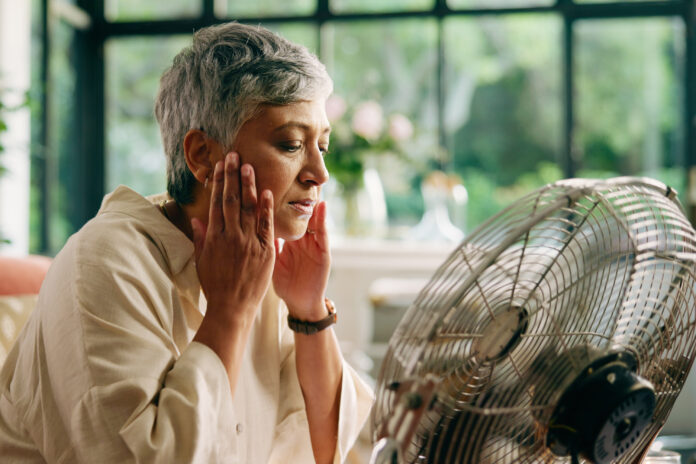
While the breeze from a fan might feel good against your skin in sweltering conditions, this won’t necessarily cool you down. That’s because fans are only effective when they move air that is cooler than your body temperature; if the air temperature is in the mid- to upper-90s or higher, a fan may instead add to heat gain by blowing hot air on your body. The humidity level and your ability to sweat also play a role in how effective fans are. And because older people are particularly vulnerable to heat-related illnesses like heat exhaustion and heat stroke, turning on a fan when the temperature rises could leave you at risk.
Fans work differently from air conditioners. With air conditioning, a refrigerant gas in the unit pulls heat and humidity out of the room. In contrast, a fan doesn’t cool the room or remove humidity. Instead, it moves air over your skin to make your sweat evaporate faster. As sweat evaporates, it removes heat with it.
A few things can interfere with a fan’s ability to cool you off. As you get older, your sweat glands don’t work as well, reducing your ability to sweat. Without sweat, the fan does nothing more than add more heat to your skin when the air temperature is high. Chronic illnesses, poor circulation, and the use of certain medications (such as beta blockers) may further inhibit your body’s ability to sweat and cool itself down.
Climate matters, too. In hot, dry conditions, any sweat your body does produce will evaporate too quickly to cool you off. High humidity causes the opposite problem. The air is so saturated with water vapor that it’s difficult for sweat to evaporate and it simply clings to your skin.
A 2024 study in JAMA investigated the effects of household electric fans in 18 people, ages 65 to 85. Participants were placed in an extreme heat simulated environment (about 97°F) with a relative humidity of 45 percent for eight hours a day over a three-day period. On one day they sat in front of a fan that was turned off. On another day they were seated in front of a fan when it was running at regular speed. And on a third day they were seated in front of a fan that was running at high speed. At the end of hours one, three, five, and seven, they performed 10 minutes of light stepping to simulate activities of daily living. They could drink as much water as they liked.
Although the participants said they felt more comfortable with the fans on and their heart rate reduced slightly (high temperatures increase heart rate and cardiovascular strain), their average core body temperature (measured with a rectal thermometer, which is generally 0.5 to 1.0 degrees higher than a temperature taken orally) was virtually the same in all three scenarios—just under 101°F. Other vital signs, like heart rate and blood pressure, were also the same with the fan off, on, and at high speed. While this was a small study, it suggests that indoor fans aren’t an effective method for cooling off older people.
Bottom line: Fans can help keep you cool in warm weather, but air conditioning is the way to go during a heatwave. If home cooling cost is a concern, lower the shades and close curtains, set your home thermostat or air conditioning unit a couple of degrees higher, and turn a fan on. Fans are more effective when they circulate cool rather than hot air.
Other ways to beat the heat include taking cool or tepid baths or showers, wearing loose-fitting clothes made from breathable fibers like cotton, and drinking extra fluids, especially water. Older adults are less likely to recognize thirst, which can quickly lead to dehydration. Avoid alcohol, which further increases the risk for dehydration and heat stroke. If you don’t have air conditioning at home and it’s very hot, visit an air-conditioned building like a library, mall, or community cooling center—or take yourself out to a movie.