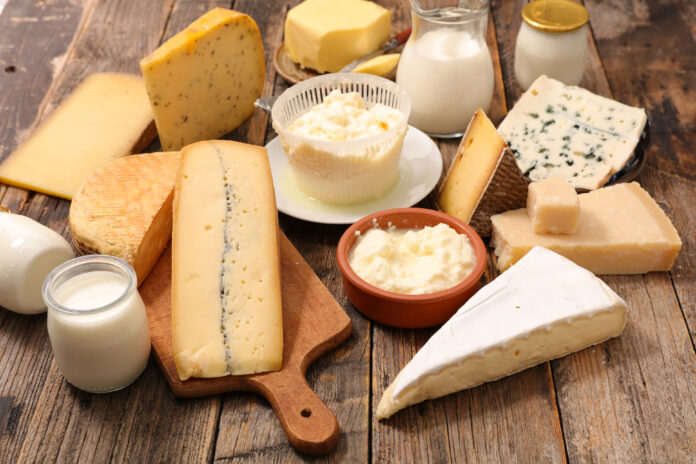
For years, dietary guidelines have recommended low-fat and nonfat dairy products over full-fat dairy products in an effort to reduce the intake of saturated fats and the associated risk of cardiovascular disease. Earlier this year, the American Journal of Clinical Nutrition published a review and analysis of the literature that countered the standard perspective and concluded that there was insufficient evidence to support the long-standing recommendation to prioritize low-fat dairy products.
The publication arose out of a gathering in Amsterdam that was sponsored by the Dutch Dairy Association, raising questions of potential conflicts of interest. According to the paper, the association “had no role in the discussions held at the high-level closed workshop and did not participate or provide comments during the development and writing of this manuscript.”
Among the authors was Dr. Ronald Krauss, a professor of pediatrics and medicine at UC San Francisco, an expert in cardiovascular disease, and an editorial board member of the Wellness Letter. We spoke with Dr. Krauss about the Amsterdam meeting, the resulting analysis, and the implications of the findings.
Wellness Letter: Can you explain the background behind this new review?
Ronald Krauss: This was a review of data from a group of international nutrition experts. The group was convened last year with the goal of assessing whether current recommendations for choosing low-fat versus high-fat dairy products were justified by the evidence, from both observational studies and randomized clinical trials. Those recommendations were developed with the goal of reducing cardiovascular risk by lowering intake of saturated fat.
Our analysis found that the data did not yield evidence for an adverse effect of full-fat versus reduced-fat dairy products on cardiovascular health. Preparing this review really confirmed what many of us had surmised based on our understanding of the bits and pieces of evidence that had emerged over the years.
WL: Can you address the fact that the meeting was sponsored and funded by the Dutch Dairy Association, and that several authors had additional links to the dairy industry?
RK: We all agreed to attend this conference with the assurance that, while the funding for it was provided by the Dutch Dairy Association, they had no role in the agenda, they were not allowed to participate in the discussion, nor did they make any contribution to the paper that we submitted. And as authors, we all disclosed any other dairy industry links.
One can always ask, “Could there have been some sort of bias based on that?” But it was all very hands-off in terms of the sponsor. I think we succeeded in making this a scientific enterprise that was not influenced by any of those links. [In the paper, Dr. Krauss disclosed receiving “financial support and travel provided by Dutch Dairy Association” and “a relationship with Dairy Management Inc that includes funding grants.”]
WL: Why then have we had this view for so long that dairy fats are “bad” if it’s not supported by the evidence?
RK: Guidelines are often developed based on various assumptions. It hasn’t really been fully recognized that there are differences among the various food sources of saturated fat in terms of effect on cardiovascular disease risk. The assumption behind the recommendation for low-fat dairy is that a higher intake of saturated fat from any source could have a detrimental effect on heart disease risk. That leads to the relatively simplistic notion that anything that reduces saturated fat intake will reduce heart disease risk.
But that idea fails to consider the overall evidence when one looks at foods rather than saturated fat itself. In the case of dairy fat specifically, it has not been established that saturated fat content is a main determinant of cardiovascular outcomes once the whole food is taken into account. Dairy products exist in various forms. There is some evidence that fermented full-fat dairy foods, like cheese and yogurt, actually have some metabolic benefits that don’t apply, for example, to the saturated fat in meat, which has an entirely different food context.
WL: How about low-fat versus full-fat milk?
RK: That’s still a bit of a question mark. There is only one study providing weak evidence that low-fat milk is preferable, and it was not really consistent with the other data. There may be subgroups of the population for whom full-fat milk may be a factor in predisposing to heart attacks. But that one study was not definitive, and we did not consider the data sufficiently strong to influence our overall conclusion that, in general, full-fat versus low-fat dairy is not something we need to be concerned about,
Foods are complex, and it is difficult to pinpoint exactly what component is responsible for a given health effect. Things get even more complicated when you’re looking at cardiovascular disease, which itself is multifactorial. When you have both a complex food and a multifactorial disease process, it’s very hard to connect the dots. In the case of dairy, the evidence has failed to support the common perception that there is a greater benefit to low fat versus full fat.
There is a consensus that intake of dairy does have benefits for blood pressure. The standard DASH [Dietary Approaches to Stop Hypertension] diet has recommended using low-fat dairy. My group did a study that tested whether it made a difference within the DASH diet if one consumed full-fat versus low-fat dairy products. We found no significant differences in the effect on blood pressure and cholesterol profile. Therefore, we concluded—and that’s what this review concludes as well—that there’s no particular reason to select low-fat dairy over high-fat dairy.
WL: What about the idea that 10 percent of total daily calories is the limit for saturated fat intake?
RK: There is no established basis for picking any specific level of saturated fat to be shooting for, and there are multiple reasons for that. The most obvious one is that the intake of saturated fat from various food sources has to be considered in the context of the overall effects of those foods, not just the saturated fat content.
WL: Do some people need to be concerned that full-fat dairy has more calories than low-fat dairy?
RK: Right, reducing those extra calories may make a modest difference for some people who need to achieve weight loss. And patients who present with high levels of cholesterol, particularly LDL cholesterol, do need to be concerned about their intake of certain sources of saturated fat. But in the case of dairy, this would apply mostly to butter and cream, which do not have low-fat versions and so were not part of our analysis. They have very high levels of saturated fatty acids compared with milk, cheese, and yogurt.
If individuals have high LDL cholesterol levels and they’re consuming large amounts of cream and butter, then there can be a benefit in restricting intake of these foods. In those cases, reduced LDL levels could translate into lower cardiovascular disease risk. But if someone’s LDL level is in an optimal range, there is no particular reason to cut back. There’s no significant benefit to achieve because heart disease risk is already low.
WL: What’s next in terms of research?
RK: We need more research into the mechanisms through which dairy fat might benefit health. Among the saturated fatty acids in dairy fat, one in particular, known as pentadecanoic acid, or C15:0, has many effects that have nothing to do with cholesterol. Blood levels of this specific saturated fat are associated with reduced diabetes risk and other beneficial health effects. This indicates that higher intake of this dairy-derived saturated fat may have metabolic benefits. Pursuing that and related lines of evidence could help us better understand the impact of dairy on health outcomes.