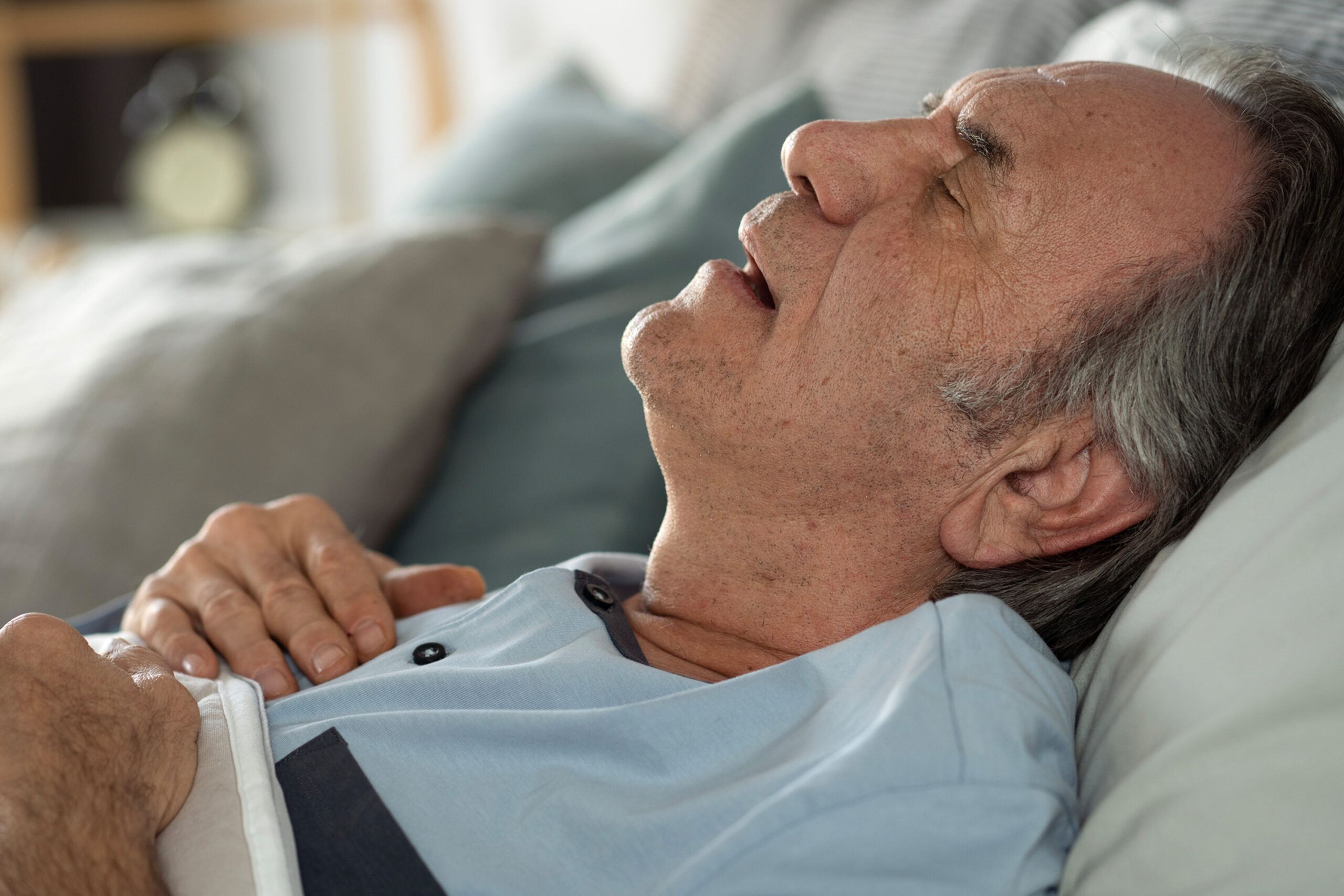
If you snore, you’re in good (albeit noisy) company. By some estimates, about 90 million American adults snore on occasion, and 37 million do so regularly. That means more than a third of U.S. adults snore on some nights, while around 15 percent are habitual snorers.
Although it may cause ill will in your sleeping partner, run-of-the-mill “primary” snoring (not obstructive sleep apnea; see box) isn’t usually dangerous to the snorer. (Some research does suggest that primary snoring may be associated with plaque formation in the carotid artery, but more examination into this link is needed.)
Primary snoring is caused by what Jana Cooke, MD, a sleep expert and member of our editorial board, refers to as “turbulent airflow.” During sleep, the tissues in the back of the throat and nose relax, narrowing the airway. Then, when we breathe and air passes through this tightened passage, the relaxed tissues vibrate, producing the familiar sound of snoring.
Confronting common causes
If sleep apnea is not to blame, a number of other underlying problems could be causing snoring—and addressing them might bring relief.
- Congestion. Allergies (whether seasonal or perennial), colds, or sinus problems can block air flow. If you’re congested from any of these causes, Dr. Cooke recommends trying a saline spray (or a nasal rinse with a neti pot) to lubricate the nasal passages. If your congestion is due specifically to allergies, she also recommends steroid and antihistamine sprays or allergy medications (over-the-counter or prescription). Pillow covers that are certified as “asthma and allergy friendly” can help keep dust mites (a common allergen) from accumulating inside the pillow. But it’s also a good idea to wash your pillow frequently and replace it every two years, according to the Asthma and Allergy Foundation of America.
- Anatomy. Having small nasal passages, a large tongue, a long uvula (the triangular piece of flesh that hangs in the back of your throat), a deviated septum (a misalignment in the wall of cartilage that separates the interior of the nose into two cavities), or nasal polyps can all cause a narrowed airway. Your doctor can determine whether you have these anatomical issues and advise about surgical correction—most commonly done for nasal polyps and a deviated septum.
- Extra body weight. Even a number that’s only slightly higher on the scale than it should be can contribute to snoring, says Dr. Cooke: “Your weight is distributed everywhere, including your throat and the tissues around the tongue.”
- Sleep deprivation. Being more tired than usual can mean that your airways relax to an abnormal extent, which can result in reduced airflow. And loud snoring can disrupt your own sleep, creating a vicious cycle of fatigue and snoring. Adults should aim for seven to nine hours of sleep a night.
- Alcohol and medications. Muscle relaxers, anti-anxiety medications, and alcoholic beverages can all contribute to excessively relaxed throat muscles. If a glass of wine at night causes you to snore, try having it earlier in the evening (or skipping it altogether). If a medication is making you so drowsy that you’re snoring, talk with your doctor about whether a different one might help you without that side effect.
- Sleeping position. Your airways narrow even more when you’re on your back, due to gravity. Try sleeping on your side, angling your torso using a wedge pillow, or elevating the head of your bed six inches—not by using pillows, but by putting blocks on the floor under the head of the bed. Or consider investing in an adjustable base for your mattress that raises the head of the bed.
- Age. The muscles in the throat and tongue weaken in older adults, making snoring more likely. Unfortunately, there’s nothing you can do about getting older. But people of any age who snore can benefit from making the lifestyle changes described above.
There’s no shortage of other snoring remedies, however—from the old idea of mouth exercises to the newer trend of mouth taping. Here’s a look at the evidence behind them.
Mouth and throat exercises
Dr. Cooke is in favor of this approach, also called oropharyngeal or orofacial myofunctional therapy, depending on which specific areas it’s targeting. “These exercises may help decrease snoring by strengthening the throat and tongue muscles,” she says.
A 2015 study in Chest divided 39 people with primary snoring or mild sleep apnea into two groups: One group did daily breathing exercises; the other performed oropharyngeal exercises. Both groups used nasal strips (adhesive strips designed to widen the nostrils and increase airflow; see below) daily. Only the group that did the oropharyngeal exercises had significant decreases in objective measures of snoring. The strips likely do offer some benefit, however, says, Dr. Cooke, though this may not have been apparent because of the small study size.
Can you sing away snoring? Maybe. A 2013 study of 127 people, again with either primary snoring or sleep apnea, found that after three months, the group that performed daily 20-minute singing exercises had reduced frequency of snoring and daytime fatigue compared with a control group that did not sing. Singing is thought to improve the tone and strength of muscles surrounding the pharynx (the tube inside the neck that connects the back of the nose to the larynx and esophagus).
You can find some examples of mouth and throat exercises at the Sleep Foundation’s website. But if this is something that you think could benefit you, it’s best to talk with your doctor.
Mouth taping
This method is just what it sounds like—taping your mouth shut while sleeping. Mouth breathers are more likely to snore because they take in air straight on, rather than in a curved pattern through the nose (resulting in more of that “turbulent airflow” that Dr. Cooke refers to).
Taping your mouth shut is having a moment on social media, with many influencers—who are not experts—touting its supposed benefits. Although any porous tape intended for use on human skin could be applied, some manufacturers have of course started selling products expressly made for mouth taping.
A small study in 2022 found that 13 of 20 people with mild sleep apnea snored less while wearing the tape. A 2015 study found that 30 people, again with mild sleep apnea, snored less severely while wearing a patch over their mouths. Even though these are only preliminary studies, it’s worth noting that they also showed a reduction in sleep apnea scores, known as the apnea–hypopnea index (AHI).
But research supporting mouth taping for primary snoring (without sleep apnea) is lacking. A 2025 review article looked at nine studies on mouth taping during sleep but only found a potential benefit for sleep apnea, and none found a benefit for primary snoring. The researchers also looked at the first 50 videos that came up in a search for “mouth taping” on TikTok. None of the videos—including those made by medical professionals—provided any evidence for their claims about the benefits of mouth taping.
“There’s not enough data on mouth taping for me to endorse it,” says Dr. Cooke.
Plus, taping your mouth can disrupt your sleep. Although the tape is (or should be) porous so you can get air in and out, the feeling of restriction may cause anxiety about being able to breathe properly. And it can be risky if you are congested and can’t breathe well through your nose, since the tape blocks the only alternative airway. The tape may also cause some skin irritation and pain when removing it.
You’ve heard of secondhand smoke—but secondhand snoring? In much the same way, your partner’s snoring can affect your health as well.
In January 2024, the Sleep Foundation surveyed 1,000 adults who shared a bed with a snorer. Seventy-five percent of respondents said the snoring had affected their sleep in some negative way. The sleep issues reported were: difficulty falling asleep (25 percent of respondents), being awakened at night (27 percent), not getting enough sleep (11 percent), and poor sleep quality (12 percent). Moving to a separate bed—or even room—often felt like a last resort for a sleep-deprived bed partner.
“There is such a thing as a ‘sleep divorce,’” says Dr. Cooke—referring to the common solution in which the snorer and partner end up in separate beds (or rooms) due to the disruption caused by the snoring. “If the problem is primary snoring (not apnea), the bed partner is the only one suffering—the person doing the snoring feels fine and sleeps fine. Treating the snoring always improves the bed partner’s sleep.”
Anti-snoring devices
Search online for “how to stop snoring,” and you’ll find a slew of products vying for your attention. External nasal strips have shown some promise in studies measuring subjective perceptions of snoring, but not in studies that used objective measures (like the one mentioned above in Chest).
Oral appliances that pull the jaw forward or keep the tongue in the front of the mouth can be very helpful for both primary snoring and obstructive sleep apnea—but only if custom made by an experienced dentist. Over-the-counter versions (where you boil the device and bite down to form the shape of your mouth) are not recommended because they’re not proven to be effective.
Internal nasal dilators, wristbands with “bionic detection,” and nasal sprays marketed for snoring reduction all are similarly unproven. “I’m skeptical of these products,” says Dr. Cooke. “They have limited benefit, and I wouldn’t recommend spending the money on them.”
BOTTOM LINE: If snoring is disrupting your own sleep, see your doctor. If it’s disrupting your partner’s sleep, see your doctor. And if someone suggests to you that sleep apnea might be playing a role … see your doctor. Sleep is too important (for you and your bed partner) to let snoring get in the way, especially when it may be very treatable.
If you have obstructive sleep apnea (OSA), you likely follow this pattern: You’ll snore loudly and often stop breathing (for anywhere from a few seconds to more than a minute), sometimes followed by choking and gasping to recover. The effect is like someone waking you 10 to 30 times an hour, though you may not even be aware of it.
Sleep apnea is caused by a temporary blockage of the throat’s breathing passages. The soft tissue at the back of the mouth vibrates during snoring, but with apnea the tongue and other soft tissues periodically fall back and totally block the airway. Sometimes the airway is only partially blocked, resulting in very shallow breathing. In either case, oxygen levels in the blood fall, and carbon dioxide rises. Your throat muscles contract as you struggle for air, you gasp or snort loudly, then you start breathing again (because your brain wakes you up briefly). You’ll fall back asleep, until the cycle starts again.
If you feel like you’re experiencing apnea (or someone else has told you so), talk to your doctor, particularly if you have hypertension or diabetes or you’re significantly overweight. A diagnosis of sleep apnea will likely mean following the same lifestyle changes as for snoring.
Your doctor may additionally prescribe treatment with CPAP (continuous positive airway pressure), an air pump attached to a mask via tubing, which is very effective at keeping your throat open while you sleep. The devices have improved in recent years—they’re less cumbersome, quieter, and less likely to cause claustrophobia.
Also available by prescription (but not covered by insurance), expiratory positive airway pressure (EPAP) devices like Bongo RX have been cleared by the FDA for mild to moderate sleep apnea. Inserted into the nostrils as a simpler alternative to CPAP, they similarly produce a pocket of air pressure to keep the airway open between breaths—but research is more limited, and the disposable devices are not suitable for everyone with sleep apnea.
Another option may be a custom-made mandibular advancement device (made by dentists who specialize in apnea) that pulls the tongue and jaw (mandible) forward while you sleep. Some reviews have found they are not as effective as CPAP, although compliance rates tend to be higher.
One of the newest treatments, Inspire, is a hypoglossal nerve stimulator that is being advertised as the “no-mask” therapy. This is a pacemaker for obstructive sleep apnea, intended for people with moderate to severe sleep apnea who have not been able to tolerate CPAP. Normally done in one procedure, potential users first undergo a sleep endoscopy to see if they are eligible, then the pacer is inserted. Electrical connections are placed in the neck, and a wire connects to a nerve there that controls the tongue. The device may need to be adjusted in a sleep lab, but home sleep testing can often be done to verify that the device is working well or to make adjustments. You turn Inspire on with a simple click of a remote control. The device has good outcomes and can be helpful for some people, says Dr. Cooke.
A 2024 review article of 30 studies concluded that although Inspire had a higher compliance rate than CPAP, more clinical trials are needed to determine whether it is actually more effective.
In December 2024, the FDA approved tirzepatide (Zepbound), the first drug treatment for people with moderate to severe OSA and obesity, to be used in combination with a reduced-calorie diet and exercise. Dr. Cooke recommends using it also in conjunction with CPAP or an oral device while weight loss is ongoing. Tirzepatide, similar to other weight-loss drugs such as semaglutide (Ozempic), reduces appetite and food intake—and thus leads to weight loss, which can help decrease symptoms of sleep apnea. Once you are at your ideal body weight, you’ll be tested again to see if the sleep apnea has resolved—not always the case.