I just bought an air fryer. Is this really a healthier way to cook—or just a lot of hype?
These countertop cooking devices, whose creation for commercial use in the mid- to late 2000s is attributed to a Dutch engineer, became especially popular during the pandemic. According to Nestlé (which has a stake in the game), about two-thirds of U.S. households have one. Now that you have one yourself, you can take advantage of all it can offer, which includes being able to cook healthier, lower-calorie meals. Generally, air fryers are easy to use—though, as with other cooking methods, it may take some experimenting to make a seamless meal.
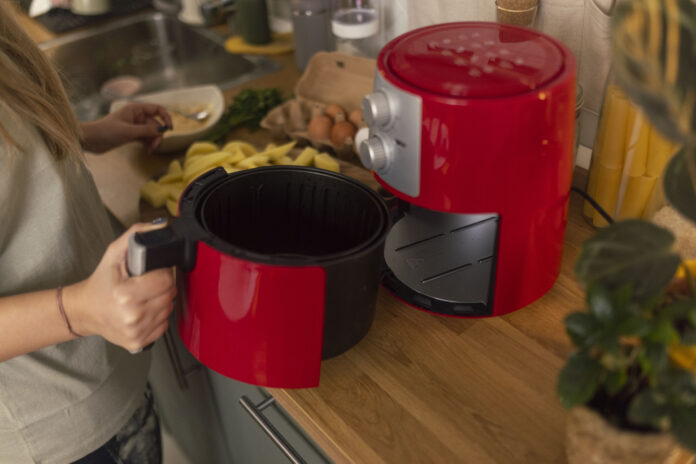
First things first: Though it’s called an “air fryer,” frying involves cooking in oil, so, technically, there’s no actual frying involved. An air fryer cooks by what’s called convection, which refers to the transfer of heat from one source to another. With a heat source above or below, a fan blows the hot air across and all around the food, which, in the most popular models, sits in a perforated basket inside the device. As the surfaces of the food are exposed to this hot air, they become crispy, somewhat similar to what occurs when foods are fried by being immersed in hot oil.
Though it’s often assumed that the main function of an air fryer is to give foods like potatoes (i.e., French fries) and shrimp (i.e., coconut shrimp) a nice crunch without having to deep fry them, you can in fact make a variety of other dishes that are not intended to be particularly crispy, including breakfast frittatas, stuffing, and eggplant parmesan. You can use your air fryer to make hard-boiled eggs, asparagus, corn on the cob, French toast, baked potatoes, Brussels sprouts, and even bread, cakes, cookies, and pies. No need to fire up the grill if you want to “grill” up some salmon, chicken, or lobster tails.
That is, the air fryer allows you to not only cook foods you would normally fry but also those you would grill, roast, or bake—and the options are practically limitless. If you’re not sure how to cook all these foods, the internet is awash with recipes. Some good resources are the Food Network and the New York Times. You can also use your air fryer to reheat foods to get back their crispness (as opposed to reheating in a microwave oven).
Still, some dishes don’t fare so well in an air fryer. For example, making fried chicken or onion rings using a very wet liquid batter can cause a big mess, because the batter can drip from the food through the basket’s perforations. This would be more of a problem with air fryers that have heating elements beneath the cooking basket. (Alternatively, you can use a breadcrumb batter.) Cooking bacon and cheese in an air fryer can create a hard-to-clean mess, too, while leafy greens often dry out.
It’s also counterintuitive to make rice, pasta, or other grains in an air fryer, as these foods cook in boiled water and the air fryer’s convection heat would boil the water away before they’re done. Adaptations can be made, such as using a cover to keep the water from evaporating, but the air fryer might be better suited to making a “fried” rice dish from already cooked rice.
Another drawback of an air fryer is that you can’t cook a lot at once because you can’t load up the basket if you want all the foods to brown well: There has to be space for the hot air to circulate around the surfaces you want to brown. That means you have to place the food in a single layer with the pieces not touching each other—and that means you may need to make several batches, depending on the size of the air fryer and how many people you are feeding.
Now for the benefits. Some recipes call for using a small amount of oil (a tablespoon or two) to enhance moistness and the development of a golden brown color, and to help seasonings stick to the food. But you can use much less oil especially when compared to deep frying—or forgo the oil altogether—which reduces the fat and calorie load of your dishes.
For instance, a study in the European Journal of Lipid Science and Technology in 2017 compared potatoes that were air fried (using some oil) or deep fried. The air-fried potatoes had about 70 percent less fat, on average—equivalent to a savings of some 45 calories per 3.5-ounce serving. Moreover, the fat in the air-fried potatoes was less oxidized. Oxidized fats can create tissue-damaging free radicals. Some (but not all) studies have also found that air frying potatoes (as opposed to deep frying them) results in significantly lower levels of acrylamide, a potential cancer-causing chemical that naturally forms when starchy foods are cooked at high temperatures.
Other advantages: Depending on the food, cooking times in an air fryer are shorter than in an ordinary oven because the heat is more concentrated. Air fryers are also more energy efficient.
Most air fryers are “basket style,” with capacities ranging from 2 to 20-plus quarts of food. “Mini” air fryers feed one person, while extra-large ones can feed six or more people. Prices range from about $60 to $170, depending on the size, style, and brand. Several organizations and publications have rated them, including Wirecutter, Best Reviews, Good Housekeeping, Food & Wine, and New York Magazine.